
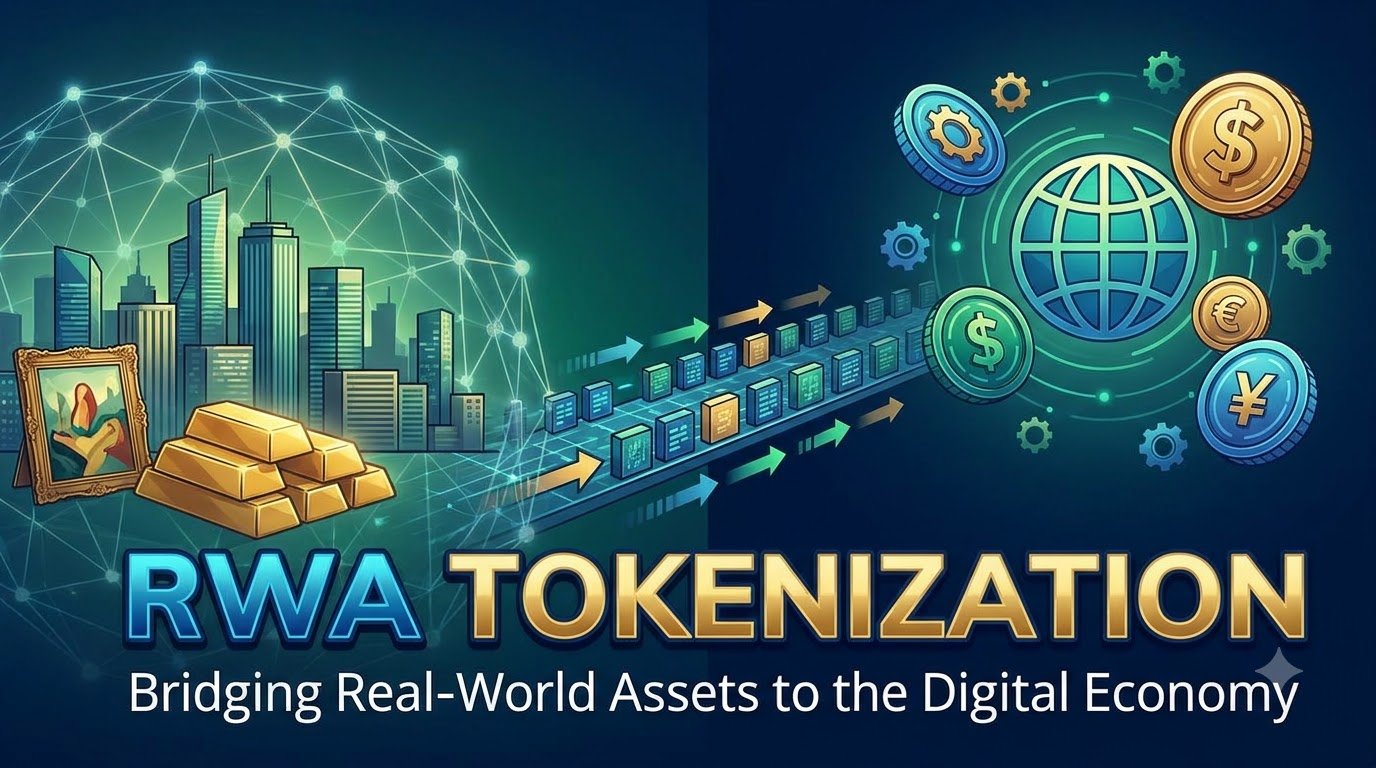
RWA Tokenization Development: Process, Technology, Benefits, and Applications
Real-world asset (RWA) tokenization is emerging as one of the most significant applications of blockchain technology beyond cryptocurrencies. It enables physical and traditional financial assets such as real estate, government bonds, commodities, private credit, artwork, and investment funds to be represented digitally on a blockchain. Instead of relying entirely on conventional databases, paper records, brokers, and lengthy settlement processes, tokenization introduces programmable digital representations that can be transferred and managed through blockchain networks.
The market is already moving beyond experimentation. According to CoinGecko's 2026 RWA report, tokenized real-world assets excluding stablecoins reached approximately $19.3 billion by the end of the first quarter of 2026, more than tripling from the beginning of 2025. Tokenized Treasuries remained the largest category, while tokenized commodities and equities also expanded significantly. This growth indicates that RWA tokenization is increasingly being explored as financial infrastructure rather than simply another cryptocurrency use case.
What Is RWA Tokenization?
RWA tokenization is the process of creating blockchain-based digital tokens that represent ownership, economic rights, claims, or interests connected to an asset that exists in the physical or traditional financial world. The token itself does not magically turn a physical asset into a blockchain asset. Instead, a legal and technological structure connects the on-chain token with the underlying asset.
For example, consider a commercial property valued at $10 million. Instead of requiring one investor to purchase the entire property, an appropriately structured tokenization model could divide the economic interest into thousands or millions of digital units. Eligible investors could acquire a fraction of the represented interest, subject to the applicable securities, property, tax, and investment regulations.
The important distinction is that tokenization is more than simply issuing a token. The underlying asset needs reliable custody, valuation, ownership documentation, compliance controls, and a legally enforceable relationship between the token holder and the asset or issuing entity.
The Bank for International Settlements has described tokenization as an integration of traditional asset information with rules and logic governing transfers. This programmable characteristic is one of the reasons tokenization can potentially change how financial assets are issued, transferred, settled, and managed.
How Does RWA Tokenization Development Work?
Successful RWA tokenization development generally involves several interconnected stages. The exact workflow differs depending on the asset class and jurisdiction, but the fundamental process remains similar.
1. Asset Selection and Feasibility Analysis
The first step is determining what asset should be tokenized and whether tokenization makes economic, legal, and technical sense. Real estate, government securities, commodities, private credit, investment funds, invoices, and other assets can have different requirements.
Developers and asset owners must evaluate the asset's ownership structure, valuation methodology, expected investor base, liquidity requirements, jurisdiction, transfer restrictions, and potential return model. This stage is important because not every asset automatically benefits from being placed on a blockchain.
2. Legal and Regulatory Structuring
The legal structure is arguably one of the most important components of an RWA project. Blockchain technology can establish ownership records and automate transactions, but it does not independently establish legal ownership in every jurisdiction.
A project may use a special-purpose vehicle, trust, fund, company, or another legal structure to hold the underlying asset. The relationship between the token and the underlying asset must then be clearly defined.
Depending on the asset and jurisdiction, the project may need to address securities regulations, investor eligibility, KYC and AML requirements, taxation, licensing, custody, reporting, and transfer restrictions.
This is why professional RWA tokenization services typically involve more than blockchain development. Legal architecture, compliance, asset verification, and technology need to work together.
3. Asset Verification and Valuation
Before tokens are issued, the underlying asset must be authenticated and valued. For a property, this may involve title verification, appraisal reports, ownership documentation, liens, insurance, and property records. For a commodity, provenance, custody, quality, and quantity may need to be verified.
Reliable data is critical because tokenization does not remove the risks associated with the underlying asset. If an asset is incorrectly valued or improperly represented, blockchain transparency cannot solve the underlying problem.
4. Token Design and Smart Contract Development
Once the legal and asset framework has been established, the token model can be designed. Developers determine supply, token distribution, transfer rules, investor restrictions, redemption mechanisms, fees, voting rights, and other functionality.
Smart contracts automate these rules. Depending on the project, smart contracts may manage token issuance, transfers, whitelisting, distributions, redemptions, compliance checks, and corporate actions.
The token standard and blockchain should also be selected according to the project's requirements. Ethereum and compatible networks are widely used, while other networks may be selected for scalability, transaction costs, institutional requirements, or interoperability.
5. Compliance and Investor Onboarding
Regulated RWA platforms commonly require identity verification before users can purchase or transfer tokens. KYC and AML procedures can be incorporated into the platform, with wallet addresses being whitelisted when necessary.
This creates an important difference between many RWA systems and unrestricted cryptocurrency tokens. An RWA token may need to operate within clearly defined investor and transfer restrictions rather than being freely transferable to every blockchain address.
6. Token Issuance and Distribution
After testing, auditing, compliance integration, and asset verification, the token can be issued. Distribution may occur through a dedicated platform, investment portal, marketplace, or institutional channel.
Investors may receive economic benefits associated with the underlying asset, such as rental income, interest, profit distributions, or redemption value, depending on the legal structure.
Technology Behind RWA Tokenization
Blockchain is the foundation of RWA tokenization, but an effective platform usually requires a broader technology stack.
Blockchain networks provide the infrastructure for recording token ownership and transactions. The selected network needs to offer suitable security, scalability, transaction costs, and ecosystem support.
Smart contracts provide programmable rules. They can automate issuance, transfers, compliance restrictions, distributions, and redemption processes.
Oracles and data infrastructure connect blockchain applications with external information such as asset prices, interest rates, property valuations, commodity data, and other real-world events.
Digital identity and compliance systems help platforms verify investors and enforce eligibility requirements.
Custody and wallet infrastructure protects digital assets and, in institutional environments, may include qualified custodians or controlled wallet systems.
APIs and interoperability layers allow tokenization platforms to connect with banking systems, payment infrastructure, exchanges, accounting platforms, identity providers, and other applications.
The BIS has noted that tokenization can potentially reduce transaction costs and enable innovative arrangements, but it also emphasizes that sound governance, regulation, and risk management remain essential.
Major Benefits of RWA Tokenization
One of the strongest advantages of tokenization is fractional ownership. High-value assets can potentially be divided into smaller investment units, allowing eligible investors to gain exposure without purchasing an entire asset.
Tokenization can also improve operational efficiency. Traditional asset transactions often involve multiple intermediaries and separate databases. Programmable blockchain infrastructure can reduce duplicated reconciliation and automate selected processes. The Monetary Authority of Singapore has highlighted the potential for tokenized assets to support more efficient settlement by allowing assets and information to move together on programmable platforms.
Transparency is another major advantage. Blockchain records can provide a shared transaction history, although transparency does not automatically mean that every underlying asset claim is truthful. Off-chain verification remains essential.
Tokenization may also improve accessibility, enable new distribution channels, and create opportunities for programmable financial products. For example, an asset token could potentially be integrated with lending, settlement, collateral management, or automated distribution systems where legally and technically appropriate.
However, tokenization should not be confused with guaranteed liquidity. Recent research has emphasized that putting an asset on-chain and creating an active secondary market are separate outcomes.
Applications of RWA Tokenization
Real Estate
Real estate is one of the most discussed RWA applications because properties are traditionally expensive, illiquid, and operationally complex. Tokenization can enable fractional exposure, automated income distribution, and potentially broader investor participation.
A recent BIS working paper using U.S. data from 2019 to 2025 found that tokenized real estate adoption was stronger in areas with limited access to traditional credit. The study also found evidence that trading activity in tokenized properties increased following certain liquidity shocks, although the effectiveness depended partly on platform structures such as buyback mechanisms.
Government Bonds and Treasuries
Tokenized government securities have become one of the most developed RWA categories. Investors can receive blockchain-based exposure to traditional fixed-income instruments while potentially benefiting from faster settlement and programmable financial infrastructure.
CoinGecko reported that tokenized Treasuries reached $5.6 billion by April 2025 and subsequently grew further, remaining the largest tokenized RWA category into 2026.
Commodities
Gold and other commodities can also be represented through blockchain tokens. Such models can provide digital representations of underlying physical holdings while enabling blockchain-based transfers and settlement.
Private Credit
Tokenization can provide infrastructure for representing loans, credit agreements, and private debt instruments. Smart contracts can potentially automate interest distributions, repayment schedules, investor reporting, and other processes.
Art and Collectibles
High-value artwork, collectibles, and other alternative assets can be divided into digital investment interests. This can create new ownership structures, although authentication, custody, valuation, and regulatory considerations remain critical.
Challenges and Risks
Despite its potential, RWA tokenization faces significant challenges. Regulation is one of the biggest because different jurisdictions classify and regulate assets differently. A token representing a security may be subject to securities laws, while a tokenized commodity or property interest may involve different requirements.
Liquidity is another major challenge. A token can technically be transferable while still having very few buyers. Therefore, tokenization does not automatically create a liquid market.
There are also technology risks, including smart contract vulnerabilities, wallet security issues, oracle manipulation, private-key compromise, and interoperability failures. Smart contract audits and continuous security monitoring are therefore important components of institutional-grade platforms.
Perhaps most importantly, RWA systems depend on the connection between blockchain records and the physical world. If a token claims to represent gold, property, debt, or another asset, investors need confidence that the asset actually exists, remains properly controlled, and is legally connected to the token.
The Future of RWA Tokenization
The future of RWA tokenization is likely to focus less on simply creating tokens and more on building complete digital financial infrastructure. Institutional adoption, regulatory clarity, interoperable networks, compliant custody, identity systems, and secondary-market infrastructure will determine how quickly the sector matures.
The rapid expansion of tokenized assets during 2025 and early 2026 suggests that the market is moving toward broader experimentation across multiple asset classes. At the same time, the industry's next challenge is proving that tokenization can deliver sustainable economic value rather than merely moving existing assets onto a blockchain.
As the technology develops, tokenized assets could become integrated with digital payments, lending, collateral management, investment platforms, and automated financial services. The most successful projects are likely to be those that treat blockchain as one component of a broader legal, financial, and technological ecosystem.
Conclusion
RWA tokenization is transforming how real-world assets can be represented, managed, distributed, and potentially traded through blockchain infrastructure. From real estate and government securities to commodities and private credit, tokenization can introduce fractional ownership, programmable transactions, improved transparency, and operational efficiency while creating new financial possibilities. However, successful implementation requires much more than smart contracts; legal compliance, asset verification, custody, security, liquidity, and investor protection must all be addressed. Businesses looking to enter this growing market can work with experienced providers of RWA tokenization development services to design secure and scalable platforms aligned with their business objectives. Blockchain App Factory provides best RWA tokenization services, combining blockchain development expertise with solutions designed to support asset tokenization, smart contracts, compliance-oriented infrastructure, and scalable RWA platforms.




0 Comments