
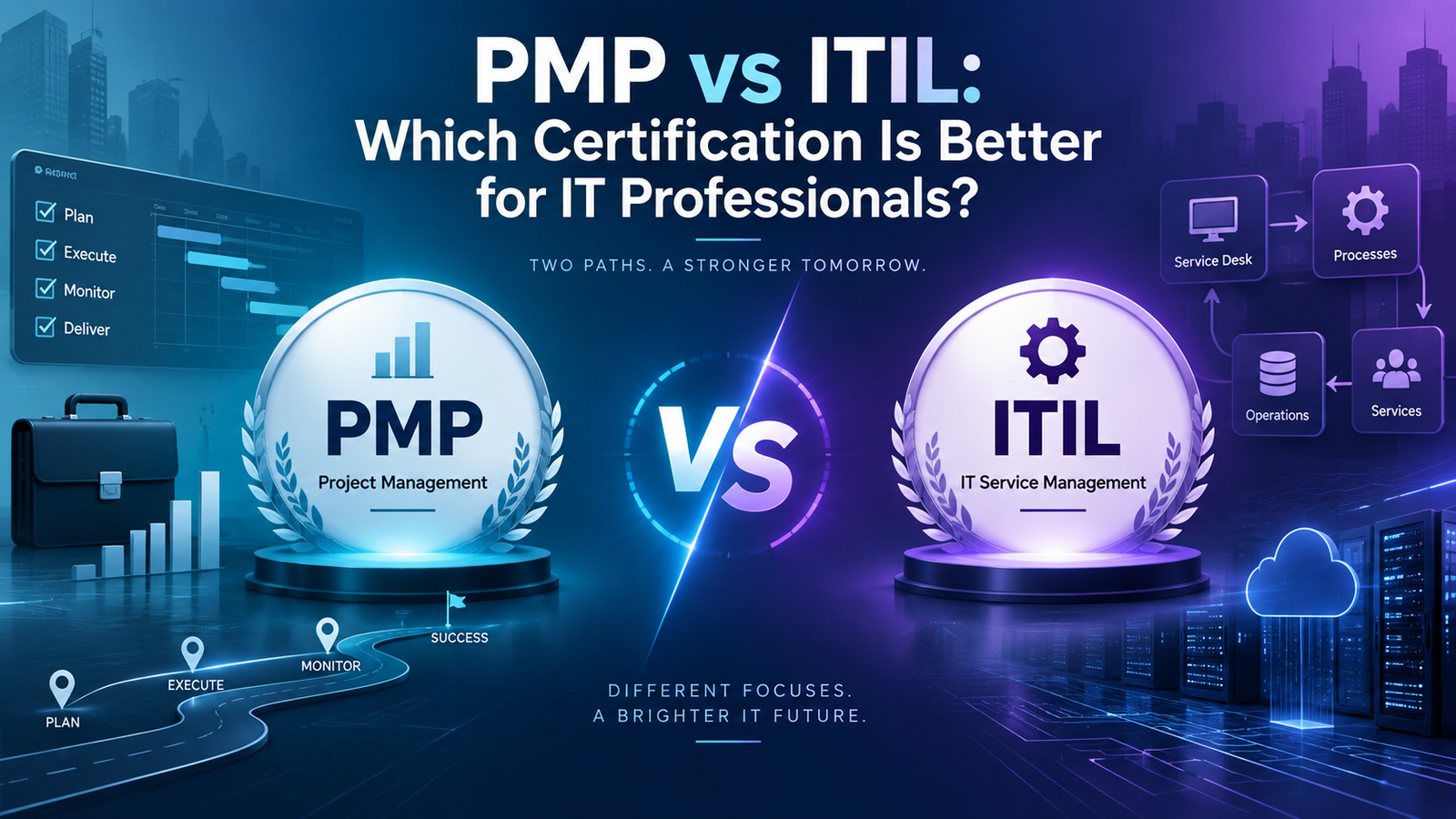
PMP vs ITIL: Which Certification Is Better for IT Professionals?
Choosing between PMP and ITIL depends on what kind of IT career you want to build.
Both credentials can be valuable, but they validate very different capabilities.
PMP focuses on leading projects, managing teams, delivering outcomes, handling stakeholders, and creating business value.
ITIL focuses on managing digital products and services, improving service quality, controlling incidents and changes, and aligning IT operations with business needs.
The simplest comparison is:
PMP = project leadership
ITIL = IT service management
For IT professionals managing implementations, migrations, transformation programs, or major technology projects, PMP can be the stronger credential. For professionals working in IT operations, service delivery, infrastructure, support, cloud operations, or ITSM, ITIL may be more directly relevant.
PMP vs ITIL at a Glance
Feature | PMP | ITIL |
Main Focus | Project management | IT service and digital product management |
Typical Level | Experienced professional | Beginner to advanced paths available |
Best For | Project managers, program leads | ITSM, operations, service managers |
Experience Required | Yes | Foundation does not require extensive experience |
Main Skills | Leadership, delivery, risk, stakeholders | Services, incidents, changes, value, improvement |
Industry Scope | Cross-industry | Strong IT/digital-service focus |
Renewal | Continuing professional development | Three-year renewal cycle |
Best Starting Point | Experienced project professionals | ITIL Foundation |
What Is PMP?
PMP stands for Project Management Professional.
It validates the ability to lead projects and manage delivery across different working approaches.
The PMP exam was updated in July 2026 to place greater emphasis on:
- AI
- Sustainability
- Stakeholder engagement
- Business impact
- Value delivery
- Adaptive project environments
The current exam contains 180 questions and provides 240 minutes. Its three domains are:
PMP Domain | Weight |
People | 33% |
Process | 41% |
Business Environment | 26% |
The updated exam therefore tests leadership, project execution, and strategic business understanding rather than only schedules, budgets, and traditional project controls.
PMP Eligibility in 2026
PMP is not an entry-level certification.
Candidates need both project leadership experience and project-management education.
Current pathways include:
- Secondary education plus 5 years of project-management experience
- Associate-level or equivalent education plus 4 years
- Bachelor's degree or equivalent plus 3 years
- Eligible accredited bachelor's or postgraduate program plus 2 years
Relevant experience can now be counted from the previous 10 years. Candidates also need the required project-management training before applying.
This makes PMP most suitable for professionals who already manage projects rather than those just entering IT.
What Is ITIL?
ITIL is a framework for managing digital products and services.
In 2026, the certification ecosystem is transitioning toward ITIL Version 5, while ITIL 4 remains available during the transition.
ITIL Foundation remains the main entry point and introduces concepts around:
- Value creation
- Digital products and services
- Service management
- Governance
- Continual improvement
- Customer experience
- Responsible AI
- Transformation
The updated ITIL framework places stronger emphasis on modern digital-service environments and AI-enabled organizations.
Key Difference 1: Projects vs Services
This is the biggest difference.
A project is temporary.
Examples include:
- Migrating a data center
- Deploying a new ERP platform
- Implementing a cloud environment
- Launching an AI system
PMP teaches you how to lead this type of work from initiation through completion.
A service continues after the project ends.
Examples include:
- IT support
- Cloud operations
- Network services
- Business applications
- Identity management
ITIL focuses on keeping these services reliable, valuable, measurable, and continually improving.
Key Difference 2: Career Direction
Choose PMP if your career is moving toward:
- IT Project Manager
- Program Manager
- Technical Project Manager
- Transformation Manager
- Implementation Manager
- Delivery Manager
Choose ITIL if your career is moving toward:
- IT Service Manager
- Service Delivery Manager
- Incident Manager
- Change Manager
- IT Operations Manager
- Service Desk Manager
There can also be overlap.
A technology leader may need both project-delivery and service-management skills.
Key Difference 3: Difficulty
PMP is generally harder to qualify for and more demanding to prepare for.
A realistic comparison is:
PMP: Hard
ITIL Foundation: Beginner to Moderate
PMP requires substantial project experience and tests scenario-based leadership decisions.
ITIL Foundation is designed as an entry point and can be suitable for professionals at different career stages.
Advanced ITIL modules naturally become more demanding as professionals move deeper into service, product, transformation, and strategy roles.
Key Difference 4: IT Relevance
ITIL is more directly focused on IT and digital-service management.
Its concepts are highly relevant to:
- Incident management
- Problem management
- Change enablement
- Service levels
- Continual improvement
- IT operations
PMP is broader.
You can apply PMP in:
- Technology
- Healthcare
- Construction
- Finance
- Government
- Manufacturing
For an IT professional, that broader applicability can be valuable when moving into enterprise project leadership.
Which Is Better for IT Project Managers?
PMP is usually better.
If your responsibilities include:
- Planning technology projects
- Managing budgets
- Coordinating teams
- Managing stakeholders
- Tracking project risks
- Delivering implementations
PMP aligns directly with your role.
Its 2026 update also places more emphasis on outcomes, value, AI, and adaptive project environments, making it particularly relevant to modern technology projects.
Which Is Better for IT Operations?
ITIL is generally better.
Operations professionals need to understand how services behave after deployment.
ITIL can help with:
- Incident handling
- Service quality
- Change control
- Continual improvement
- Customer outcomes
- Operational governance
This makes it highly relevant to infrastructure, service desk, cloud, and production support teams.
Which Is Better for Cloud Professionals?
It depends on the role.
Cloud Project Manager
Choose PMP.
Cloud Operations Engineer
Choose ITIL.
Cloud Service Manager
Choose ITIL.
Cloud Transformation Lead
PMP may provide greater value, although combining both can be useful.
Cloud environments involve both temporary implementation projects and ongoing operational services.
Which Is Better for DevOps Professionals?
ITIL can be useful because DevOps professionals work continuously with:
- Releases
- Deployments
- Incidents
- Changes
- Reliability
Modern ITIL is intended to support digital product and service environments rather than simply traditional help-desk processes.
PMP becomes more relevant when a DevOps professional moves into leadership of larger transformation or migration programs.
Which Is Better for Cybersecurity Professionals?
Again, this depends on responsibilities.
Choose ITIL if you work with:
- Security operations
- Incident processes
- Service continuity
- Operational governance
Choose PMP if you lead:
- Security transformation projects
- Compliance implementations
- IAM migrations
- Security-platform deployments
A cybersecurity manager may eventually benefit from both perspectives.
Career Benefits of PMP
PMP can help IT professionals develop:
- Project leadership
- Stakeholder management
- Risk management
- Strategic thinking
- Team coordination
- Delivery management
- Business-value awareness
It can be especially useful when moving from technical work into management.
Career Benefits of ITIL
ITIL can strengthen:
- ITSM knowledge
- Incident management
- Problem management
- Change management
- Service-level management
- Continual improvement
- Service delivery
It is particularly valuable in organizations with formal IT-service processes.
During certification preparation, Cert Mage can complement structured learning with exam-focused preparation resources alongside official objectives, practical IT scenarios, and hands-on professional experience.
PMP Cost vs ITIL Cost
PMP currently has a standard exam fee of:
- $405 for members
- $655 for non-members
Training and membership costs can add to the total investment.
ITIL pricing varies more significantly because candidates often purchase bundled training, learning materials, and exam access.
Because of these differences, ITIL Foundation is generally easier for beginners to enter, while PMP requires a larger commitment in both experience and preparation.
Certification Maintenance
PMP
PMP holders maintain their credential through continuing professional development.
ITIL
Current ITIL Version 5 certificates use a three-year renewal date.
Renewal options include continuing professional development, taking another certification within the same product suite, or retaking the certification.
ITIL 4 vs ITIL Version 5 in 2026
ITIL is currently transitioning.
Professionals holding ITIL 4 do not need to restart from the beginning.
Existing ITIL 4 qualifications remain recognized for progression into higher-level Version 5 modules.
The current plan is to sunset ITIL 4 modules on December 31, 2027.
New learners should therefore make sure their chosen training aligns with the current qualification path.
Should IT Professionals Earn Both?
For some careers, yes.
The two credentials can complement each other because they address different parts of the technology lifecycle.
Consider a cloud migration.
PMP can help manage:
Planning → Budget → Stakeholders → Implementation → Delivery
ITIL can help manage:
Operations → Incidents → Changes → Service levels → Continual improvement
A strong IT leader may need both.
Recommended Career Paths
IT Project Management
Technical experience → PMP
IT Service Management
Technical/support experience → ITIL Foundation → advanced ITIL
IT Leadership
ITIL + project experience → PMP
Cloud Transformation
Cloud certification + PMP + service-management knowledge
IT Operations
Technical certification + ITIL
There is no requirement to follow all of these paths.
Choose credentials based on your responsibilities.
PMP vs ITIL: Final Verdict
Best for Project Managers
PMP
Best for IT Service Managers
ITIL
Best for IT Operations
ITIL
Best for Large Technology Projects
PMP
Best for Beginners
ITIL Foundation
Best for Experienced IT Leaders
Potentially both.
The easiest decision rule is:
Choose PMP if you manage projects.
Choose ITIL if you manage services.
If your role involves both, the certifications can complement each other.
Conclusion
PMP and ITIL are both valuable for IT professionals, but they are not direct competitors.
PMP focuses on managing temporary initiatives and delivering project outcomes.
ITIL focuses on operating and improving ongoing digital products and services.
For professionals moving into project leadership, PMP is usually the stronger choice.
For professionals in ITSM, support, cloud operations, infrastructure, or service delivery, ITIL is usually more directly relevant.
A mature IT career may eventually combine both:
PMP for delivery + ITIL for operations
The best certification is therefore the one that matches the work you want to perform next.
FAQs
Is PMP better than ITIL?
PMP is generally better for project-management careers, while ITIL is more appropriate for IT service management and operations. Neither is universally better.
Is ITIL easier than PMP?
ITIL Foundation is generally more accessible because PMP requires substantial professional project-management experience and a more demanding application process.
Can an IT professional earn both PMP and ITIL?
Yes. PMP and ITIL complement each other because one focuses on projects and the other on ongoing digital services.
Which certification is better for an IT manager?
It depends on the role. Project-oriented IT managers may benefit more from PMP, while service and operations managers may benefit more from ITIL.
Which certification is better for cloud professionals?
PMP suits cloud project and transformation leaders, while ITIL is more relevant to ongoing cloud operations and service management.
Is ITIL Version 5 available in 2026?
Yes. ITIL Version 5 is being introduced progressively, with Foundation serving as the entry point. Existing ITIL 4 certifications remain recognized during the transition.
Learn More: How Hard Is the PL-300 Exam? Difficulty, Preparation Time & Passing Strategy






0 Comments