
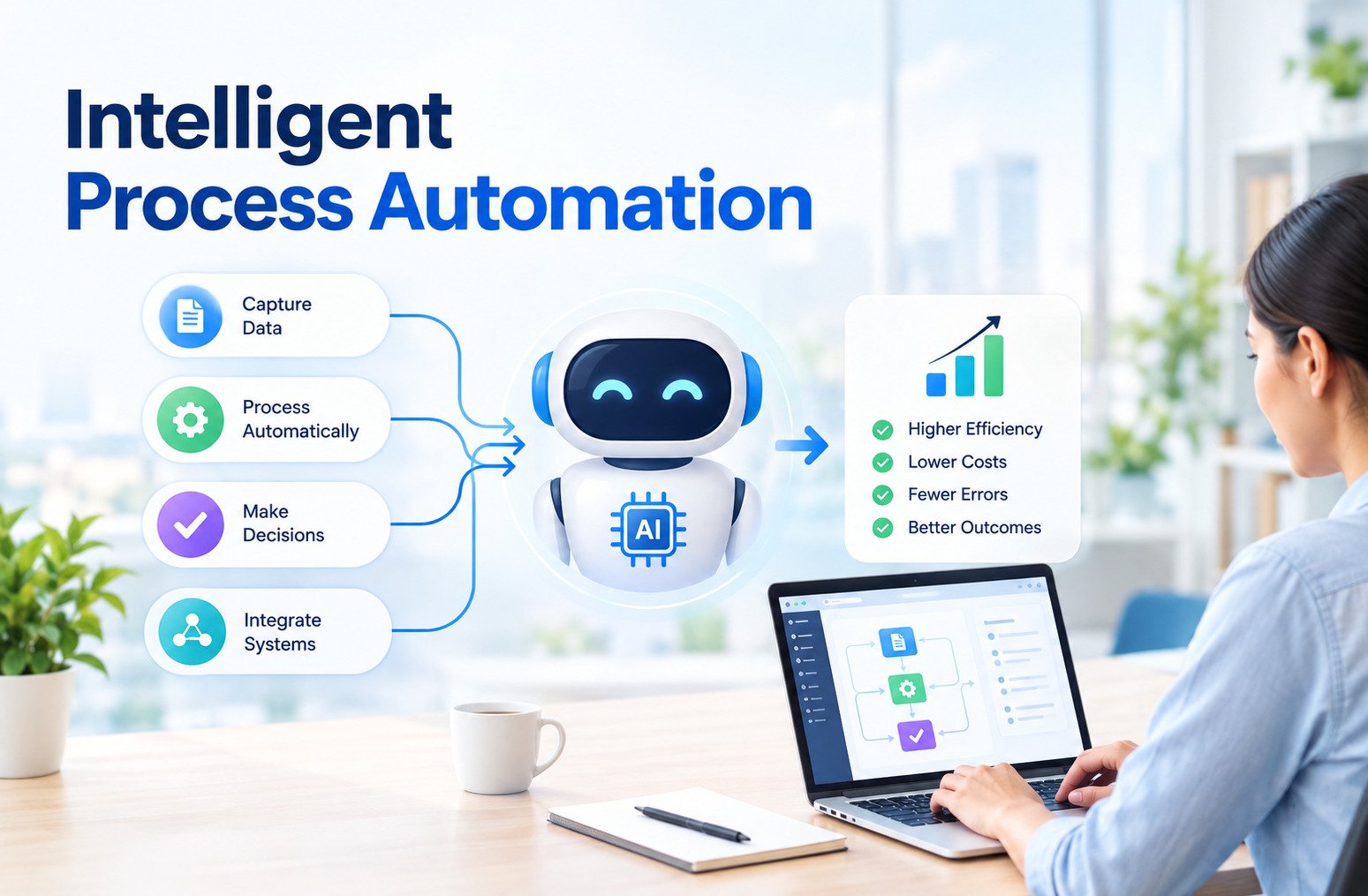
How to Choose the Best Intelligent Process Automation Services
Businesses are under constant pressure to reduce operational costs, improve productivity, and deliver faster customer experiences. Manual processes, repetitive data entry, disconnected applications, and inefficient workflows can prevent organizations from achieving these goals.
Intelligent Process Automation (IPA) Services help businesses overcome these challenges by combining automation, artificial intelligence, machine learning, and workflow technologies. Unlike basic automation, IPA can handle processes that require data analysis, decision-making, document understanding, and interaction between multiple business systems.
However, choosing the right automation partner can be challenging. Many providers offer similar services, but their capabilities, technologies, industry experience, and implementation approaches can differ significantly.
The right provider should understand your business processes, identify valuable automation opportunities, integrate with your existing systems, and build solutions that can scale as your business grows.
What Are Intelligent Process Automation Services?
Intelligent Process Automation Services combine traditional business process automation with AI technologies to automate complex and repetitive business operations.
Traditional automation generally follows predefined rules. IPA goes further by using technologies such as artificial intelligence, machine learning, natural language processing, intelligent document processing, and AI-powered decision-making.
For example, an intelligent process automation solution can:
- Extract information from invoices and documents
- Classify and process customer requests
- Automate employee onboarding
- Qualify and route sales leads
- Synchronize information between business applications
- Automate financial workflows
- Analyze data and trigger business actions
- Support customer service operations
This makes IPA particularly valuable for organizations that want to automate processes involving unstructured data, multiple systems, and conditional decisions.
Benefits of Intelligent Process Automation
Intelligent Process Automation (IPA) helps businesses automate repetitive and complex processes by combining workflow automation with AI-powered capabilities. Beyond saving time, IPA can improve accuracy, productivity, decision-making, and scalability across different business functions.
1. Reduces Operational Costs
IPA automates repetitive tasks and reduces manual effort, helping businesses lower operational expenses and use resources more efficiently.
2. Improves Employee Productivity
By handling routine activities such as data entry, document processing, and reporting, IPA lets employees focus on higher-value, strategic business activities.
3. Minimizes Human Errors
Automated workflows perform tasks consistently and accurately, reducing mistakes caused by manual data entry, repetitive processing, and missed steps.
4. Speeds Up Business Processes
IPA enables workflows to run faster with fewer manual delays. Processes such as approvals, customer responses, data synchronization, and document handling can be completed more efficiently.
5. Supports Business Growth and Scalability
IPA allows businesses to handle increasing workloads without proportionally increasing their workforce. Organizations can also expand automation across departments as their needs grow.
How to Select a Reliable IPA Service Provider
Implementing automation is not simply about purchasing an automation tool. A poorly designed solution can create new bottlenecks, increase integration problems, or fail to deliver the expected return on investment.
A reliable provider should focus on your business objectives rather than recommending technology without understanding the underlying process.
The right partner can help you:
- Identify processes with high automation potential
- Reduce repetitive manual work
- Improve operational accuracy
- Connect disconnected business systems
- Create scalable automation workflows
- Improve employee productivity
- Measure automation performance
- Build a long-term automation strategy
This is why businesses should evaluate an automation provider based on technical expertise, business understanding, integration capabilities, security, scalability, and ongoing support.
1. Evaluate IPA Expertise
Choose a provider with proven experience in Intelligent Process Automation (IPA) Services. They should understand AI, robotic process automation, intelligent document processing, machine learning, and workflow automation. A technically experienced provider can identify the right automation opportunities and recommend solutions based on your specific business requirements.
2. Check AI Automation Capabilities
Look for a provider with practical experience delivering an AI automation service. They should be able to use AI for data processing, pattern recognition, decision-making, and intelligent task execution. The provider should also understand how to integrate AI with your existing systems while maintaining security and customization.
3. Assess AI Workflow Automation Skills
Strong AI workflow automation expertise is essential for connecting different business applications and automating processes. Check whether the provider can create intelligent workflows for CRM, ERP, finance, customer service, sales, and other operations. They should be able to automate repetitive tasks while using AI for complex decisions.
4. Examine Integration and API Expertise
Your IPA provider should have strong API and integration capabilities. They should be experienced with CRM, ERP, databases, cloud applications, SaaS platforms, and custom software. Effective integration ensures information can move securely between systems, reduces manual data entry, and allows automation to become part of your existing technology environment.
5. Review Security and Scalability
Security and scalability should be major considerations when selecting an IPA provider. Ask about data encryption, access controls, authentication, monitoring, and compliance. At the same time, ensure the solution can handle increasing workloads and expand across departments as your business grows and automation requirements evolve.
6. Evaluate ROI and Customization
Choose a provider that can customize automation according to your workflows, business rules, and systems. They should also define measurable KPIs such as cost savings, processing time, productivity, and error reduction. Focusing on both customization and ROI ensures your automation investment delivers meaningful and measurable business value.
Intelligent Process Automation vs. Traditional Automation
Factor | Traditional Automation | Intelligent Process Automation |
Decision-making | Rule-based | AI-assisted |
Data | Mostly structured | Structured and unstructured |
Flexibility | Limited | More adaptable |
AI capabilities | Usually limited | Built into workflows |
Document processing | Basic | Intelligent extraction and classification |
Complex workflows | Limited | Better suited |
Business intelligence | Limited | Can support data-driven decisions |
Scalability | Process dependent | Designed for broader intelligent workflows |
IPA is particularly useful when a process requires more than simple predefined rules.
Why Choose Vision Infotech for Intelligent Process Automation?
Vision Infotech Intelligent Process Automation (IPA) Services can help businesses identify, design, and implement intelligent automation solutions tailored to their operational requirements.
With capabilities across AI, workflow automation, software development, API integration, and business process automation, Vision Infotech can support organizations that want to modernize repetitive and complex processes.
The focus should be on understanding the existing workflow, identifying automation opportunities, integrating the necessary systems, and developing solutions that can deliver measurable improvements.
For businesses exploring AI-powered automation, working with a technology partner that combines IPA, AI automation, AI workflow automation, and AI development capabilities can provide a more complete approach to digital process transformation.
Final Thoughts
Choosing the best Intelligent Process Automation (IPA) Services provider requires more than comparing prices or automation tools. Businesses should evaluate technical expertise, AI capabilities, integration experience, customization, security, scalability, and ongoing support.
The right provider will first understand your processes and business objectives before recommending an automation strategy. It should also be capable of combining traditional automation with AI when a process requires intelligent decision-making or unstructured data processing.
Whether your goal is to automate customer service, finance, HR, sales, document processing, or internal operations, selecting the right partner can help turn automation into a long-term business advantage.
If your organization is ready to identify high-value automation opportunities and build smarter business workflows, partnering with an experienced AI development company can help you move from manual processes toward intelligent, scalable operations.
FAQs
What business processes are best suited for IPA?
IPA is useful for repetitive, time-consuming, and rule-based processes such as invoice processing, employee onboarding, lead management, customer support, document processing, data entry, approvals, reporting, and information synchronization between business applications.
How long does it take to implement intelligent automation?
Implementation time depends on workflow complexity, integrations, data requirements, and customization. Simple workflows may be implemented relatively quickly, while complex enterprise processes involving multiple systems, AI models, and security requirements typically require more planning, development, testing, and optimization.
How much does Intelligent Process Automation cost?
The cost depends on the number of processes, workflow complexity, required integrations, AI technologies, customization, and ongoing support. Businesses should evaluate the expected savings, productivity improvements, and operational benefits alongside the initial implementation cost.
Can IPA reduce the workload of employees?
Yes. IPA can automate repetitive administrative activities and reduce manual workload. Employees can spend more time on strategic, analytical, and customer-focused responsibilities while automated systems handle routine tasks such as data processing, document handling, notifications, and workflow updates.
How can businesses identify automation opportunities?
Businesses can begin by analyzing processes that involve repetitive tasks, frequent errors, high processing volumes, multiple applications, or significant employee time. An automation assessment can then prioritize processes based on potential cost savings, productivity improvements, complexity, and business impact.








0 Comments