
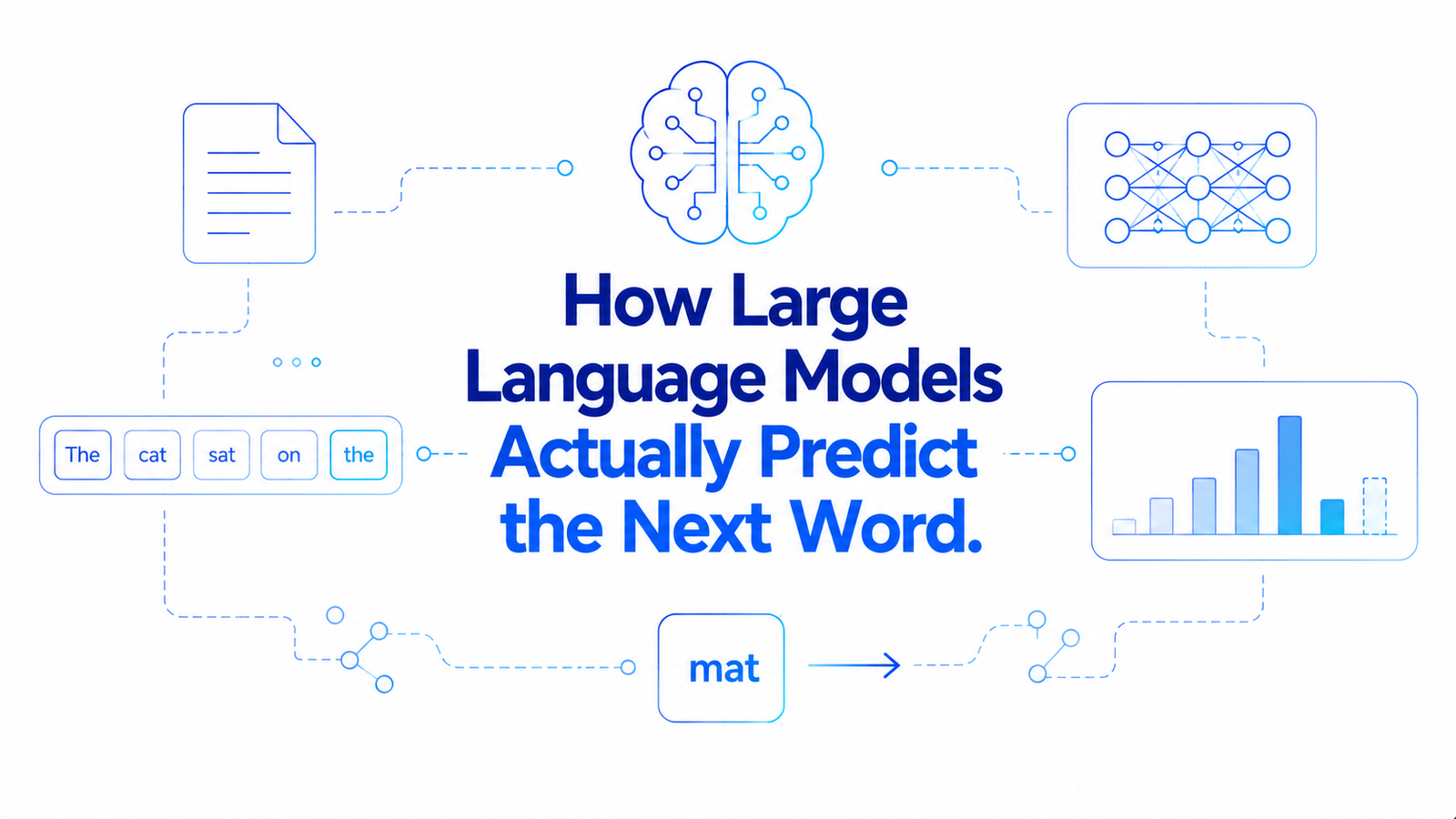
How Large Language Models Actually Predict the Next Word
Large Language Models (LLMs) have revolutionized the way we interact with technology. From answering questions and writing content to coding and language translation, these AI systems have proven to be extremely versatile. Yet, at the heart of every impressive response lies a surprisingly simple task: predicting the next word.
While the idea is simple, the execution requires billions of parameters, extensive training, and powerful neural networks. In this article, we will discuss how Large Language Models predict the next word and why it makes them so successful.
What Is the Main Point of Large Language Models?
The main point of Large Language Models is to predict the most probable next word. Rather than understanding the context of what they write, LLMs generate text based on patterns they observed during training.
For example, if you ask a question:
"Artificial intelligence is changing the..."
the model will analyze thousands of possible outcomes and pick the one with the highest predicted probability. Once it outputs the next word, it will perform the same operation to determine the following word, and so on, until the response is completed.
What Makes LLMs So Good at Predicting the Next Word?
Modern language models are based on a powerful architecture called the transformer. Unlike early recurrent neural networks, which analyzed text sequentially, one word at a time, transformer networks can read an entire passage and determine the context of each word based on its position. This is achieved through a self-attention mechanism, which allows the model to pay attention to relevant parts of the input.
As a result, language models can follow conversations, understand complex sentences, and maintain coherence throughout the response. This is especially important for chatbots, virtual assistants, and other AI applications that require natural language understanding. Companies that provide Artificial Intelligence development services use transformer-based models to build powerful conversational agents, content generators, document summarizers, and much more.
How Are These AI Models Trained to Predict the Next Word?
Before being able to predict the next word, language models need to be trained on a large amount of text. During training, models analyze books, research papers, websites, articles, and other sources of information. The more text they process, the better their understanding of the language becomes.
Specifically, large language models learn to predict the next word by performing billions of trials and adjusting their parameters whenever they make a mistake. This allows them to acquire extensive knowledge of the language, including grammar, syntax, semantics, and context. However, it is important to note that they do not actually understand what they write. Instead, they generate text based on patterns learned during training.
As a result, large language models may produce responses that sound correct but contain factual errors or make things up. This is why it is important to fact-check information retrieved from these systems. Businesses that want to implement large language models often hire dedicated developers to train, fine-tune, and deploy these solutions in their production environment.
Why Is Context Important for LLMs?
One of the most important developments in Large Language Models is their ability to maintain context. While early chatbots had a limited understanding of conversations, modern language models can follow multiple turns of dialogue and retrieve relevant information.
This means that when you ask a follow-up question, the model will take into account the entire conversation history and provide a more accurate response. For example, if you ask a question about healthcare, the model will be more likely to use medical terms and provide relevant information.
This is especially useful for chatbots and virtual assistants, which need to understand the context of user queries to provide accurate answers. Companies that offer AI development solutions can help you build powerful conversational agents that understand context and perform specific tasks.
Do LLMs Actually Understand What They Write?
Large language models do not actually understand what they write. Instead, they use complex algorithms to determine the most probable next word based on patterns learned during training. While they can generate coherent text, they do not possess human-like intelligence or comprehension.
This is why large language models are prone to hallucinations and may provide incorrect information. In some cases, they may even make up entire facts or respond to questions that were not explicitly asked. For this reason, it is important to use common sense when interacting with these systems.
Businesses that want to implement large language models should consider hiring professional developers to ensure that these solutions are used responsibly and ethically. In particular, it is important to fine-tune large language models on domain-specific data to improve their accuracy and reduce the risk of errors.
Can These Models Be Fine-Tuned for Specific Tasks?
Large language models can be fine-tuned to perform specific tasks. While general-purpose models like GPT-3 or LLaMA can answer a wide range of questions, they may not be accurate enough for specific use cases.
Fine-tuning allows developers to train a language model on a specific domain, such as healthcare, finance, law, or technology. This improves the model's accuracy and allows it to perform better on specialized tasks.
Many companies that offer AI development services provide fine-tuning solutions for large language models. By leveraging domain-specific data, businesses can build powerful AI assistants that perform exactly as needed.
What Are Some Common Use Cases for LLMs?
The ability of large language models to predict the next word has led to the development of numerous practical applications. Some of the most common use cases include:
- Intelligent chatbots and virtual assistants
- Content generation and summarization
- Code completion and software development
- Email composition and language translation
- Document analysis and knowledge management
As you can see, large language models have a wide range of applications. From customer service automation to code generation, these AI systems are transforming the way we interact with technology. Companies that want to stay ahead of the competition often invest in advanced AI solutions to build powerful applications that enhance their products and services.
How Are LLMs Used in Business?
Large language models are used in business to improve customer service, automate repetitive tasks, and generate high-quality content. By leveraging the power of AI, companies can provide better support, reduce costs, and increase productivity.
For example, businesses can use large language models to power chatbots that provide 24/7 customer support. These AI assistants can handle simple inquiries, troubleshoot common issues, and escalate complex requests to human agents when needed. Similarly, large language models can be used for email management, document summarization, and content creation, helping businesses save time and improve efficiency.
Companies that offer LLM development solutions specialize in building enterprise-grade applications that integrate large language models. By working with experienced developers, businesses can create powerful AI solutions that transform their operations and deliver exceptional results.
What Can We Expect from LLMs in the Future?
Large language models are a relatively new technology, and researchers are constantly working to improve their capabilities. In the future, we can expect to see more powerful models that can reason, learn, and adapt to different tasks.
Researchers are also working on making language models more efficient, scalable, and accessible. As these technologies mature, businesses will be able to leverage large language models to develop innovative applications that solve real-world problems.
In particular, organizations will invest more in advanced AI solutions and services to build next-generation AI assistants that can understand and execute complex commands.
Conclusion
Large language models predict the next word by analyzing patterns in the text and selecting the most probable outcome. While the concept is simple, the execution requires billions of parameters, extensive training, and powerful neural networks. Understanding how large language models predict the next word can help you better grasp their inner workings and potential applications.
From chatbots to code completion, these AI systems are transforming the way we interact with technology. As research continues, we can expect to see even more impressive developments in the field of large language models.


0 Comments