
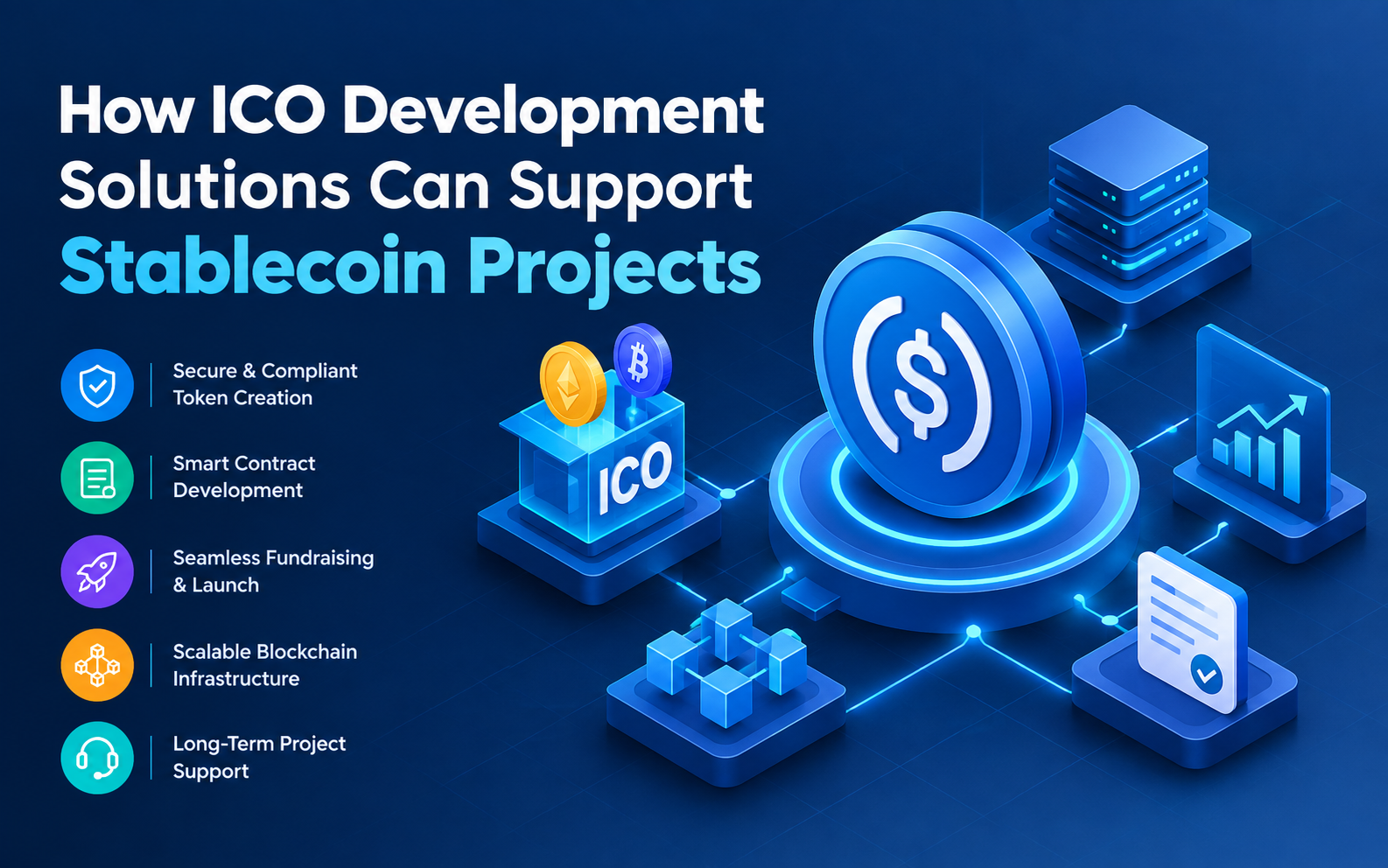
How ICO Development Solutions Can Support Stablecoin Projects
Stablecoins have moved beyond their early role as trading instruments and are increasingly becoming part of payment, settlement, treasury, and digital financial infrastructure. Their appeal comes from combining blockchain-based transferability with a value reference such as the U.S. dollar or another fiat currency. This has created opportunities for businesses that want to build payment networks, cross-border settlement platforms, financial applications, and blockchain-native ecosystems around stable digital assets.
The market already reflects this expansion. Visa reported that stablecoin supply grew by more than 50% during 2025, reaching $274 billion in December 2025 compared with $186 billion a year earlier. Adjusted transaction volume was on track to exceed $10 trillion during 2025, while more than 316 million stablecoin wallets were active. DeFiLlama currently tracks the overall stablecoin market at more than $305 billion in market capitalization.
This growth creates a different development challenge from a conventional utility-token launch. A stablecoin needs a functioning monetary model, reserve structure, issuance and redemption system, compliance framework, smart contracts, custody infrastructure, and mechanisms that support price stability. ICO development solutions can provide much of the technology and fundraising infrastructure needed to bring these components together.
Why Stablecoin Projects Need More Than a Token Contract
A conventional token can often be launched with a smart contract that defines supply, transfers, and basic ownership rules. A stablecoin requires a much broader architecture because its value proposition depends on maintaining a credible relationship between the token and its reference asset.
For a fiat-backed stablecoin, the development model may need to connect the token to reserves held with banks or other regulated custodians. Users need a mechanism to acquire the stablecoin and, where applicable, redeem it for the underlying currency. The issuer also needs systems for tracking circulating supply, reserve balances, transactions, compliance records, and reporting.
This creates a structure that can be viewed as:
Reserve assets → Custody → Issuance engine → Smart contract → Wallets → Transfers → Redemption → Reporting
ICO development solutions can help build the digital layer connecting these components. The legal and financial structure still requires qualified professionals, but the technology can be designed around those requirements from the beginning.
The Stablecoin Market Is Expanding Beyond Crypto Trading
The growing stablecoin market is increasingly connected to real-world financial activity. Visa's 2026 research shows that stablecoins are being explored for payments, settlement, treasury management, and cross-border transactions.
Visa also reported in April 2026 that its stablecoin settlement pilot had reached a $7 billion annualized run rate after growing 50% quarter over quarter, with support expanded to nine blockchains. These developments illustrate why stablecoin projects are attracting interest from fintech companies, payment providers, financial institutions, and Web3 businesses.
For a stablecoin issuer, this creates a requirement for infrastructure that can support more than speculative trading. The platform may need merchant payment integrations, API access, treasury tools, cross-border transfers, wallet connectivity, on-chain settlement, and integrations with exchanges or decentralized applications.
An ICO development company can contribute to this infrastructure by building the token platform and supporting applications around it.
ICO Development Can Support Stablecoin Fundraising
Although stablecoins differ from typical utility tokens, fundraising may still be necessary to finance the development of their underlying ecosystem. An ICO platform can provide a controlled environment for raising capital through a token offering where the legal structure permits such an approach.
The fundraising platform can include investor registration, wallet connection, allocation management, payment processing, token distribution, vesting, transaction records, and investor dashboards. These components can be adapted to the project's regulatory and offering structure.
For a stablecoin startup, the funds raised may support technology development, liquidity infrastructure, compliance systems, reserve management operations, payment integrations, or market expansion. The use of funds should be clearly defined and communicated to potential participants.
The important distinction is that stablecoin fundraising should not confuse the fundraising token with the stablecoin itself. Depending on the project's structure, the asset used for fundraising and the stablecoin intended for payments may have completely different functions and regulatory considerations.
Reserve Management Is Central to Stablecoin Development
The most important difference between a stablecoin and many other crypto assets is the role of reserves. If a project claims that every stablecoin is backed by a specific amount of fiat currency or permitted assets, the technology must support accurate issuance and redemption against that backing structure.
This makes reserve transparency an important part of the product. Users need confidence that the issuer can meet redemption obligations under the stated terms. The technology may therefore need to track the relationship between issued tokens and reserve information without exposing confidential banking or customer data.
The U.S. GENIUS Act framework provides a useful example of how regulatory expectations can shape stablecoin infrastructure. The Congressional Research Service's overview of the 2025 legislation describes requirements for permitted reserve assets, redemption procedures, periodic reporting of outstanding stablecoins and reserve composition, and AML and sanctions compliance programs.
For stablecoin developers, the broader lesson is that reserve management cannot be treated as an accounting process disconnected from blockchain infrastructure. Issuance, redemption, custody, reporting, and smart-contract controls need to work together.
Smart Contracts Need Controlled Issuance and Redemption
Stablecoin smart contracts require more careful design than a basic token contract. The issuer may need mechanisms to mint tokens when new backing assets are received and burn tokens when users redeem them.
Depending on the model, the contract may also require administrative controls, role-based permissions, emergency functions, pausing mechanisms, blacklisting or transfer restrictions, and supply monitoring.
These functions introduce additional security considerations. A compromised minting role, for example, could create an unlimited number of tokens without corresponding reserves. A flaw in redemption logic could also create operational or financial risks.
Independent smart contract audits are therefore important before deployment. Testing should cover minting, burning, transfers, access controls, upgrade mechanisms, administrative permissions, and edge cases involving high transaction volumes.
The goal is not simply to make the token transferable. It is to create a controlled digital representation of the project's monetary model.
KYC and AML Infrastructure Can Become Part of the Platform
Stablecoins designed for payments and financial applications can face significant compliance requirements depending on their jurisdiction, issuer structure, and use case.
A development platform may therefore need to integrate KYC and AML systems into the user journey. Instead of treating compliance as a separate manual process, the platform can connect identity verification, sanctions screening, wallet checks, transaction monitoring, and account permissions.
This becomes particularly important when the stablecoin is used for cross-border payments. Visa notes that stablecoins can support faster settlement and potentially lower costs for international money movement, while also pointing out that network, compliance, and off-ramp conditions remain important considerations.
ICO development solutions can support the technical implementation of these controls. The precise compliance requirements should still be determined by legal and regulatory specialists based on the project's markets and structure.
Multi-Chain Deployment Can Expand Stablecoin Utility
Stablecoin demand does not exist on one blockchain. Users and applications operate across Ethereum, Tron, Solana, Base, Arbitrum, Avalanche, and other networks.
Visa's expansion of its stablecoin settlement pilot to nine blockchains demonstrates the growing importance of multi-chain infrastructure for institutional settlement.
A stablecoin project therefore needs to decide whether it will launch on one network initially or support multiple chains. Multi-chain deployment can expand accessibility, but it also introduces additional smart contracts, bridges or interoperability systems, liquidity fragmentation, and security considerations.
An experienced development team can create chain-specific token contracts while maintaining consistent supply controls and issuance rules. Cross-chain supply management is particularly important because the same economic unit should not accidentally become duplicated across networks.
Liquidity and Exchange Integration Matter After Launch
Creating a stablecoin does not automatically create a liquid market. Users need reliable ways to acquire, transfer, exchange, and redeem the asset.
ICO development solutions can support liquidity infrastructure through exchange integrations, decentralized exchange connectivity, wallet integrations, payment gateways, and market-access systems. The project may also require mechanisms for maintaining sufficient liquidity across supported networks.
For stablecoins, liquidity serves a different purpose from the speculative liquidity associated with many utility tokens. Users generally expect to convert the asset near its reference value. Deep liquidity can help reduce friction when moving between the stablecoin and other assets.
The development strategy should therefore consider liquidity from the beginning rather than treating exchange listing as a final marketing milestone.
Stablecoins Are Becoming More International
The next phase of stablecoin development is not limited to U.S. dollar assets. Visa reported in May 2026 that local-currency stablecoin supply had reached approximately $1.2 billion across more than 30 blockchains by February 2026. Supply grew roughly 90% year over year, while unique holder addresses increased from around 40,000 in January 2023 to more than 1.2 million.
This creates opportunities for projects focused on regional payments and currencies. A euro, yen, rupee, real, or other local-currency stablecoin may target specific payment corridors or financial applications.
For ICO development teams, this increases the importance of flexible architecture. The system may need configurable reference currencies, reserve reporting, regional compliance controls, localized onboarding, and integrations with appropriate banking or payment infrastructure.
Building a Stablecoin Ecosystem Around the Core Asset
A successful stablecoin project is rarely just a token. Its value depends on the ecosystem surrounding it.
That ecosystem can include wallets, payment applications, merchant tools, exchanges, DeFi protocols, treasury platforms, remittance systems, APIs, dashboards, and institutional settlement infrastructure.
ICO development solutions can help create the technology layer connecting these components. A project may begin with token creation and fundraising infrastructure, then expand into payment processing, wallet development, exchange integration, cross-chain deployment, and enterprise APIs.
This approach creates a more practical development roadmap. Instead of launching a stablecoin and searching for utility afterward, the issuer can build the applications that create demand alongside the token.
Security and Operational Resilience Cannot Be Secondary
Stablecoins can potentially handle substantial financial value, making security a fundamental requirement. Smart contract vulnerabilities are only one part of the risk landscape.
Projects also need to protect private keys, administrative credentials, reserve-management systems, APIs, user accounts, and custody infrastructure. Operational procedures should address incidents such as compromised wallets, unauthorized minting, abnormal transactions, network outages, or disruptions involving banking partners.
Security audits, penetration testing, access controls, multisignature custody, monitoring systems, and incident-response procedures can help reduce operational risk.
The larger the stablecoin ecosystem becomes, the more important operational resilience becomes. A project processing millions or billions of dollars cannot rely on the same controls used for a small experimental token.
What ICO Development Solutions Can Bring to Stablecoin Projects
A complete development strategy can bring together several technology layers:
- Stablecoin token development: Smart contracts for minting, burning, transfers, and supply controls.
- ICO and fundraising platform: Investor onboarding, allocation, payments, dashboards, and token distribution.
- Reserve infrastructure: Systems for issuance, redemption, supply monitoring, and reporting.
- Compliance integrations: KYC, AML, sanctions screening, wallet screening, and transaction monitoring.
- Multi-chain deployment: Support for multiple blockchain networks and controlled cross-chain supply.
- Wallet and exchange integration: Access to trading, custody, payments, and liquidity.
- Payment infrastructure: Merchant tools, APIs, settlement systems, and cross-border payment integrations.
- Security: Smart contract audits, access controls, monitoring, and operational safeguards.
The exact architecture depends on the stablecoin's backing model, jurisdiction, intended users, and business purpose. A fiat-backed payment stablecoin, for example, may require a very different infrastructure from an overcollateralized crypto-backed asset.
The Future of ICO Development for Stablecoin Businesses
Stablecoins are becoming increasingly connected to mainstream financial infrastructure. Market growth, institutional experiments, payment integrations, and clearer regulatory frameworks are creating a stronger foundation for new projects.
Visa's research suggests that stablecoin activity is expanding beyond crypto-native trading toward payments and financial applications, while the current market capitalization tracked by DeFiLlama shows the scale already reached by the sector.
This creates an opportunity for stablecoin startups, but it also raises the standard for development. Investors, users, payment partners, and regulators increasingly need to understand how the stablecoin works, what supports its value, how redemption operates, and how risks are controlled.
ICO development can support this transition by connecting fundraising technology with token infrastructure, compliance systems, smart contracts, liquidity, and real-world applications.
Conclusion
Stablecoin projects require a broader technology foundation than conventional token launches. The development process needs to account for reserves, issuance, redemption, smart contract security, compliance, investor onboarding, liquidity, multi-chain deployment, and the applications that generate real utility.
As stablecoins become increasingly relevant to payments and settlement, ICO development solutions can help startups build the infrastructure needed to introduce, fund, distribute, and scale these digital assets. The strongest projects will not treat the stablecoin as a standalone token. They will build an ecosystem around it with clear economic logic, reliable infrastructure, strong security, and a defined use case.
Blockchain App Factory provides ICO development, token development, smart contract development, tokenomics, fundraising platforms, wallet integration, and blockchain solutions for businesses building digital asset ecosystems. For stablecoin startups, combining these capabilities can create a foundation for launching and scaling a blockchain-based financial product in an increasingly mature market.









0 Comments