
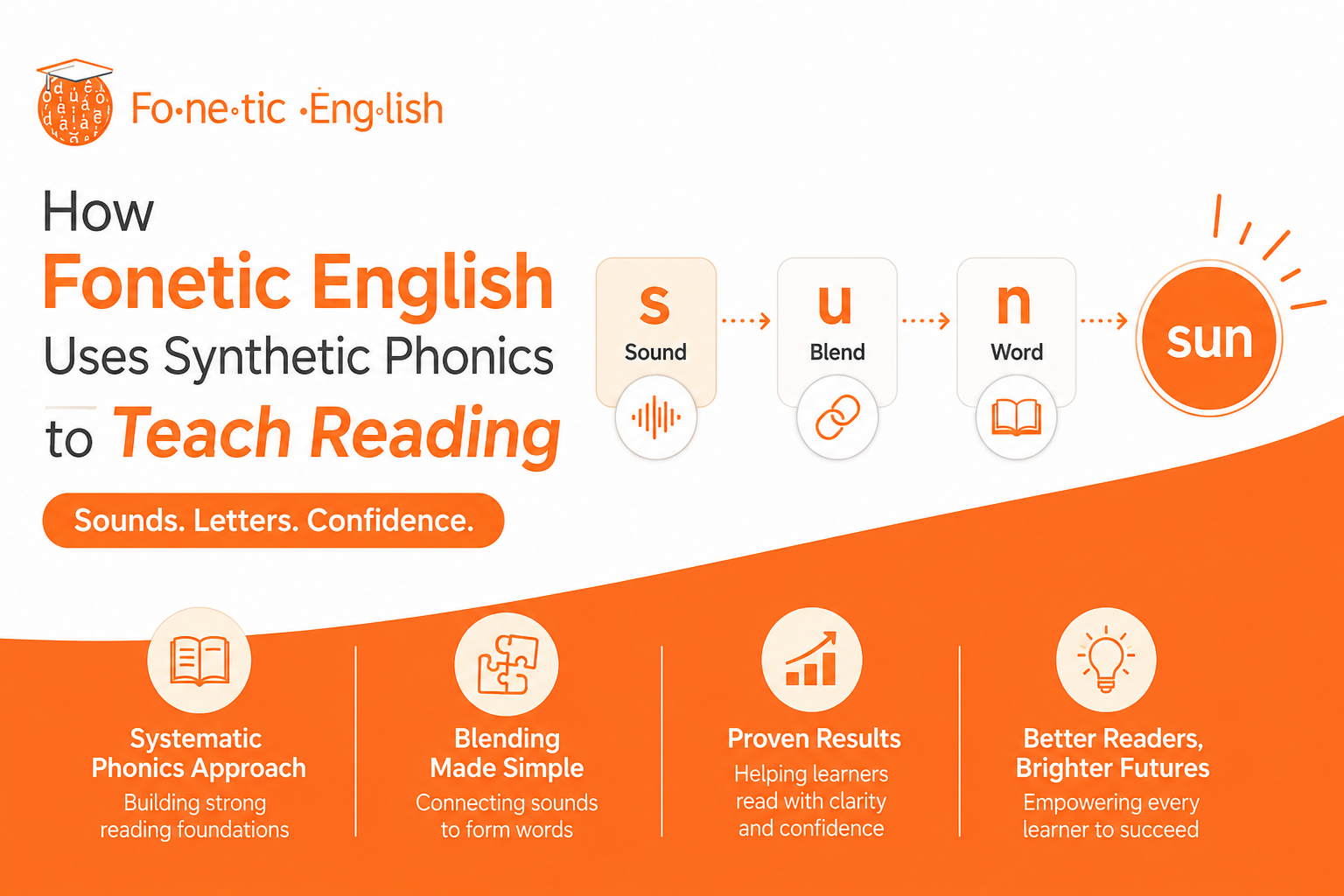
How Fonetic English Uses Synthetic Phonics to Teach Reading
Learning to read is one of the most complex skills a young mind will ever tackle, yet the method used to teach it can make the difference between a confident reader and a frustrated one. Synthetic phonics, a systematic approach where children learn individual letter sounds before blending them into words, has become the gold standard in early literacy instruction across the UK, Australia, and increasingly the rest of the world. Understanding how this method works, and why it's more effective than piecemeal or memorization-heavy approaches, helps parents and educators make informed choices about a child's reading journey.
What Makes Synthetic Phonics Different
Traditional reading instruction often relied on "look and say" methods, where children memorized whole words by sight. This approach works for a limited vocabulary but breaks down quickly once children encounter unfamiliar words. Synthetic phonics flips this model: it teaches the smallest units of sound (phonemes) and their corresponding letters (graphemes) first, then shows children how to blend these sounds "synthesizing" them to decode any word, familiar or not.
This is the foundation that Fonetic English builds its entire teaching approach around. Rather than asking children to memorize hundreds of sight words, the program introduces letter-sound relationships in a carefully sequenced order, so children develop a genuine decoding skill they can apply independently, long after a lesson ends.
Why Sequencing Matters
One of the quiet strengths of a synthetic phonics program is the order in which sounds are introduced. Sounds that are used most frequently and combine easily into simple words are typically taught first, so children experience early wins — reading their first three-letter words within days rather than months. This sequencing isn't arbitrary; it draws on decades of literacy research about how the brain builds automaticity.
Fonetic English follows this same evidence-based logic in its lesson design, which you can explore in more depth on the science that Fonetic English is built on. Every stage is designed to reduce cognitive load, so a learner's mental energy goes toward blending and comprehension rather than guessing.
From Sounds to Syllables to Fluency
Synthetic phonics doesn't stop at single sounds. As children progress, they learn to chunk words into syllables — a skill that dramatically speeds up decoding of longer, more complex words. This step is often where many phonics programs fall short, leaving a gap between early decoding and genuine reading fluency.
This is precisely the gap that using syllables to learn to read English is designed to close. By teaching syllable division as a natural extension of phonics, learners move from sounding out individual words to reading full sentences with far less strain, which is often the point where reading confidence takes root.
Why This Approach Builds Real Independence
The ultimate goal of synthetic phonics isn't just to help a child read the words in front of them; it's to give them a transferable skill they can apply to any word they encounter for the rest of their life. This is a meaningfully different outcome than memorization-based approaches, which require constant reinforcement and don't generalize well to new vocabulary.
Parents and tutors evaluating any reading program should ask a simple question: does it teach decoding as a skill, or does it teach word recognition as a habit? Programs built on synthetic phonics, including Fonetic English, are designed around the former, because it's the approach best supported by literacy research and the one most likely to produce readers who can tackle unfamiliar texts with confidence.
For a deeper look at how sounds, letters, and cognitive science come together in practice, see how reading works.








0 Comments