
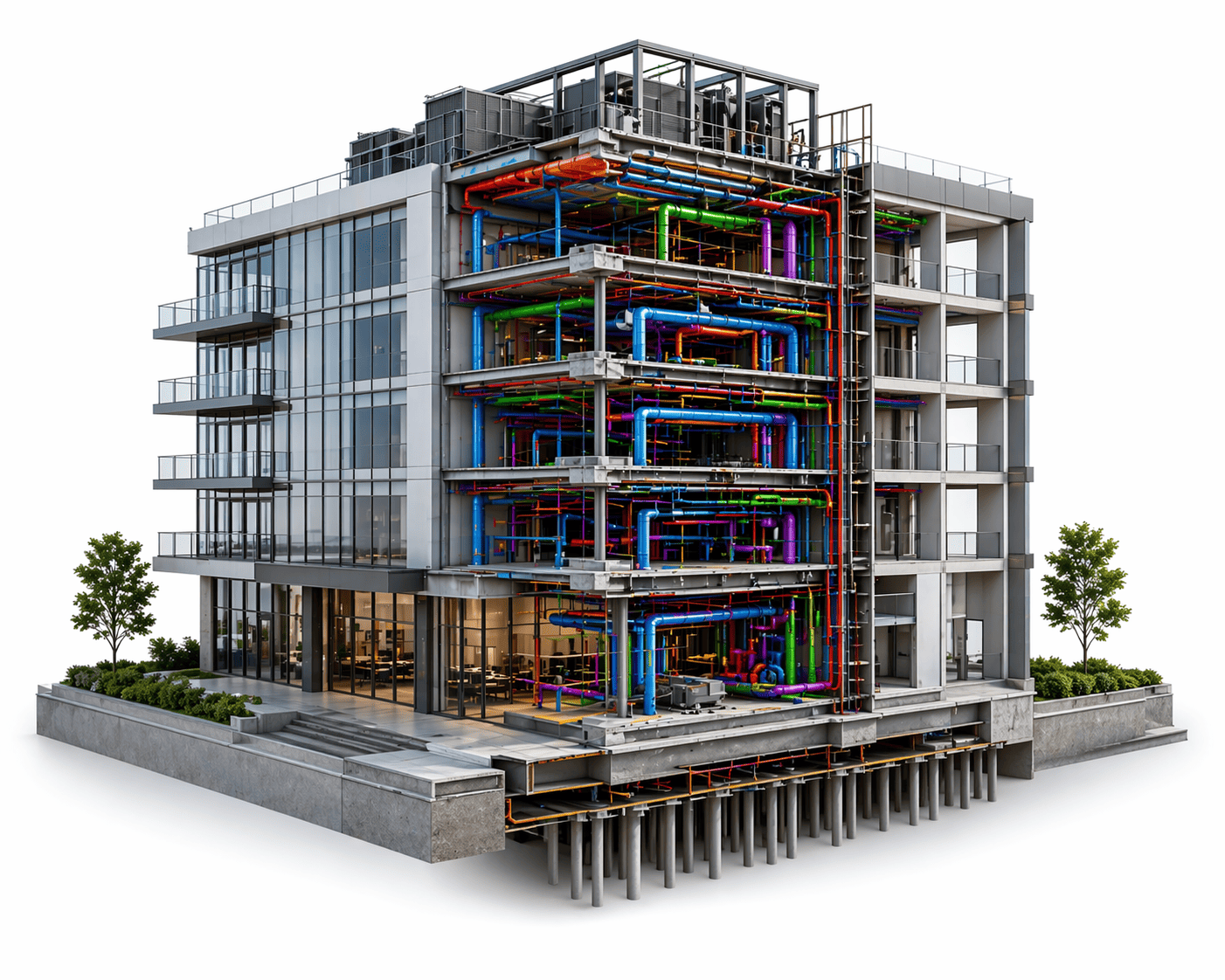
How Architectural BIM Services Simplify Complex Building Designs
Modern building geometries have reached a level of structural intricacy that challenges the capacity of conventional design methods. High performance facades with parametric curtain wall systems, multi curvature roof assemblies and mixed use vertical towers demand synchronized coordination across thousands of interlocking structural, mechanical, and architectural components. Architects and VDC managers must simultaneously manage material specifications, dimensional tolerances, MEP routing paths, and load bearing systems. Each governed by performance thresholds that directly impact construction outcomes. The volume of interdependent data generated across even a small scale contemporary project far exceeds what manual coordination methods can process with the required fidelity.
A data-driven approach to design management transforms the way multidisciplinary AEC teams control this escalating complexity. Industry research consistently identifies rework as consuming 5–15% of total project cost, with its root causes originating in upstream design coordination failures and fragmented documentation workflows. Design teams that adopt intelligent parametric modeling platforms gain measurable advantages in spatial conflict resolution, constructability analysis, and material quantity validation achieving LOD 400-level precision long before fabrication and installation begin. The cost of resolving clashes in a digital design environment remains a fraction of the expenditure incurred when the same conflicts surface during active construction phases.
Understanding Architectural BIM Services
The AEC industry transitioned from flat 2D drafting environments to multidimensional parametric modeling platforms that encode full geometric, material, and performance intelligence into every building element. These platforms function as centralized data repositories for all design intent capturing geometry, metadata, thermal performance values, structural load capacities, acoustic ratings, and lifecycle cost parameters within a single, version-controlled model. Architectural BIM services form the technical backbone of a multidimensional modeling environment. They manage parametric families in Autodesk Revit and handle IFC interoperability between different discipline platforms. They also produce construction documentation that reflects real time, model design decisions. The digital construction workflows embedded within these services connect architects, engineers, and contractors through shared Federated Models that eliminate version conflicts and documentation fragmentation across all project phases.
Core technical capabilities delivered through these services include:
1. Parametric Object Creation: Intelligent Revit Families that update geometry, material schedules, and documentation views simultaneously when designers modify input parameters eliminating redundant manual revisions across entire drawing sets
2. Material Quantization: Automated quantity takeoffs extracted directly from model geometry and integrated with 5D cost management platforms, producing accurate procurement data and budget forecasting free of manual measurement error
Spatial Validation: Rule-based clash detection algorithms executed within Navisworks and Revit that identify hard conflicts, soft conflicts, and clearance violations across architectural, structural, and MEP system intersections before construction commences
3. LOD 400 Detailing: Element-specific geometry and fabrication-level data supporting shop drawing generation, off-site prefabrication coordination, and precision installation sequencing for complex assemblies
4. Interoperability Protocols: IFC data exchange across Revit, Archicad, and Tekla Structures, maintaining model integrity across all disciplinary boundaries throughout every project phase
The collaborative environment formed when architects, structural engineers, and MEP consultants share a single federated model redefines project communication at every stage. Design decisions made by one discipline propagate instantaneously across all associated drawings, schedules, and material specifications. This shared authoritative source removes the fragmented documentation cycles that characterized traditional CAD workflows and positions every project stakeholder to contribute informed, data validated decisions from schematic design through final construction documentation delivery.
How BIM Services Transform Complex Architectural Designs
Reality capture technology fundamentally changes the site analysis phase by generating high density point cloud data from existing field conditions before design development begins. Terrestrial LiDAR scanners and photogrammetry systems capture millions of coordinate measurements every second. These measurements are used to create accurate, georeferenced digital models of site topography, existing structures and surrounding spatial constraints. Design teams import this scan data directly into Revit through Point Cloud Registration workflows, enabling parametric modeling grounded in verified, measured site geometry rather than assumed or estimated dimensions.
Laser scanning in construction
It extends measurement-based verification into active construction phases, enabling site engineers to capture current field conditions. They can then compare these conditions with the theoretical BIM model at millimeter level accuracy. Quantified variance reports identify the exact locations, magnitudes, and affected building systems of deviations. This replaces estimation field decisions with geometry confirmed installation instructions and reduces coordination errors throughout construction.
As-built BIM models
They are especially valuable in complex renovation and historic preservation projects. In such cases existing structural systems often contain dimensional irregularities that were not accurately recorded in legacy documentation. Preservation architects use these detailed 3D models to design targeted interventions that integrate contemporary building systems, respect original material assemblies, and satisfy heritage authority compliance requirements within a fully parametric environment.
Automated Clash Detection
Conflict resolution should be addressed at the earliest possible stage of the project. Navisworks aggregates architectural, structural, and MEP models into a unified federated environment and executes rule clash tests across all disciplinary system intersections. Project teams that resolve clashes during design rather than during construction consistently report 20–30% reductions in RFIs and substantial decreases in change order volumes that inflate project costs.
Lifecycle Data Management
It transforms the BIM modeling services from a construction coordination deliverable into a long-term operational asset supporting facility management. Each parametric family carries embedded data fields for manufacturer specifications, maintenance schedules, warranty periods, and replacement cost indices. Facility managers access this structured data through BIM 360 cloud platforms, enabling condition maintenance programs that extend asset performance and reduce lifecycle operating expenditure across the building's full service life.
High Fidelity Visualization
Advanced visualization tools in Revit along with rendering engines like Enscape and Lumion, create photorealistic walkthroughs. These visuals effectively convey spatial quality, material character, and daylighting performance to clients and regulatory stakeholders. These immersive, dimensionally accurate visualization outputs accelerate design approval cycles by replacing abstract drawing sets with representations that match proposed design outcomes precisely improving stakeholder comprehension and reducing misinterpretation revision cycles.
Conclusion
Digital integration across the full project lifecycle measurably reduces project risk and advances design integrity from conceptual development through construction execution and into long term facility operation. BIM projects demonstrate accelerated approval timelines, reduced coordination rework, and improved budget adherence relative to projects managed through traditional fragmented design workflows.
The future of architecture positions creative vision and computational precision as deeply interdependent forces. Where parametric modeling, federated model coordination, AI-augmented generative design, and cloud lifecycle data management converge into a unified AEC delivery ecosystem. Design teams that embed these digital disciplines into their core operational frameworks gain a decisive competitive advantage in delivering complex, high-performance building projects with measurable accuracy, cost efficiency, and lasting operational value.



0 Comments