
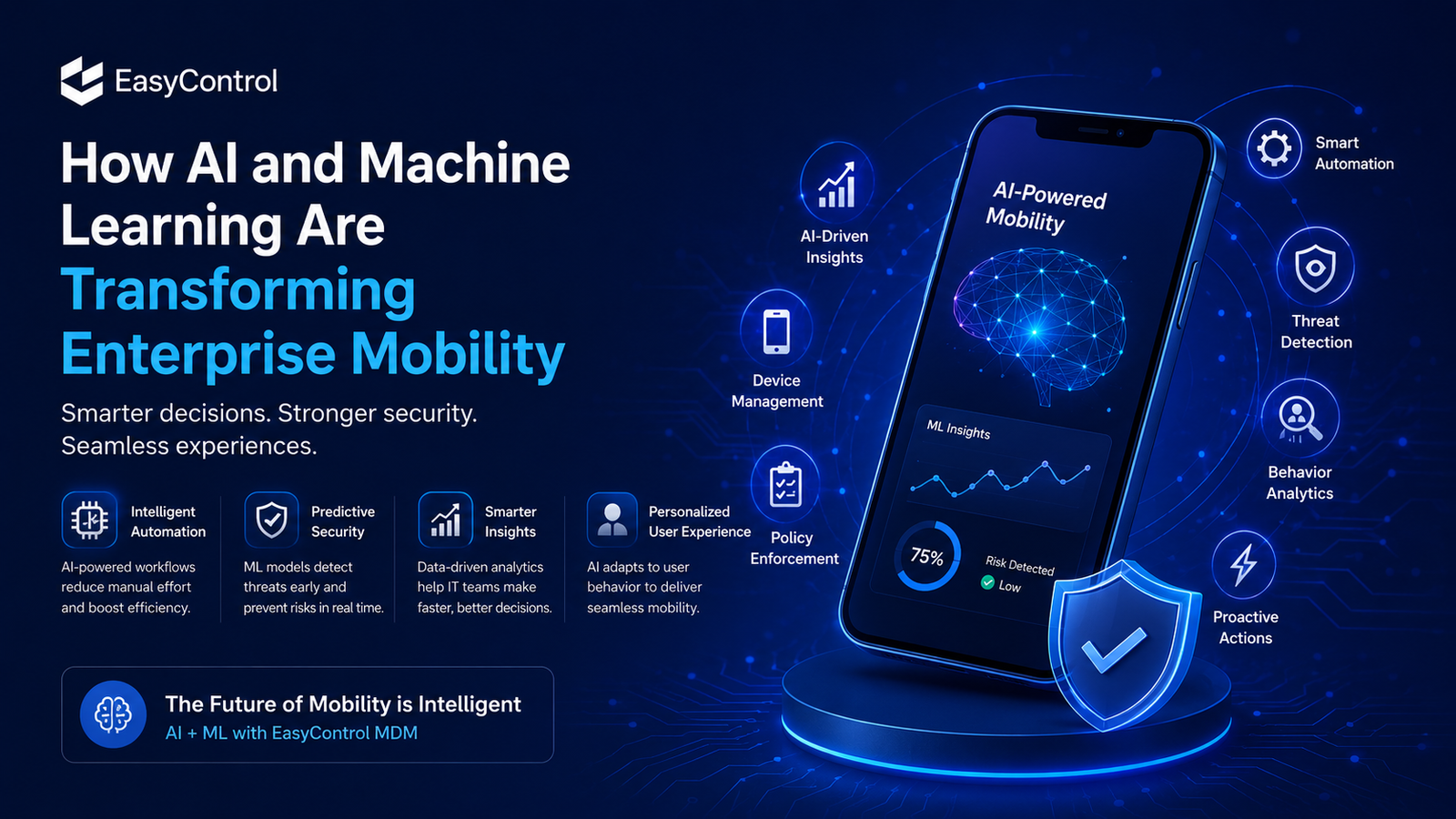
How AI and Machine Learning Are Transforming Enterprise Mobility
Enterprise mobility has evolved far beyond giving employees smartphones, tablets, or laptops. Today, businesses rely on connected devices, cloud applications, remote work platforms, and digital workflows to keep operations moving. As these environments become larger and more complex, traditional device management approaches are no longer enough.
This is where Artificial Intelligence (AI) and Machine Learning (ML) are changing the game.
Instead of relying entirely on manual monitoring and predefined rules, modern enterprise mobility strategies can use intelligent automation to identify patterns, detect potential risks, optimize device management, and help IT teams respond faster.
For businesses managing large fleets of corporate devices, AI-powered mobility can transform IT from a reactive support function into a more proactive and intelligent operation.
What Is Enterprise Mobility?
Enterprise mobility refers to the use and management of mobile devices, applications, data, and technologies that allow employees to work securely from different locations.
It can include:
- Smartphones and tablets
- Laptops and desktop endpoints
- Enterprise applications
- Cloud services
- Remote access
- Mobile security
- Device management
- Data protection
- Employee productivity tools
The challenge is maintaining security and productivity while employees access company resources from offices, homes, customer sites, and other locations.
Traditional IT teams often have to monitor hundreds or thousands of endpoints manually. AI and ML can reduce this burden by automating many repetitive processes and identifying issues before they become serious problems.
How AI Is Changing Mobile Device Management
Mobile Device Management already provides centralized control over enterprise devices. IT administrators can configure devices, distribute applications, enforce security policies, monitor device status, and remotely manage endpoints.
AI can make these capabilities more intelligent.
Instead of simply showing an administrator that a device has a problem, an AI-powered management platform could analyze device behavior, identify unusual patterns, prioritize risks, and recommend an appropriate response.
This creates a shift from “manage when something goes wrong” to “predict and prevent potential problems.”
Modern MDM platforms are increasingly moving toward AI-powered automation, threat identification, and integration with broader endpoint security technologies.
1. Smarter Threat Detection
Cybersecurity is one of the biggest areas where AI and machine learning can contribute to enterprise mobility.
Employees may access company resources from multiple devices and networks. A device showing unusual behavior could indicate a security issue, compromised account, or unauthorized activity.
Machine learning models can analyze patterns such as:
- Unusual login behavior
- Unexpected application activity
- Abnormal device behavior
- Changes in device configurations
- Suspicious network activity
- Repeated policy violations
Rather than treating every event equally, intelligent systems can help security teams focus on higher-risk activities.
This can strengthen an organization's overall mobile device security strategy.
2. Automating Routine IT Tasks
IT teams spend considerable time handling repetitive tasks such as application deployment, device configuration, updates, policy enforcement, and troubleshooting.
AI-powered automation can reduce this workload.
For example, instead of manually checking every endpoint for outdated applications, intelligent management systems can identify devices that require updates and help administrators prioritize remediation.
This becomes particularly valuable as businesses scale.
A company managing 50 devices may be able to handle certain tasks manually. A company managing 5,000 devices across multiple locations needs automation.
That is where AI-driven enterprise mobility management becomes increasingly valuable.
3. Better Employee Productivity
Enterprise mobility is not only about security. It is also about helping employees work efficiently.
AI can analyze device and application patterns to identify potential productivity bottlenecks.
For example, organizations can identify:
- Frequently used applications
- Unused business applications
- Repeated technical issues
- Devices requiring support
- Workflow interruptions
- Excessive non-business application usage
This information can help IT teams improve device configurations and application policies.
Organizations looking to Control Employee Mobile Usage can combine clearly defined policies with MDM capabilities such as application restrictions, website controls, monitoring, and centralized device management.
The goal should not be invasive surveillance. Instead, businesses should establish transparent policies that balance productivity, privacy, and security.
4. Intelligent Application Management
Enterprise applications are another major part of modern mobility.
Employees may use CRM platforms, communication tools, productivity software, inventory systems, payment applications, and industry-specific applications every day.
Managing these applications across hundreds or thousands of devices can become complicated.
AI can help organizations understand application usage and identify opportunities for optimization.
For example, an intelligent management system could help identify applications that are:
- Outdated
- Rarely used
- Consuming excessive resources
- Installed on unauthorized devices
- Creating compatibility issues
- Requiring security updates
This supports more effective enterprise application management and can help IT teams maintain a cleaner application environment.
5. Smarter Mac Management
Enterprise mobility is not limited to smartphones and tablets. Macs have also become important business endpoints.
Organizations using Apple devices need to manage configurations, applications, security policies, updates, and device inventory across their Mac fleet.
Modern mac management software can help IT administrators remotely deploy applications, enforce security policies, monitor device status, and maintain device inventory.
AI can add another layer of intelligence by helping administrators identify unusual device behavior, prioritize devices that require attention, and automate repetitive management workflows.
For organizations operating mixed environments, combining Mac, Windows, Android, and iOS management within a unified platform can also reduce administrative complexity.
6. Predictive Device Maintenance
One of the most promising applications of machine learning is predictive analysis.
Instead of waiting for a device to fail, AI systems can potentially identify patterns associated with performance degradation or recurring problems.
For example, a management platform could analyze:
- Device performance trends
- Battery behavior
- Storage usage
- Application crashes
- Connectivity problems
- Repeated configuration issues
This information can help IT teams determine which devices may require attention before employees experience major disruption.
Predictive maintenance can reduce downtime and improve the overall device lifecycle.
7. AI-Powered Remote Device Management
Remote work has made centralized device management essential.
IT administrators may need to support employees located in different cities, countries, or time zones. Physically accessing every device is impractical.
Modern MDM platforms provide remote capabilities for device configuration, application management, policy enforcement, monitoring, and troubleshooting.
AI can make remote management more efficient by helping prioritize incidents and automate routine responses.
Instead of an administrator reviewing thousands of device alerts manually, intelligent systems can identify the most important issues first.
8. Stronger Security Through Zero Trust
AI and ML also fit naturally into Zero Trust security models.
Zero Trust assumes that users and devices should not automatically be trusted simply because they are inside a corporate environment.
AI can continuously evaluate signals such as:
- User behavior
- Device compliance
- Application activity
- Location
- Access patterns
- Security posture
When combined with identity management and device compliance controls, these signals can support more dynamic access decisions.
This makes enterprise mobility security more adaptive than traditional perimeter-based approaches.
9. AI and MDM Software in the US
As remote and hybrid work continue to influence business operations, organizations need scalable tools for managing mobile endpoints.
MDM software is increasingly relevant for businesses that need centralized device security, remote management, application control, policy enforcement, and compliance support. EasyControl's MDM approach highlights capabilities such as multi-platform support, cloud-based administration, application management, security controls, and scalability.
The next generation of MDM platforms is likely to place greater emphasis on automation and intelligent decision-making.
The objective is simple: reduce manual IT work while improving security and operational visibility.
Challenges of Using AI in Enterprise Mobility
AI is powerful, but organizations should not treat it as a replacement for human decision-making.
Businesses need to consider:
Data Privacy
AI systems require data to identify patterns. Organizations should carefully define what information is collected, how it is processed, and who can access it.
False Positives
Machine learning systems can sometimes incorrectly identify legitimate activity as suspicious. Human review remains important for sensitive security decisions.
Transparency
Employees should understand what company-owned devices are monitored and why. Clear policies are especially important when organizations implement employee mobile usage controls.
Integration
AI capabilities are most useful when they integrate with existing MDM, UEM, endpoint security, identity, and IT service management systems.
The Future of AI-Powered Enterprise Mobility
The future of enterprise mobility is moving toward intelligent, automated, and predictive management.
Instead of simply asking, “Is this device compliant?”, IT teams will increasingly ask:
“What is likely to happen next, and what can we do about it now?”
That shift could change how organizations manage their entire endpoint environment.
AI-powered platforms can potentially automate repetitive tasks, identify anomalies, optimize application usage, support predictive maintenance, and provide IT teams with actionable insights.
For businesses managing large and distributed fleets, this can mean fewer manual processes, faster responses, stronger security, and better employee experiences.
Final Thoughts
AI and machine learning are transforming enterprise mobility by making device and endpoint management more intelligent.
From MDM software in the US to mac management software, modern businesses are moving toward centralized platforms that combine automation, security, application management, monitoring, and remote administration.
At the same time, organizations that want to Control Employee Mobile Usage can use technology alongside transparent policies to create a more productive and secure mobile environment.
The biggest opportunity is not simply adding AI to existing management tools. It is using AI to make enterprise mobility predictive, proactive, and adaptive.
As device fleets continue to grow and employees become increasingly mobile, businesses that adopt intelligent mobility management will be better positioned to secure their endpoints, reduce IT complexity, and support the future of work.




0 Comments