
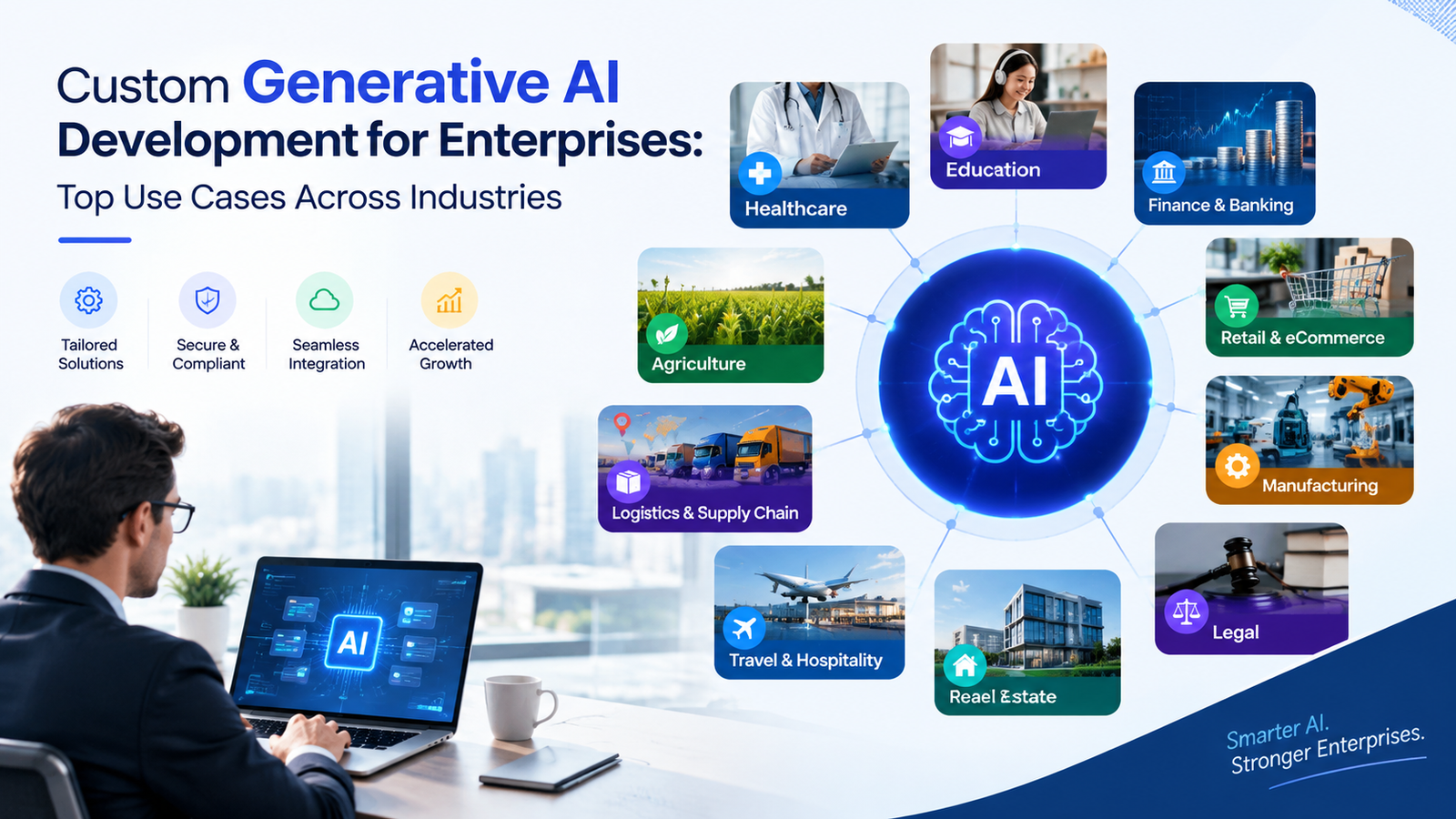
Custom Generative AI Development for Enterprises: Top Use Cases Across Industries
Generative AI is no longer limited to simple chatbots, content generation, or experimental projects. Enterprises are increasingly investing in custom AI solutions that can integrate with internal systems, understand business-specific data, automate complex workflows, and deliver measurable value.
The growing demand for Generative AI Development Services is being driven by a major shift in how businesses approach artificial intelligence. Instead of adopting generic AI tools and expecting them to solve every challenge, organizations are now looking for custom-built solutions designed around their industry, workflows, customers, and operational goals.
This approach is particularly important for large enterprises that manage complex data, legacy software, regulatory requirements, and specialized business processes. Custom generative AI can help connect advanced AI models with enterprise knowledge bases, CRM platforms, ERP systems, customer support tools, and other digital infrastructure.
Industry research and current enterprise implementations show that generative AI use cases are expanding across sectors, with applications ranging from customer service and document intelligence to healthcare workflows, financial services, manufacturing, and personalized education.
In this micro blog, we explore the most important Generative AI Use Cases across industries and how enterprises can benefit from custom AI development.
Why Enterprises Need Custom Generative AI Development
Public AI platforms can be useful for general tasks, but enterprises often require much more control and customization.
A custom generative AI solution can be designed to:
- Access approved enterprise data
- Understand industry-specific terminology
- Integrate with existing business applications
- Automate multi-step workflows
- Follow organizational security requirements
- Support role-based access
- Improve response accuracy using enterprise knowledge
- Provide monitoring and governance capabilities
For example, a healthcare organization may require an AI system that can summarize approved documentation while operating within strict privacy and compliance requirements. A financial institution may need an AI assistant capable of analyzing internal documents and supporting employees with complex queries.
This is why Generative AI Development Services are increasingly focused on building enterprise-ready applications rather than simply deploying a general-purpose chatbot.
1. Intelligent Enterprise Knowledge Assistants
One of the most valuable Generative AI Use Cases for enterprises is the development of intelligent knowledge assistants.
Large organizations often have thousands of documents, reports, policies, technical manuals, training materials, and internal knowledge resources. Finding the right information can take significant time.
A custom AI knowledge assistant can help employees:
- Search internal documentation
- Summarize lengthy reports
- Answer policy-related questions
- Retrieve technical information
- Generate contextual responses
- Support employee onboarding
These systems can be developed using Retrieval-Augmented Generation (RAG), allowing the AI to retrieve relevant information from approved knowledge sources before generating a response.
This makes enterprise AI more useful because responses can be connected to current organizational information rather than relying only on the general knowledge of a foundation model.
2. AI-Powered Customer Support
Customer service is another major area where custom generative AI can create value.
Traditional chatbots are usually limited to predefined flows and scripted responses. Generative AI can enable more conversational systems that understand context and generate relevant responses based on available business information.
Custom AI customer support solutions can help with:
- Automated responses to common queries
- Conversation summarization
- Ticket classification
- Knowledge retrieval
- Agent assistance
- Multilingual customer support
- Personalized recommendations
- Follow-up communication
AI does not necessarily need to replace human support teams. In many enterprise use cases, it can function as a copilot that helps support representatives find information and respond more efficiently.
This combination of automation and human oversight can help organizations improve response times while maintaining control over complex customer interactions.
3. Generative AI for Healthcare
Healthcare is one of the most promising industries for custom generative AI development.
Healthcare organizations manage large volumes of information, including clinical documentation, research materials, patient communications, operational records, and administrative data.
Potential Generative AI Use Cases in healthcare include:
- Clinical documentation support
- Medical content summarization
- Patient communication assistance
- Healthcare knowledge assistants
- Administrative workflow automation
- Research and document analysis
- Internal employee support
- Appointment and communication automation
Custom solutions can be developed around specific healthcare workflows and integrated with approved systems and data sources.
However, enterprise AI development in healthcare requires a strong focus on privacy, security, accuracy, governance, and appropriate human oversight. AI should be designed to support qualified professionals and established processes rather than operate without appropriate controls.
Custom AI architecture can help healthcare organizations define what information the system can access, who can use it, and how outputs are monitored.
4. Generative AI in Banking and Financial Services
Financial institutions process massive amounts of structured and unstructured data.
Reports, contracts, policies, customer communications, research documents, and transaction-related information can create significant operational complexity.
Custom generative AI solutions can support areas such as:
- Financial document analysis
- Customer service automation
- Report generation
- Internal knowledge management
- Compliance workflow assistance
- Research summarization
- Personalized financial communication
- Employee productivity tools
For example, generative AI can assist customer service teams by summarizing interactions and reducing repetitive note-taking. Industry examples also show AI being used to support service and operational workflows in financial organizations.
The key advantage of custom development is that enterprises can integrate AI with their existing systems and define appropriate governance around sensitive data.
5. AI Agents for Business Process Automation
AI agents represent one of the most important developments in enterprise generative AI.
Unlike a basic chatbot that only responds to prompts, an AI agent can be designed to perform multi-step tasks within defined workflows.
For example, an AI agent may be able to:
- Receive a request from a user.
- Retrieve relevant information.
- Analyze available data.
- Generate a response or document.
- Trigger an approved workflow.
- Update an enterprise application.
- Escalate complex tasks to a human employee.
Potential applications include sales operations, customer support, HR, procurement, internal IT, and business administration.
The real value comes from connecting AI capabilities with business processes. Enterprises increasingly need solutions that integrate models into actual workflows while addressing reliability, security, and governance requirements.
6. Personalized Retail and eCommerce Experiences
Retail and eCommerce companies are using generative AI to create more personalized customer experiences.
Custom AI solutions can support:
- Product description generation
- Personalized recommendations
- AI shopping assistants
- Automated marketing content
- Customer support
- Product discovery
- Dynamic customer communication
- Content localization
Instead of manually creating hundreds of variations of marketing content, businesses can develop AI-powered systems that generate relevant content based on product data, customer segments, and campaign requirements.
Custom development allows enterprises to connect AI directly with product catalogs, customer platforms, and marketing systems.
This can create a more scalable approach to personalization.
7. Generative AI for Education and EdTech
Education is another industry where personalized AI experiences can create significant opportunities.
Traditional learning platforms often provide the same content and learning experience to every student. Generative AI can help create more adaptive and personalized systems.
Key use cases include:
- AI tutoring assistants
- Personalized learning content
- Automated question generation
- Course material development
- Learning content summarization
- Student support chatbots
- Assessment assistance
- Language learning tools
A custom education-focused AI platform can adapt explanations based on the learner's level, provide additional examples, and support different learning formats.
For educational organizations, AI can also help reduce repetitive administrative tasks and assist educators with content preparation.
However, custom AI development should also consider student data privacy, content quality, responsible AI use, and educator oversight.
8. Manufacturing and Industrial Intelligence
Manufacturing enterprises manage complex operations involving equipment, inventory, supply chains, quality control, and technical documentation.
Generative AI can support industrial teams through:
- Technical documentation assistants
- Maintenance knowledge systems
- Production reporting
- Quality management support
- Supply chain communication
- Engineering document analysis
- Employee training assistance
- Operational knowledge retrieval
A manufacturing AI assistant, for example, could help employees quickly access technical manuals and maintenance procedures.
Generative AI can also support design and engineering processes by helping teams explore variations, summarize technical information, and accelerate knowledge-intensive tasks. Industry examples demonstrate how generative AI can support areas such as automotive design and faster design workflows.
9. Legal and Document Intelligence Solutions
Legal teams and enterprises often spend significant time reviewing contracts, policies, regulations, and other documentation.
Custom generative AI applications can help with:
- Contract summarization
- Legal document analysis
- Internal knowledge retrieval
- Case information organization
- Draft preparation assistance
- Policy comparison
- Compliance support
Industry adoption is increasingly focused on AI systems designed specifically for legal workflows and secure connections to relevant data and software tools.
For enterprises, custom development can create systems tailored to specific document types and business processes.
10. Generative AI for Sales and Marketing
Sales and marketing teams are among the most active users of generative AI.
Custom enterprise solutions can support:
- Personalized email generation
- Sales proposal creation
- Lead research
- Customer interaction summaries
- Marketing content generation
- Campaign personalization
- Social media content support
- Competitive research
Instead of using disconnected AI tools, enterprises can integrate generative AI into their CRM and marketing platforms.
For example, a sales copilot could access approved customer information and help representatives prepare for meetings, summarize previous conversations, and generate follow-up communication.
The goal is to make AI part of the existing workflow rather than another standalone application.
11. Software Development and IT Operations
Generative AI is also transforming how enterprises build and maintain software.
Development teams can use AI for:
- Code generation
- Code explanation
- Documentation
- Test case generation
- Debugging support
- Legacy code analysis
- Software modernization
- Technical knowledge management
Custom AI development can help organizations create internal developer assistants trained or connected to approved code repositories, technical documentation, and development workflows.
However, AI-generated code still requires human review, security testing, and architectural validation.
The strongest enterprise implementations use AI to improve developer productivity while maintaining engineering standards and oversight.
12. Human Resources and Employee Experience
HR departments can also benefit from custom AI assistants.
Possible applications include:
- Employee policy assistants
- HR knowledge management
- Onboarding support
- Training content generation
- Internal communication assistance
- Job description creation
- Employee self-service
An enterprise HR assistant can provide employees with quick access to approved company policies and information.
Role-based access and data governance are particularly important because HR systems often contain sensitive employee information.
Custom Generative AI Development Services can help organizations build controlled systems around their specific HR processes and data access requirements.
The Importance of Industry-Specific AI Solutions
A major trend in enterprise AI is the move toward industry-specific applications.
Healthcare, banking, retail, manufacturing, education, and legal services all have different requirements.
A generic AI solution may not understand industry terminology, workflows, compliance expectations, or business priorities.
Custom development allows enterprises to create AI systems designed for a specific environment.
For example:
- Healthcare AI may prioritize privacy and documentation workflows.
- Financial AI may focus on data security and analysis.
- Retail AI may prioritize personalization and customer engagement.
- Manufacturing AI may focus on technical knowledge and operational efficiency.
- Education AI may focus on personalized learning experiences.
This specialization is one reason businesses continue to seek experienced AI development partners.
How to Choose From the Top Generative AI Development Companies in USA
The growing AI market has created a large number of technology providers offering custom AI solutions. Current industry rankings and directories show a broad and competitive landscape of providers serving enterprise AI and generative AI projects in the United States.
When evaluating the Top Generative AI development companies in USA, enterprises should look beyond marketing claims and consider factors such as:
1. Enterprise AI Experience
Look for experience with complex applications, enterprise integrations, and scalable architecture.
2. Industry Knowledge
A development partner with experience in your industry may better understand your workflows and challenges.
3. AI and Data Expertise
The company should understand LLMs, RAG, AI agents, data engineering, model integration, and AI evaluation.
4. Security and Governance
Enterprise AI projects should include appropriate security, access control, monitoring, and governance practices.
5. Integration Capabilities
The AI solution should work with existing systems such as CRM, ERP, cloud platforms, databases, and internal applications.
6. End-to-End Development
The right partner should be able to support strategy, AI development, integration, testing, deployment, and ongoing optimization.
Conclusion
Custom generative AI is creating new opportunities for enterprises across nearly every industry.
From healthcare and financial services to retail, manufacturing, education, legal services, and software development, the number of practical Generative AI Use Cases continues to expand.
The biggest opportunity is not simply using an AI model. It is building the right system around that model.
Successful enterprise AI solutions require high-quality data access, workflow integration, security, governance, human oversight, and industry-specific customization.







0 Comments