
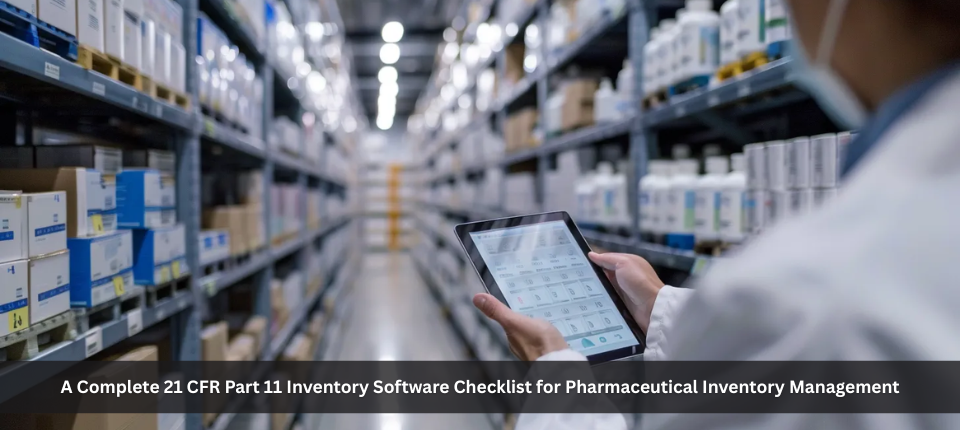
A Complete 21 CFR Part 11 Inventory Software Checklist for Pharmaceutical Inventory Management
Managing pharmaceutical inventory is about far more than tracking stock levels. Pharma companies subject to FDA regulation must adhere to stringent electronic records and signature requirements of 21 CFR Part 11 for every transaction, status update, and quantity change. Not only does non-compliance create operational headaches, it has the potential to open your organization up to warning letters and expensive remediation.
Whether you're evaluating 21 CFR Part 11 inventory software for the first time or auditing your existing system, this checklist gives you a clear framework for what compliant pharmaceutical inventory management actually looks like in practice.
21 CFR Part 11 Inventory Software Checklist for Pharmaceutical
1. Electronic Records Integrity
This checklist shows you what compliant pharmaceutical inventory management really looks like in practice, whether that’s your first time evaluating 21 CFR Part 11 inventory software, or auditing your existing system.
- Validation of electronic records to ensure accuracy, reliability and tamper-evidence is the foundation of 21 CFR Part 11 compliance. Your inventory system must generate and store records in a secure, computer-readable format that cannot be altered without detection.
- Maintain complete audit trails that capture who made a change, what was changed, when it occurred, and the reason for the change.
- Ensure records are retrievable throughout their required retention period.
- Protect records from unauthorized access, modification, or deletion.
2. Electronic Signatures
One of the most operationally significant requirements of Part 11 is electronic signatures. In inventory management, this applies to material releases, lot status changes, and quantity adjustments. Verify that your software that supports 21 CFR Part 11 compliance includes:
- Unique, individual user credentials linked to each electronic signature — shared logins are a direct violation.
- A two-component signature mechanism (e.g., username + password) for each signing event.
- Clear signature manifestations that display the signer's name, date, time, and the meaning of the signature.
- Controls that prevent signature falsification or repudiation.
3. Access Controls and User Management
Restricting system access to authorized personnel is a core Part 11 requirement — and a practical safeguard against inventory errors. Your 21 CFR Part 11 inventory software should:
- Enforce role-based access controls that limit each user to only the functions their job requires.
- Log all login attempts, including failed ones.
- Automatically time-out inactive sessions.
- Require periodic password changes and enforce complexity rules.
- Provide a clear mechanism to immediately revoke access when personnel leave or change roles.
4. Audit Trail Completeness
FDA investigators pay close attention to audit trails during inspections. An incomplete or inconsistent trail is often cited as a standalone 483 observation. Confirm your system:
- Automatically captures audit entries without relying on user action to initiate them.
- Records the original value and the new value for every modified field.
- Timestamps all entries using a secure, synchronized system clock.
- Stores audit trail data separately from transaction records so it cannot be overwritten.
- Presents audit data in a human-readable format reviewable during inspections.
5. Validation Documentation
Software that supports 21 CFR Part 11 compliance must itself be validated — meaning your vendor must provide the documentation to prove the system works as intended. Look for:
- A Functional Requirements Specification (FRS) covering all inventory functions in scope.
- Operational Qualification (OQ) scripts with a Trace Matrix linking each function to its validation test.
- Installation Qualification (IQ) documentation confirming the system environment meets requirements.
- Documented Validation Results signed off by qualified personnel.
- A vendor-supported re-validation process for system updates
6. Lot Traceability and Material Status Control
Pharmaceutical inventory management has compliance requirements that go beyond generic Part 11 rules. Your system also needs to support:
- Complete lot genealogy — tracking raw materials through intermediates to finished product.
- Electronic material status changes (quarantine, approved, rejected) with mandatory e-signature.
- Shelf life and stability tracking with system-enforced expiry controls.
- Certificate of Analysis (COA) attachment and retrieval at the lot level.
Conclusion
Meeting this checklist requires more than configuring a generic ERP system. It demands purpose-built 21 CFR Part 11 inventory software designed from the ground up for pharmaceutical operations with validation documentation, compliant audit trails, and electronic signatures built into the core product, not bolted on as afterthoughts.


0 Comments