
Can Your Roof Become Your Own Power Plant?
A newly constructed business park is preparing to welcome its first tenants, but one concern dominates the facility manager's planning—rising electricity costs. Rather than relying entirely on conventional grid power, the developer installs rooftop solar arrays across office buildings to reduce operating expenses and improve energy resilience. Similar decisions are being made by homeowners, hospitals, schools, and factories across India. Understanding how a solar system for home works helps property owners make informed decisions about clean energy, long-term savings, and sustainable infrastructure.
Why Understanding a Solar System for Home Matters
A solar system for home converts sunlight into electricity that can power lighting, appliances, air conditioning, and other electrical loads. While the technology may appear complex, its operating principle is straightforward: solar panels capture sunlight, generate electricity, and distribute it safely through an inverter and the building's electrical network.
As electricity demand continues to increase, a well-designed solar system offers a practical way to improve energy independence while reducing dependence on conventional power sources. Whether installed on a residence or a commercial facility, the engineering principles remain largely the same.
How a Solar Panel System Generates Electricity
Every solar panel contains photovoltaic (PV) cells made from semiconductor materials, typically silicon. When sunlight strikes these cells, photons excite electrons, producing direct current (DC) electricity through the photovoltaic effect.
The generated DC power cannot be used directly by most household equipment. Instead, a solar inverter converts it into alternating current (AC), which is compatible with electrical appliances and distribution boards.
How a Solar System for Home Delivers Usable Power
Once AC electricity is produced, it follows a simple operating sequence:
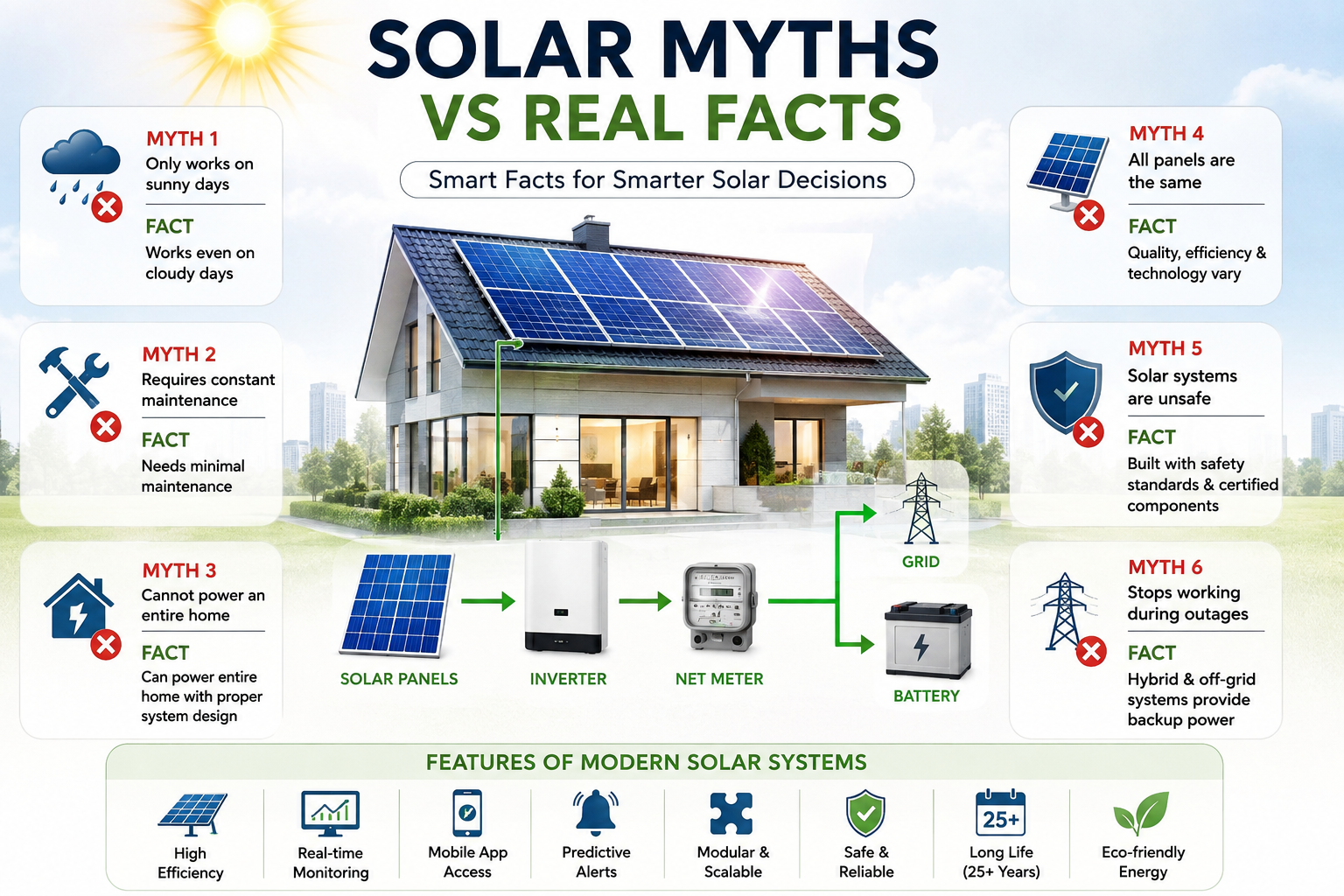
- Solar panels generate DC electricity.
- The inverter converts DC into AC power.
- The building consumes the generated electricity.
- Any excess power may be exported to the utility grid through net metering.
- During low sunlight conditions, electricity is supplied by the grid or battery storage, depending on the system configuration.
Modern installations also provide real-time monitoring through cloud platforms and mobile applications, allowing users to track daily generation, energy consumption, and overall system health.
Types of Solar Panels
Not every project requires the same panel technology. The best solar panels depend on available installation space, environmental conditions, and expected energy production.
- Monocrystalline panels provide the highest efficiency and excellent long-term performance.
- Polycrystalline panels offer a balance between affordability and energy output.
- Thin-film panels are lightweight and suitable for selected commercial applications where flexibility is important.
Choosing the right panel technology should always be supported by engineering calculations rather than efficiency ratings alone.
Understanding Solar System Configurations
The way a solar installation operates depends on its overall configuration.
- On-grid systems remain connected to the utility network and use net metering to export surplus electricity.
- Off-grid systems operate independently with battery storage for areas where utility power is unavailable.
- Hybrid systems combine battery backup with grid connectivity, improving reliability during outages.
Proper inverter sizing, battery capacity, and electrical load analysis ensure each configuration performs efficiently throughout its service life.
Engineering Features That Improve Performance
Modern solar technology extends well beyond electricity generation. Today's systems incorporate intelligent engineering features that improve operational efficiency and simplify maintenance.
Key features include:
- High-efficiency photovoltaic modules
- Scalable system architecture
- Smart inverter technology
- Energy generation monitoring
- Mobile app compatibility
- Remote diagnostics and alerts
- Predictive maintenance capabilities
- Modular inverter and panel expansion
- Grid synchronization functionality
- Weather-resistant construction
- Low maintenance requirements
- Operational life exceeding 25 years
- Comprehensive grounding and electrical protection
These features contribute to reliable long-term performance across residential, commercial, and industrial installations.
Where Solar Systems Are Commonly Installed
Solar technology is no longer limited to individual homes. A rooftop solar system can support a wide variety of facilities with different electrical demands.
Typical applications include:
- Residential houses
- High-rise housing societies
- Commercial office buildings
- Hospitals and healthcare centres
- Manufacturing plants
- Hotels and resorts
- Shopping malls
- Educational campuses
- Government infrastructure
- Agricultural irrigation systems
- Warehouses and logistics parks
- Smart city development projects
Each installation requires customized engineering to match energy consumption patterns and available installation space.
What Affects Solar Panel System Cost?
Many buyers compare only the Solar panel system cost, but actual project value depends on multiple engineering factors.
Important considerations include:
- Roof orientation and usable installation area
- Daily electricity consumption
- Panel technology selection
- Inverter capacity
- Battery storage requirements
- Structural design considerations
- Installation complexity
- Net metering approvals
- Monitoring software integration
- Annual maintenance planning
- Lifecycle operating costs
- Expected payback period
Similarly, solar system for home price varies depending on system capacity, component quality, project location, and site-specific engineering rather than a fixed market rate.
Choosing the Right Solar Installation Partner
Successful projects begin with experienced engineering and quality installation practices.
Before selecting an installation company, buyers should evaluate:
- Industry experience
- Engineering and EPC capability
- Project portfolio
- MNRE and BIS compliance
- Product testing procedures
- Warranty coverage
- Installation standards
- Documentation support
- Net metering assistance
- Solar panel maintenance services
- AMC availability
- Long-term technical support
Organizations developing integrated renewable energy solutions, including a Sigma Power Tech solar panel system, generally focus on engineering design, safety compliance, and operational performance throughout the project's lifecycle.
Common Mistakes to Avoid
Several avoidable mistakes can reduce the efficiency and lifespan of a solar installation.
These include:
- Skipping professional site and load assessment
- Ignoring future expansion requirements
- Installing panels in shaded areas
- Selecting equipment based only on upfront price
- Choosing incompatible panels and inverters
- Delaying preventive maintenance
- Ignoring grounding and surge protection
- Overlooking regulatory approvals
- Failing to establish realistic energy-saving goals
- Poor installation and commissioning practices
Educational demonstrations such as a solar system model or a classroom solar system project provide a useful introduction to photovoltaic principles, but real-world installations demand detailed engineering, electrical safety, and compliance with national standards.
Conclusion
Understanding how a solar system for home works makes it easier to evaluate system performance, energy savings, and long-term investment value. A properly engineered installation combines efficient solar panels, correctly sized inverters, intelligent monitoring, and regulatory compliance to deliver dependable electricity for decades. By focusing on quality engineering, lifecycle performance, and professional installation practices rather than initial cost alone, homeowners, businesses, and institutions can build a resilient, cost-effective, and sustainable clean energy infrastructure for the future.







0 Comments