
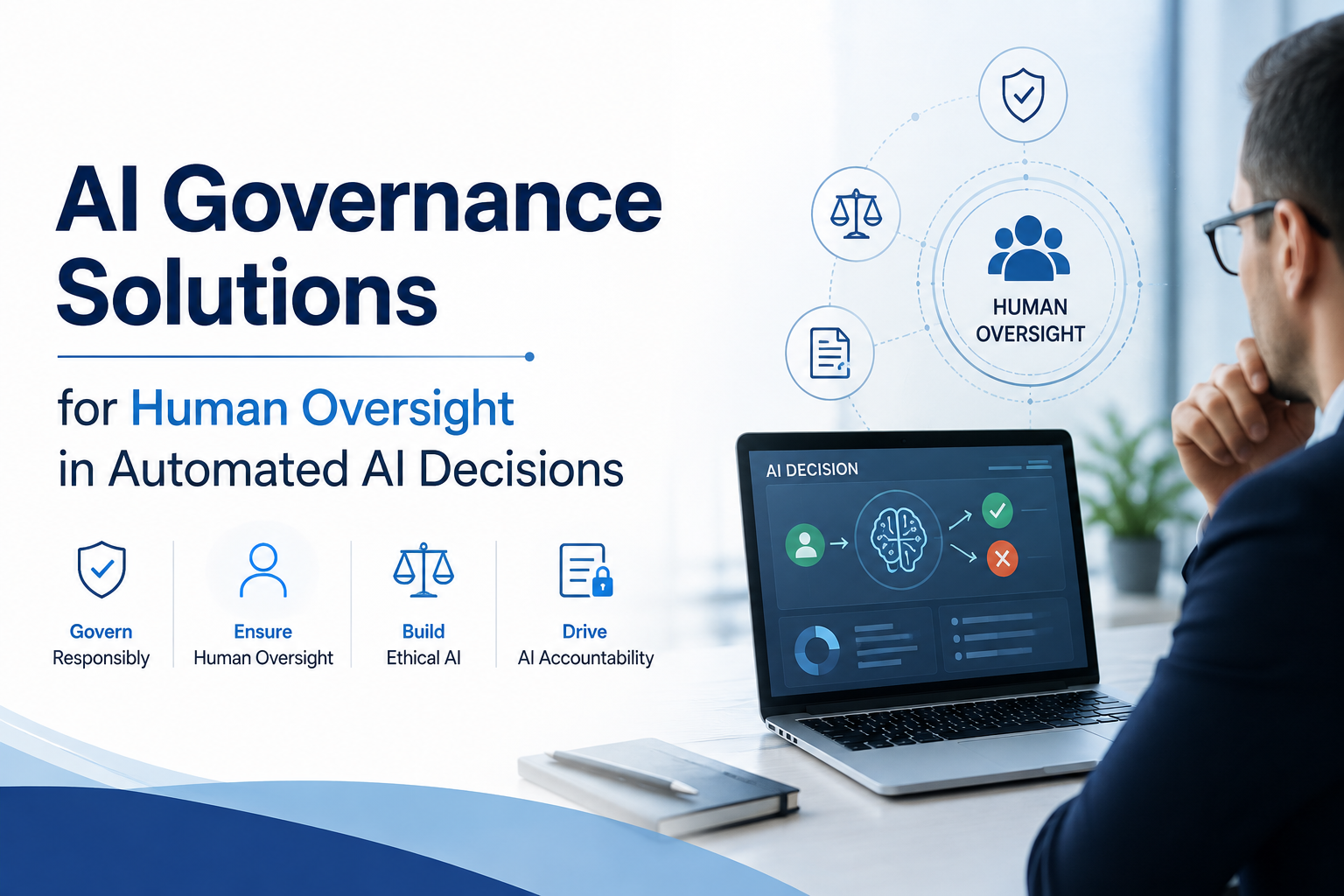
AI Governance Solutions for Human Oversight in Automated AI Decisions
A fraud detection model flags a legitimate transaction as suspicious and freezes a customer's account. A resume-screening tool filters out a qualified candidate because their career gap didn't match the training pattern. Neither of these is a hypothetical; they're the kind of incident that happens quietly, every week, inside companies that automated a decision without building in a real way to catch it when the model gets it wrong.
This is the part of AI governance that gets talked about least and matters most: human oversight. Not oversight as a checkbox in a compliance deck, but as an actual operational layer that catches bad decisions before they reach a customer, a regulator, or a headline.
Why "Human in the Loop" Usually Means Nothing
Most companies already claim to have human oversight. Ask what that means in practice, and the answer is often a single person spot-checking a sample of outputs once a month, or a support rep with the authority to override a decision if a customer complains loudly enough. That's not oversight; it's damage control after the fact.
Real oversight has to be designed the same way the AI system itself was designed: deliberately, with clear boundaries around what the model can decide alone and what it can't.
This is where AI governance solutions earn their place. They're not about restricting AI; they're about defining, system by system, where automation ends and a human decision begins.
The Three Tiers of Automated Decisions
Not every AI decision needs the same level of oversight. Treating all of them equally either slows the business down or leaves genuinely risky decisions unchecked. A useful way to split them:
Fully automated, low stakes
Product recommendations, content sorting, low-value fraud scoring. Wrong outputs here are inconvenient, not damaging. Oversight can be periodic auditing rather than real-time review.
Automated with a human checkpoint
Loan pre-approvals, resume screening, insurance claim triage. The model can recommend or pre-decide, but a person reviews before the decision becomes final, especially for outcomes near a decision boundary, where the model's confidence is lowest.
Human-decided, AI-assisted
Medical diagnoses, legal risk assessments, termination decisions. The AI provides analysis; a qualified person makes the actual call and is accountable for it. The model never has final authority here, no matter how confident its output looks.
Mapping every automated decision in the company to one of these tiers is usually the first real deliverable in any serious AI governance and consulting engagement because most companies haven't done this mapping at all. They've automated decisions based on what the technology could do, not what oversight tier the decision actually required.
What a Working Oversight System Actually Includes
Once decisions are tiered, oversight needs infrastructure to function not just intention.
Escalation triggers, not just spot checks
The system should flag decisions for human review automatically when the model's confidence score drops, when the case falls outside its training distribution, or when the outcome crosses a defined risk threshold. Waiting for a human to randomly notice a problem doesn't control its luck.
Override authority that's actually usable
A reviewer needs the power, the time, and the incentive to overturn a model's decision. If overriding a system takes longer than accepting its output, or if reviewers get penalized for slowing down throughput, the checkpoint exists on paper only.
A feedback loop back into the model
Every override should feed back into retraining or recalibration. Otherwise, the same category of mistake keeps surfacing, and the human reviewer becomes a permanent patch instead of a temporary check.
Logged reasoning, not just logged outcomes
When a human overrides an AI decision, the reason needs to be recorded, not just that it happened. That record is what turns oversight from a one-off save into a pattern the business can actually learn from.
Where Oversight Systems Usually Break Down
A few recurring failure points show up across companies that built oversight without outside input:
- Review fatigue. Too many decisions get routed to human review, reviewers start rubber-stamping to keep pace, and the checkpoint stops functioning.
- No defined accountability if the human misses something. If the reviewer's sign-off doesn't carry real accountability, the checkpoint becomes symbolic.
- Oversight bolted on after deployment. Trying to insert human review into a system that was architected for full automation is far harder and far more expensive than designing it from the start.
- Treating oversight as a legal requirement instead of a decision-quality tool. Companies that view it purely as compliance tend to build the thinnest version that technically qualifies, which defeats the purpose.
Avoiding these usually takes more than internal policy writing. It's why companies increasingly bring in an AI consulting company early, while systems are still being architected, rather than after an incident forces the conversation.
How EitBiz Builds Oversight Into AI Systems
At EitBiz, oversight isn't treated as a governance add-on; it's part of how the system gets built in the first place. Our AI governance services work starts by tiering the specific decisions a client's AI systems make, then designing escalation logic and override mechanisms around the actual risk level of each one.
Because EitBiz also delivers artificial intelligence consulting and hands-on development together, the oversight layer isn't a recommendation handed off for someone else to build; it gets engineered directly into the model pipeline, the escalation triggers, and the review interfaces the human team actually uses. That's a meaningfully different outcome than a governance framework that sits in a document while engineering builds something else entirely.
For companies further along, this also plugs into broader artificial intelligence solutions; work oversight isn't retrofitted onto a finished system, it's built in alongside the models as they're developed.
The Real Test of Oversight
The real test of a human oversight system isn't whether it exists on paper. It's whether, the next time a model makes a decision that shouldn't have gone through unchecked, someone actually catches it, and the system learns from that catch instead of just moving past it.
That's the difference between AI governance that protects a business and AI governance that just protects a compliance audit.



0 Comments