
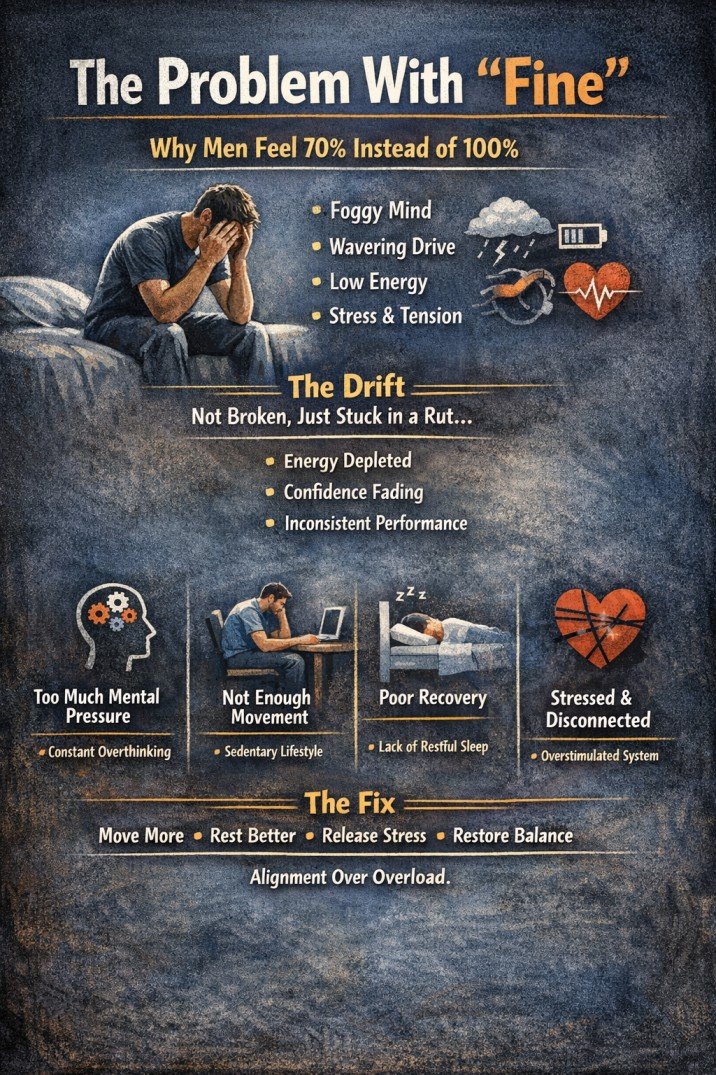
Why Modern Men Feel “Off” Without Being Broken
Here’s the strange part of modern male decline:
Nothing is obviously broken.
Career is moving.
Life is functional.
Health looks “okay” on paper.
Yet something feels off.
Energy isn’t what it used to be.
Drive comes in waves.
Confidence fluctuates.
Motivation requires effort instead of instinct.
This isn’t collapse.
It’s drift.
And drift is harder to notice—until it’s everywhere.
The Problem With “Fine”
Most men don’t feel terrible.
They feel:
- 70% instead of 100%
- Sharp sometimes, foggy others
- Confident until pressure hits
- Motivated, but inconsistent
Because nothing is urgent, nothing gets addressed.
But vitality doesn’t disappear overnight.
It erodes quietly.
Modern Life Rewards Survival, Not Vitality
Today’s world rewards:
- Sitting still
- Constant attention switching
- Mental pressure without physical release
- Delayed gratification without recovery
- Productivity over presence
The male body wasn’t designed for this.
It was designed for:
Stress → release
Effort → recovery
Focus → rest
Movement → calm
When release disappears, tension becomes the default state.
Why Energy Is the First Casualty
Energy is not just calories.
It’s:
- Nervous system balance
- Blood flow
- Sleep quality
- Stress load
- Motivation chemistry
Men lose energy not because they’re lazy—but because their systems are overstimulated and under‑recovered.
- Coffee replaces sleep.
- Screens replace rest.
- Scrolling replaces stillness.
- The system never resets.
Confidence Doesn’t Vanish—It Becomes Conditional
Modern confidence is fragile.
It exists:
- When things go smoothly
- When pressure is low
- When expectations are manageable
But under stress, it cracks.
Why?
Because confidence is not a thought.
It’s a state of regulation.
A calm, grounded body produces confident behavior automatically.
A tense body produces doubt—even with the same personality.
Why Men Start Overthinking Their Bodies
When performance becomes inconsistent, men don’t panic outwardly.
They internalize.
They start checking:
- Energy levels
- Focus
- Desire
- Physical response
- Mental sharpness
Monitoring replaces trust.
Once trust is gone, pressure increases.
Pressure tightens the system.
Tight systems don’t perform well.
The Role of Blood Flow (Again—and Always)
Vitality lives in circulation.
Poor circulation doesn’t always feel dramatic.
It feels like:
- Slower warm‑up
- Less responsiveness
- Reduced endurance
- Inconsistent performance
Sedentary habits, stress, and posture quietly choke flow.
Restore flow—and multiple problems soften at once.
Stress Is the Tax Men Underestimate
Stress isn’t just emotional.
It’s physiological.
Chronic stress:
Keeps the nervous system alert
Restricts blood vessels
Reduces recovery
Disrupts sleep depth
Blunts motivation
Men often adapt so well to stress that they stop noticing how heavy it is.
Adaptation ≠ optimization.
Why Motivation Feels Forced Now
Motivation thrives on contrast.
Effort feels good when:
Rewards are earned
Stimulation is limited
Recovery is real
Modern life removes contrast.
Everything is available instantly.
Nothing feels deeply rewarding.
Effort feels optional—and exhausting.
Men don’t lose discipline.
They lose neurochemical contrast.
Movement Is the Reset Button
Movement isn’t about looks.
It’s about:
Nervous system discharge
Blood flow restoration
Dopamine regulation
Stress reduction
Confidence grounding
Men who move daily—even lightly—report feeling more “themselves.”
That’s not coincidence.
That’s regulation.
Supplements: Support, Not Salvation
Supplements work best when:
Sleep is improving
Stress is being addressed
Movement is consistent
Expectations are realistic
They don’t override chaos.
They support order.
Used correctly, they help stabilize—not spike—vitality.
The Goal Isn’t Peak—It’s Baseline
Most men don’t want to feel unstoppable.
They want to feel:
Normal again
Reliable
Present
Confident without effort
Energized without stimulants
That’s not fantasy.
That’s what happens when systems are supported instead of pushed.
Final Word
Men aren’t broken.
They’re overloaded, overstimulated, and under‑recovered.
Vitality doesn’t return through pressure.
It returns through alignment.
Less noise.
More movement.
Better sleep.
Lower stress.
Smarter support.



0 Comments