
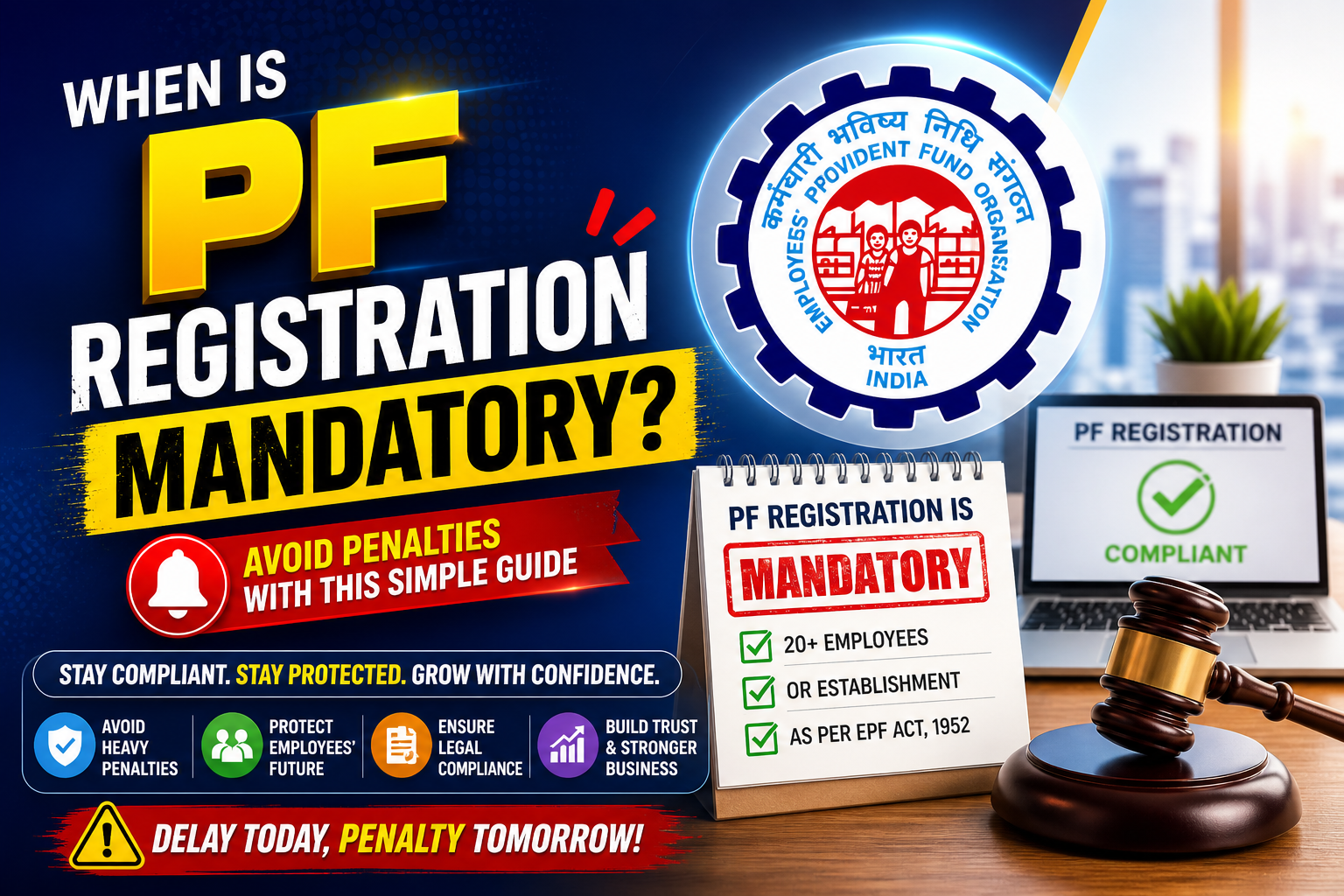
When Is PF Registration Mandatory? Avoid Penalties with This Simple Guide
Last Updated: May 2026 | Reading Time: ~8 minutes
If you run a business in India — whether a startup, an SME, or an established company, the question of PF registration is not one you can afford to ignore. Miss the deadline, misunderstand the threshold, or skip the process entirely, and you're looking at financial penalties, legal notices, and reputational damage.
This guide answers the most common questions business owners ask about PF registration, cuts through the confusion, and walks you through exactly what you need to do, and when.
What Is PF Registration, and Why Does It Matter?
The Employees' Provident Fund (EPF) is a government-mandated retirement savings scheme governed by the Employees' Provident Funds and Miscellaneous Provisions Act, 1952, administered by the Employees' Provident Fund Organisation (EPFO).
Under this scheme, both the employer and the employee contribute a percentage of the employee's basic salary toward a long-term savings corpus. For the employee, it's a secure retirement fund. For you as an employer, it's a legal obligation, and failure to comply triggers serious consequences.
PF registration is the process by which your business is officially enrolled with the EPFO, receives a unique PF Establishment Code, and begins fulfilling its statutory obligations.
When Is PF Registration Mandatory?
This is where many employers get confused. Here's the clear rule:
PF registration is mandatory for any establishment that employs 20 or more employees.
Once your headcount reaches 20, you are required to register within 30 days from the date of crossing that threshold. There's no grace period beyond this window.
What Counts as an "Employee"?
This is a common area of misunderstanding. For the purpose of the 20-employee threshold, the following are typically counted:
- Full-time permanent employees
- Part-time workers on regular payroll
- Contract workers engaged through a contractor (in many cases)
- Probationary employees
Importantly, even if your workforce later drops below 20, once you are registered, compliance obligations continue. You cannot deregister simply because headcount falls.
Voluntary Registration Below 20 Employees
Even if you employ fewer than 20 people, voluntary PF registration is permitted and advisable. Many employees today specifically seek employers who offer EPF benefits. Registering voluntarily signals credibility, aids employee retention, and can be a competitive advantage when hiring talent.
Additionally, the Central Government has the power to extend EPF coverage to establishments with fewer than 20 employees through a notification — so voluntary registration keeps you ahead of any future regulatory expansion.
ESI and PF Registration
Many business owners confuse ESI and PF registration — or assume they're the same process. They are not.
ESI PF Registration is a common phrase used in business contexts, but it actually refers to two separate registrations under two separate laws:
- EPF (Employees' Provident Fund) — Governed by the EPF & MP Act, 1952. Threshold: 20 employees.
- ESI (Employees' State Insurance) — Governed by the ESI Act, 1948, administered by the ESIC. Threshold: 10 employees (in most states).
Under ESI, both employer and employee contribute to a health insurance and social security fund that covers medical, maternity, and disability benefits.
Key Difference at a Glance
Parameter | PF Registration | ESI Registration |
Governing Body | EPFO | ESIC |
Employee Threshold | 20 employees | 10 employees |
Employer Contribution | 12% of basic wages | 3.25% of gross wages |
Employee Contribution | 12% of basic wages | 0.75% of gross wages |
Salary Ceiling for ESI | N/A | ₹21,000/month |
If your establishment crosses the ESI threshold before the PF threshold, you PF Registration Process must register for ESI first. Many growing businesses end up needing both registrations, which is why the phrase "ESI PF registration" is so commonly used together.
The PF Registration Process
Completing your PF registration online is now fully digital through the EPFO Unified Portal. Physical visits to regional EPFO offices are no longer necessary for most cases.
Step 1: Gather Required Documents
Before you begin, keep these documents ready:
- PAN card of the establishment/company
- Certificate of incorporation or partnership deed or trust deed
- Address proof of the establishment (utility bill, lease deed, etc.)
- Bank account details and cancelled cheque
- Digital Signature Certificate (DSC) of the authorized signatory
- Details of directors/partners/owners (PAN, Aadhaar)
- Employee details (strength, salary structure)
- Contact information (mobile number and email linked to Aadhaar/PAN)
Step 2: Register on the EPFO Unified Portal
- Visit the official EPFO portal: unifiedportal-emp.epfindia.gov.in
- Under the "Establishment Registration" section, click on "Registration for EPFO"
- You will first need to register using your establishment's details and create login credentials
Step 3: Fill the Registration Form
Once logged in, you will fill out the online registration form (Form 1) with:
- Establishment name, address, and nature of business
- Date of commencement of business and date of coverage (when you crossed 20 employees)
- Details of employees
- Bank account details
- Owner/director/partner details with DSC
Step 4: Submit and Obtain Establishment Code
After submission and document verification, the EPFO allots a PF Establishment Code. This is your unique identifier for all future PF-related filings and correspondence.
The entire PF registration process, if documents are in order, is typically completed within 3–7 working days online.
Ongoing Compliance After Registration
Registration is just the beginning. Here's what monthly compliance looks like:
- Monthly PF contributions must be deposited by the 15th of the following month
- ECR (Electronic Challan cum Return) must be filed monthly
- Annual PF returns must be submitted
- Any change in employee details, salary, or establishment status must be updated with the EPFO
Failing to deposit contributions on time attracts interest at 12% per annum under Section 7Q and damages up to 25% of arrears under Section 14B of the EPF Act.
What Happens If You Don't Register on Time?
Non-compliance is not a grey area. Consequences include:
Financial penalties: Interest and damages on unpaid contributions can accumulate rapidly. For delays beyond 4 months, damages can reach 25% of the amount due.
Criminal liability: Under Section 14 of the EPF Act, willful non-compliance can lead to imprisonment of up to 1 year and/or a fine.
Employee grievances and litigation: Employees can file complaints with the EPFO, triggering inspections and recovery proceedings.
Blocked contracts and tenders: Many government tenders and corporate contracts require proof of EPF compliance. Non-registered businesses are ineligible.
The takeaway: the cost of compliance is always lower than the cost of non-compliance.
Common Mistakes to Avoid During PF Registration
1. Delaying registration after crossing 20 employees The 30-day window is strict. Start the process proactively — don't wait until month-end payroll.
2. Incorrect date of coverage The "date of coverage" (when you first employed 20+ people) must be accurate. Misreporting this date can attract backdated dues.
3. Not including contract workers in the count If you engage workers through contractors, many of them may still count toward your threshold. Consult a compliance professional if you use contract labour.
4. Incomplete DSC or outdated credentials The online registration process requires a valid DSC. Ensure the authorized signatory's DSC is active and Class 2 or Class 3 certified.
5. Ignoring ESI registration simultaneously If you're at the PF threshold of 20 employees, you've almost certainly crossed ESI's threshold of 10 already. Handle both registrations together.
Should You Use a Professional Service for PF Registration Online?
For most small and medium businesses, the online PF registration process is manageable. However, professional assistance is genuinely worth considering if:
- You are unsure of the correct date of coverage
- You have a mix of contract and permanent employees
- Your establishment operates in multiple states
- You are simultaneously handling ESI PF registration
- You want to ensure monthly compliance is handled without internal HR overhead
Chartered accountants, company secretaries, and dedicated compliance platforms can manage the end-to-end process, reducing the risk of errors that trigger notices.
Frequently Asked Questions
Q: Can I do PF registration online without a DSC? For certain proprietorship firms, Aadhaar-based OTP verification may be permitted as an alternative. For companies and LLPs, DSC is mandatory.
Q: Is PF registration applicable to NGOs and trusts? Yes. NGOs, trusts, and societies with 20 or more employees are covered under the EPF Act.
Q: What is the employer's contribution toward PF? The employer contributes 12% of the employee's basic wages. Of this, 8.33% goes to the Employees' Pension Scheme (EPS) and 3.67% goes to the EPF account.
Q: Can an employee opt out of EPF? Employees drawing a monthly basic salary of more than ₹15,000 at the time of joining (and not previously a member of EPFO) can choose not to contribute. However, existing members cannot opt out.
Final Thoughts
PF registration is not optional — it's a foundational legal obligation for any employer crossing the 20-employee mark. The PF registration process is now entirely online, faster than ever, and well within reach of any business owner who prepares documents in advance.
More importantly, PF compliance is an investment in your people. Employees who see their employer contributing faithfully to their EPF account are more engaged, more loyal, and more financially secure — which ultimately benefits your business.


0 Comments