
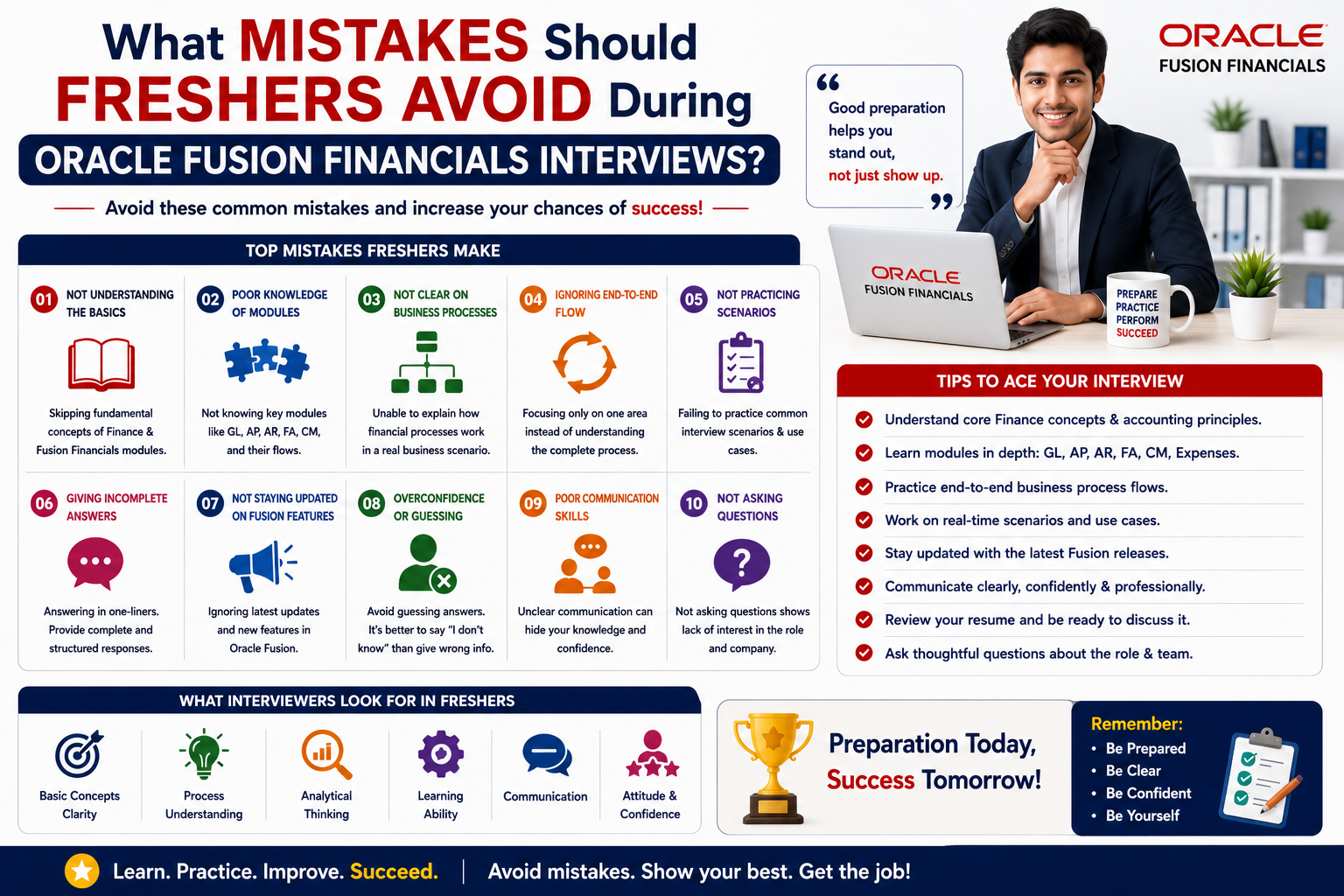
What Mistakes Should Freshers Avoid During Oracle Fusion Financials Interviews?
Introduction
Talk to enough recruiters who interview Oracle Fusion Financials candidates, and you'll notice something interesting, the freshers who don't get the offer usually aren't the ones who knew less. They're the ones who tripped over avoidable habits that quietly undercut everything they actually understood. Tech Leads IT has watched this play out enough times to know these mistakes are genuinely fixable, once you know what to look out for.
If you're working through Oracle Fusion Financials Training and gearing up for your first round of interviews, spotting these patterns ahead of time can save you from repeating them.
Reciting Definitions Instead of Actually Understanding Them
Plenty of freshers walk in having memorized the exact wording for what a Ledger is or how Accounts Payable functions. It falls apart the second an interviewer rephrases the question or asks a follow-up. Genuine understanding, not memorized phrasing, is what lets you handle a slightly different angle on the same question without freezing.
Learning the Software While Skipping Accounting Basics
It's tempting to dive straight into Oracle screens and skip the accounting logic underneath, but interviewers almost always open with basic accounting questions before touching anything Oracle-specific. Freshers who stumble on debits, credits, or a trial balance lose momentum before they even get to show off what they actually know about the platform.
Studying Modules as Isolated Topics Instead of a Connected System
Learning General Ledger, Accounts Payable, and Accounts Receivable as separate subjects, without understanding how they actually connect, is a genuinely common gap. Interviewers love process-based questions, walk me through Procure-to-Pay end to end, and freshers who've only studied modules in isolation struggle badly here.
Having Zero Hands-On Practice to Draw From
Reading about invoice processing and actually configuring one feel completely different. Candidates who've only studied theory tend to give vague, textbook-flavored answers to scenario questions, while those who've genuinely worked through a comprehensive Oracle Fusion Financials Course describe real steps with real confidence, because they've actually done it before.
Stretching the Truth About Your Skill Level
It's tempting to inflate familiarity with something you've barely touched, but experienced interviewers ask follow-ups designed specifically to test depth. The moment the questioning goes past surface level, an exaggerated claim collapses, and it tends to color the rest of the interview, even in areas where you genuinely do know your stuff.
Rambling Instead of Just Answering the Question
Nervous freshers sometimes respond to a simple question with a long, meandering explanation that never quite lands anywhere. Interviewers value clarity far more than length, a tight, well-structured answer beats an anxious, rambling one every time.
Showing Up Without Any Concrete Examples Ready
Saying you understand Accounts Payable configuration means a lot less than walking through an actual example you worked through during training, even if it was just a practice exercise. Freshers with a few concrete examples ready consistently outshine those speaking only in abstractions.
Ignoring Communication and Soft Skills Prep Entirely
Some freshers pour everything into technical prep and completely forget how they're actually coming across, tone, clarity, confidence, professionalism. Since functional consultants spend so much time talking to business users and clients, interviewers are quietly weighing communication just as heavily as technical accuracy, sometimes more.
Skipping Mock Interviews Before the Real Thing
Making the real interview your first attempt at saying this material out loud is a genuine handicap. Freshers who skip mock interviews often realize, mid-answer, that they know the content but struggle to articulate it clearly under real pressure. Practicing out loud beforehand closes this gap considerably.
Walking In Without Researching the Company
Skipping basic research on the hiring company, its industry, or the specific role signals disengagement, even with solid technical knowledge. A bit of homework lets you tailor your answers and ask sharper questions, both of which leave a genuinely stronger impression.
Treating "Any Questions for Us?" as a Formality
Plenty of freshers skip this moment entirely or offer a throwaway question. It's actually a real opportunity to show genuine curiosity about the role, the team, or the kind of projects you'd actually be working on, exactly the kind of engagement interviewers remember afterward.
Panicking Instead of Reasoning Through an Unknown Answer
Freshers sometimes freeze or guess wildly when they hit something they genuinely don't know. Interviewers respond far better to an honest "I'm not sure, but here's how I'd figure it out" than a confidently wrong guess, since it shows real problem-solving instinct instead of bluffing.
How to Genuinely Avoid Falling Into These Traps
Nearly all of these mistakes trace back to the same root cause, not enough hands-on practice and not enough rehearsal actually speaking about what you know. Structured Oracle Fusion Financials Training that includes real configuration work, business scenarios, and mock interview practice addresses most of these gaps at once, rather than leaving you to discover them the hard way in a real interview.
Why Structured Preparation Genuinely Pays Off Here
Freshers who go through a comprehensive Oracle Fusion Financials Course combining technical depth with real interview coaching tend to sidestep these mistakes almost naturally, since the practice itself builds the confidence and clarity that prevents most of these missteps from happening in the first place.
Conclusion
Most freshers who struggle in Oracle Fusion Financials interviews aren't short on knowledge, they're tripping over avoidable habits around communication, preparation, and nerves. Spotting these pitfalls ahead of time genuinely improves your odds of making a strong impression. Enrolling in Oracle Fusion Financials Training builds the practical foundation to avoid these errors, and a comprehensive Oracle Fusion Financials Course combines hands-on practice with genuine interview prep, helping freshers walk into their next interview actually ready, not just hoping for the best.








0 Comments