
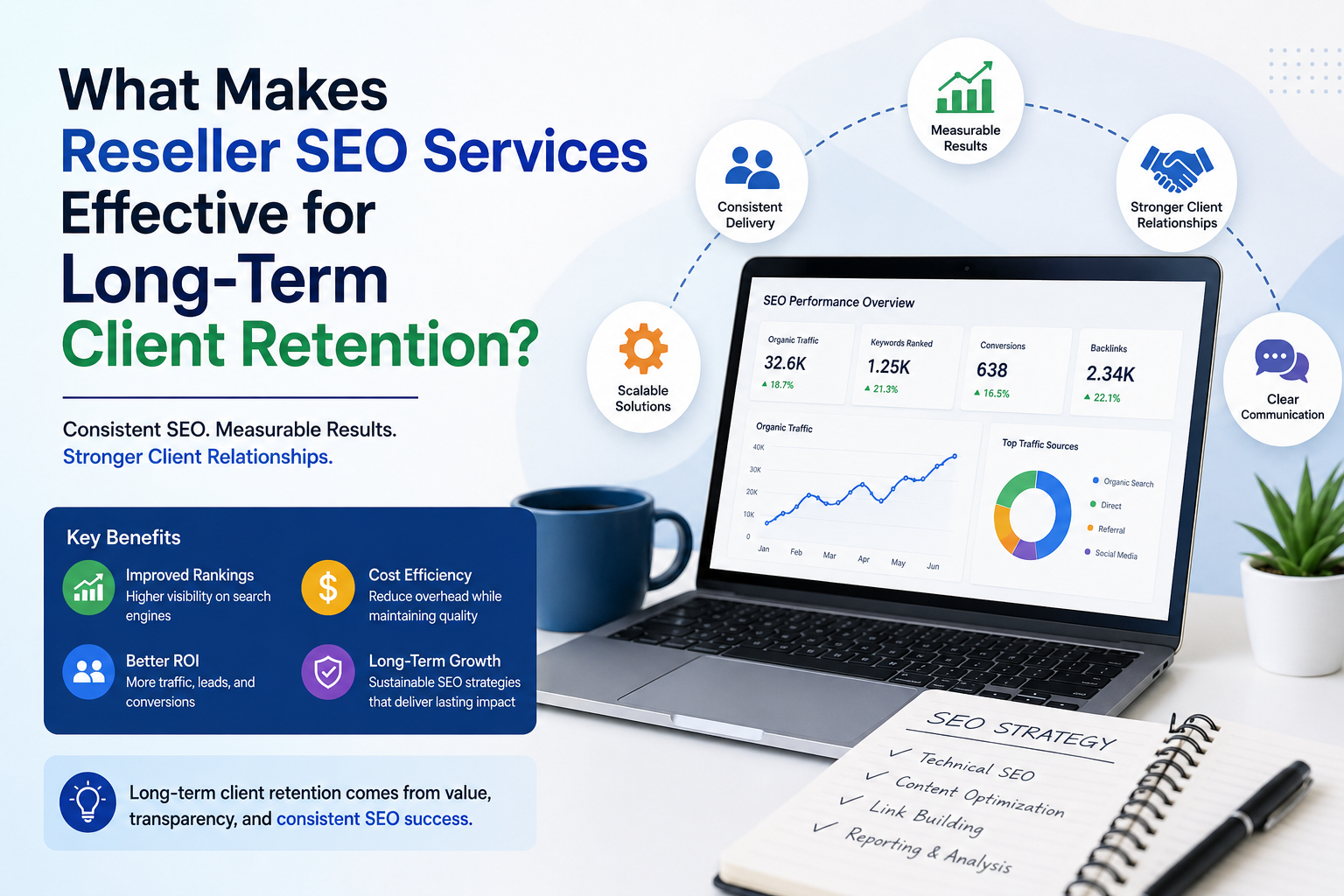
What Makes Reseller SEO Services Effective for Long-Term Client Retention?
Search engine optimization is rarely a one-time project. Rankings move, competitors change their content strategies, search algorithms evolve, and a website that performs well today may need a different approach six months from now. This is one reason agencies increasingly use reseller SEO models to support recurring optimization work while keeping their own client relationships at the center.
The real question is not simply whether outsourced SEO can improve rankings. It is whether the model can consistently deliver measurable, understandable, and sustainable work that gives clients a reason to continue. Long-term retention usually depends on that combination of performance, communication, transparency, and adaptability.
Why Client Retention Matters in SEO
SEO has a naturally recurring business cycle. A technical audit may identify problems quickly, but fixing those problems is only one stage of optimization. Content needs updating, internal links need refinement, competitors need monitoring, and search intent can shift over time.
For agencies using the best reseller SEO services, retention is therefore closely connected to operational consistency. Clients tend to stay when they can see that optimization is an ongoing process rather than a collection of isolated tasks.
There is another factor that is easy to overlook: expectations.
A client does not necessarily expect every keyword to reach position one. They do expect the agency to explain what happened, what is being changed, and why those changes matter. A clear monthly report can sometimes be more valuable than a long list of technical activities.
Consistent SEO Delivery Builds Trust
Consistency is one of the strongest foundations for retention.
Imagine a local service business that receives a technical audit in January, several optimized pages in February, and then little meaningful activity for two months. Even if the agency eventually produces good results, the client may begin questioning the value of the relationship.
A structured SEO workflow avoids that gap. Depending on the website and industry, recurring work can include:
- Technical health monitoring
- Keyword and search-intent analysis
- Content optimization
- Internal linking
- Competitor research
- Local SEO improvements
- Backlink profile monitoring
- Conversion and landing-page analysis
- Performance reporting
This does not mean every task should be repeated every month. Good SEO prioritizes what the website actually needs.
Transparency Makes Results Easier to Understand
SEO metrics can become confusing very quickly. Organic traffic, impressions, clicks, rankings, referring domains, conversions, and engagement metrics each tell a different part of the story.
A useful reporting system connects those numbers to business objectives.
For example, suppose an e-commerce website gains 35% more organic traffic but generates only 3% more revenue. Reporting only the traffic increase creates an incomplete picture. A deeper review might reveal that informational visitors increased while commercial landing pages remained unchanged.
That insight changes the next SEO decision.
For agencies evaluating an SEO reseller partnership model, this level of reporting is important because the agency remains responsible for explaining performance to its client. Data should help answer practical questions: What improved? What declined? Why did it happen? What should happen next?
How Adaptability Supports Long-Term SEO
Search behavior is not static. A page optimized around one phrase may need restructuring when users begin searching with more specific questions or when Google's search results increasingly satisfy the query through different content formats.
This is where a rigid SEO process can become a problem.
Long-term campaigns benefit from regular reassessment. A page that once targeted “commercial cleaning services” might later need supporting content around location-specific searches, pricing questions, service comparisons, or industry-specific cleaning requirements.
The goal is not to chase every algorithm update.
It is to understand whether changes in search results, competitors, user behavior, or website performance require a strategic adjustment.
The Role of Cost in Reseller SEO
Cost is another consideration, particularly for agencies serving several client segments.
A reseller model can change the economics of SEO because repetitive production activities may be handled through an external fulfillment structure. However, lower operational cost does not automatically create better client retention.
If inexpensive fulfillment results in generic content, weak communication, or inconsistent technical work, the apparent saving can become expensive when clients leave.
A more useful calculation considers the relationship between delivery cost, campaign quality, reporting time, revision requirements, and client lifetime value.
For example, an agency might compare:
Monthly client revenue − fulfillment cost − account management cost = contribution margin
That simple calculation can reveal whether an SEO package is sustainable without relying on unrealistic volume assumptions.
Industry Benefits of a Reseller SEO Model
Different industries create different SEO requirements. A local dentist, software company, online retailer, and legal practice do not compete in the same search environment.
A scalable SEO fulfillment model can help agencies accommodate those differences while maintaining a consistent workflow.
For local businesses, the focus may include Google Business Profile optimization, location pages, local citations, and geographically relevant content. E-commerce websites often require product-page optimization, category architecture, structured internal linking, and management of duplicate or thin content.
B2B companies may need deeper educational content because their buyers research solutions over a longer period.
Healthcare, finance, and other sensitive industries introduce another consideration: content quality and accuracy carry additional importance. Publishing large quantities of poorly researched material can create reputational problems rather than organic growth.
The broader lesson is simple: scalable SEO should standardize processes, not eliminate industry expertise.
Communication Can Be a Retention Strategy
Good communication does not mean sending more emails.
It means reducing uncertainty.
A useful monthly update might contain:
- What was completed — specific pages, technical fixes, or content changes.
- What changed — organic visibility, conversions, rankings, or other meaningful metrics.
- What was learned — patterns discovered through search and competitor analysis.
- What comes next — the highest-priority actions for the following period.
This format gives clients a narrative around their data. They can understand the relationship between the work performed and the outcomes being measured.
That matters because SEO often produces gradual gains rather than dramatic overnight changes.
Measuring the Signals That Actually Matter
Rankings still have value, but retention-focused SEO reporting should look beyond individual keyword positions.
Useful indicators can include:
- Organic conversions
- Non-branded organic traffic
- Qualified leads
- Revenue from organic search
- Search impressions and click-through rates
- Growth of valuable landing pages
- Technical error reduction
- Visibility across relevant topic clusters
For example, moving 20 low-value keywords from positions 50 to 20 may look impressive in a report, but improving three commercial keywords from positions 11 to 6 could have greater business significance.
The right metrics depend on the client's objectives.
Building a Sustainable Client Relationship
Long-term retention usually comes from accumulated trust rather than one impressive month. Clients need to see reliable execution, realistic expectations, useful reporting, and a willingness to adjust when evidence points in another direction.
For agencies, the strongest reseller model is therefore not simply the one with the largest task list. It is the one that supports consistent quality while leaving enough room for strategic thinking and client communication.
SEO works best when treated as an evolving business process. Search demand changes. Websites change. Competitors react. Client priorities shift.
When those changes are monitored and translated into practical decisions, ongoing optimization becomes easier to understand and justify. That is ultimately what makes best reseller SEO services valuable for long-term client retention: not a promise of permanent rankings, but a repeatable process that continues to create measurable, relevant work as the search environment evolves.










0 Comments