
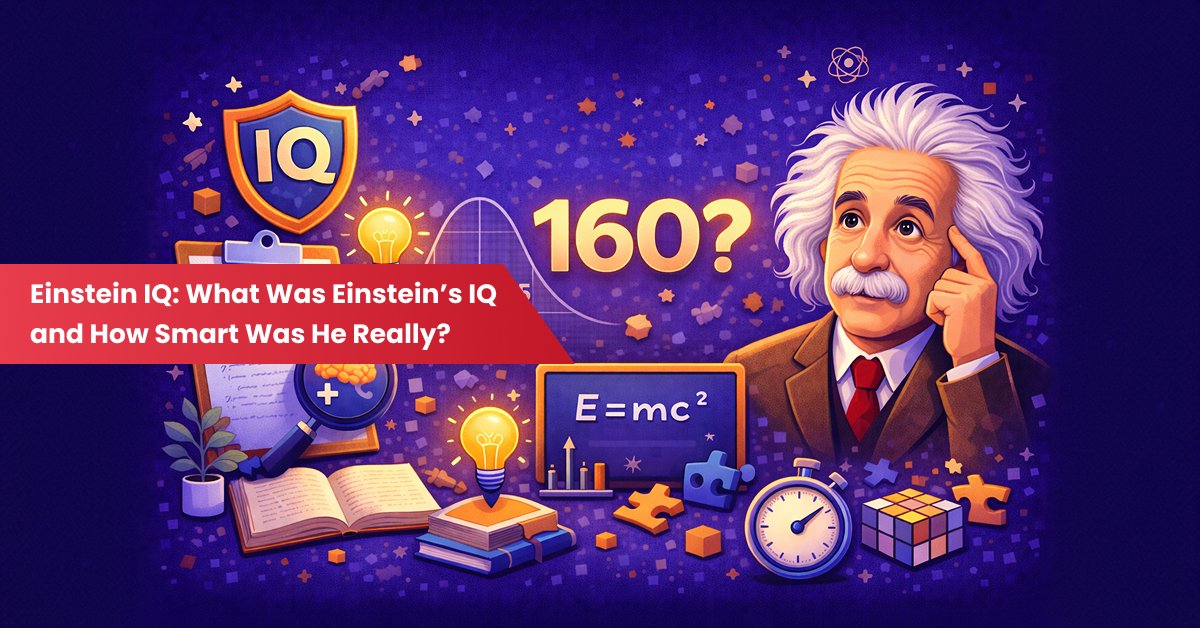
What Is Einstein's IQ Compared to Stephen Hawking and Other Great Minds?
Introduction
The question what is Einstein's IQ has fascinated people for generations. Albert Einstein is widely considered one of the greatest scientific thinkers in history, and his name has become almost synonymous with genius. His theories of relativity changed how humanity understands space, time, gravity, and the universe. Because of his extraordinary achievements, many people want to know how his intelligence compares with other famous minds such as Stephen Hawking, Isaac Newton, and modern intellectuals.
However, the answer is not as simple as a single number. Albert Einstein never took a modern standardized IQ test, which means there is no official record of his IQ score. Most figures associated with Einstein's intelligence are estimates based on his achievements, reasoning abilities, and scientific contributions.
In this article, we will explore what is Einstein's IQ, how researchers estimate it, and how his intelligence compares with other legendary thinkers.
Did Einstein Have an Official IQ Score?
Before comparing Einstein with other geniuses, it is important to understand one key fact: Einstein did not have a verified IQ score.
Modern intelligence testing developed during the twentieth century, but Einstein was never formally evaluated using the types of IQ tests commonly used today. As a result, any number connected to what is Einstein's IQ is an estimate rather than a confirmed measurement.
Many online sources claim that Einstein had an IQ of 160, while some suggest it was between 160 and 180. These estimates are based on his exceptional scientific reasoning, creativity, and ability to solve complex theoretical problems.
Although these estimates are widely repeated, they should not be considered official facts.
What Is Einstein's IQ Estimated to Be?
When people ask what is einstein's iq the most common answer is around 160.
An IQ score of 160 is considered extremely rare and falls within the range often associated with exceptional intellectual ability. Researchers and writers have suggested this estimate because Einstein demonstrated extraordinary skills in abstract reasoning, mathematics, and scientific imagination.
Some estimates place Einstein's IQ between 160 and 180. However, there is no scientific evidence proving an exact number.
The more important point is that Einstein's accomplishments cannot be explained only by intelligence testing. His creativity, curiosity, and persistence were major factors in his success.
Einstein Compared to Stephen Hawking
Stephen Hawking is another scientist frequently compared with Einstein.
Hawking was one of the most influential theoretical physicists of the modern era. His research on black holes, cosmology, and the nature of the universe changed scientific understanding.
Like Einstein, Hawking is often reported to have had an IQ of around 160. However, there is limited public evidence confirming an official IQ score for him.
The similarities between Einstein and Hawking go beyond estimated IQ numbers. Both scientists:
- Studied some of the most complex questions in physics.
- Used mathematics and theoretical reasoning to explore the universe.
- Challenged existing scientific ideas.
- Communicated difficult concepts to the public.
While IQ estimates may place them in a similar range, their scientific contributions remain the strongest measure of their brilliance.
Einstein Compared to Isaac Newton
Isaac Newton is another historical figure often compared with Einstein.
Newton developed the laws of motion and universal gravitation, discoveries that shaped classical physics for centuries. Like Einstein, Newton transformed humanity's understanding of the natural world.
Some modern writers estimate Newton's IQ to have been between 190 and 200. However, these numbers are highly speculative because Newton lived long before modern IQ testing existed.
Comparing Einstein and Newton using IQ alone is difficult. Newton's achievements came from his mathematical innovations and discoveries in physics, while Einstein revolutionized physics through theories of relativity and new ways of thinking about space and time.
Both men demonstrated extraordinary intellectual ability, but their genius appeared in different forms.
Einstein Compared to Leonardo da Vinci
Leonardo da Vinci represents another type of genius.
Unlike Einstein and Newton, Leonardo was not primarily known for theoretical physics. He was an inventor, artist, engineer, and scientific thinker whose curiosity covered many fields.
Some websites assign Leonardo an estimated IQ between 180 and 220. However, these figures are not based on actual testing.
Leonardo's brilliance came from his ability to combine creativity, observation, and innovation. His notebooks reveal ideas about engineering, anatomy, flight, and technology that were centuries ahead of his time.
Comparing Leonardo with Einstein shows that intelligence can take many forms. Einstein's strength was theoretical physics, while Leonardo's genius was multidisciplinary creativity.
Einstein Compared to Terence Tao
Terence Tao is often mentioned among the smartest living mathematicians.
Tao demonstrated exceptional mathematical ability from childhood and reportedly scored extremely high on intelligence tests. Unlike many historical figures, Tao has documented experiences with modern cognitive assessments.
His estimated IQ is often reported around 225 to 230.
Tao's achievements in mathematics are extraordinary. He has made major contributions to fields such as harmonic analysis, number theory, and partial differential equations.
Comparing Tao and Einstein highlights an important difference between measured intelligence and achievement. Tao's IQ estimates are based on actual testing, while Einstein's are based on historical achievements and educated guesses.
Einstein Compared to Other Modern Geniuses
Many modern intellectuals are associated with high IQ scores, including researchers, mathematicians, and scientists.
Some individuals with exceptionally high reported IQ scores include:
- Marilyn vos Savant, known for her extremely high IQ test results and contributions to problem-solving discussions.
- Christopher Hirata, who demonstrated advanced scientific ability from a young age.
- Kim Ung-Yong, known for exceptional childhood intelligence and academic achievements.
However, comparing these individuals with Einstein is complicated because IQ scores and achievements measure different things.
A high IQ may indicate strong reasoning ability, but historical impact often depends on creativity, opportunity, education, persistence, and the ability to apply knowledge effectively.
Why Einstein's Genius Cannot Be Reduced to IQ
The popularity of what is Einstein's IQ often creates the impression that intelligence can be measured with one number.
In reality, IQ tests measure only certain cognitive abilities, such as:
- Logical reasoning
- Pattern recognition
- Memory
- Problem solving
- Processing speed
They do not fully measure creativity, imagination, curiosity, or scientific insight.
Einstein's greatest achievements came from his ability to imagine possibilities that others had not considered. His famous thought experiments allowed him to explore concepts that were difficult to test directly.
His creativity was one of his greatest intellectual strengths.
The Role of Creativity in Einstein's Success
Einstein once emphasized the importance of imagination in scientific discovery.
His ability to visualize complex ideas helped him develop revolutionary theories. For example, his thinking about light, motion, and observers led to the development of special relativity.
This type of creativity is difficult to measure through traditional IQ tests.
A person may have a very high IQ but lack the imagination needed to create groundbreaking ideas. Einstein demonstrated that genius requires both analytical thinking and creative exploration.
The Importance of Persistence and Curiosity
Another reason Einstein stands out among great minds is his dedication to learning.
He spent years working on difficult scientific problems and refining his theories. His achievements were not the result of intelligence alone.
Curiosity pushed him to ask deeper questions.
Persistence allowed him to continue searching for answers.
Independent thinking helped him challenge accepted scientific beliefs.
These qualities were essential parts of his success.
Why IQ Comparisons Can Be Misleading
Comparing Einstein's IQ with Stephen Hawking, Newton, or modern geniuses can be interesting, but it has limitations.
Many historical figures never took standardized IQ tests. Their estimated scores are based on assumptions rather than measurements.
Additionally, intelligence is not a competition. Different thinkers contribute in different ways.
A scientist who discovers new theories, an artist who changes culture, and a mathematician who solves complex problems may all demonstrate genius through different abilities.
Final Thoughts
So, what is Einstein's IQ compared to Stephen Hawking and other great minds? The most accurate answer is that Einstein's IQ is unknown because he never completed a verified modern intelligence test. Many researchers estimate his IQ to have been around 160, with some suggesting a higher range, but these figures remain unofficial.
Compared with Stephen Hawking, Isaac Newton, Leonardo da Vinci, and modern intellectuals such as Terence Tao, Einstein's estimated intelligence places him among history's most exceptional thinkers. However, his true genius came from more than a number.
Einstein's creativity, curiosity, imagination, and determination allowed him to transform science forever. While IQ estimates can be interesting, his lasting impact provides the clearest evidence of his extraordinary mind.







0 Comments