
What Are the Biggest Challenges in Modern Financial Management?
Dealing with money is getting complicated! In today's rapidly evolving world, businesses are bombarded with a vast sea of financial information, are expected to navigate the shifting landscape of regulations, keep everything perfectly balanced, and be able to make critical decisions using the most up-to-date data. Tech Leads IT empowers you to get a grip on the cutting edge of financial systems, offering Oracle Financials Online Training designed to tackle these complex challenges.
With businesses expanding their global reach and digitalizing their operations, finance teams are more crucial to success than ever. But are old accounting tools and clunky financial systems able to keep up with the needs of a 21st-century business? The need for sophisticated financial management systems and the expertise to run them is more pressing than ever before.
Join us as we unpack the main hurdles of financial management in 2023 and discover how to clear them to boost efficiency, compliance, and better decision-making.
Understanding Modern Financial Management
The reality is that managing money today goes beyond bookkeeping and accounting. Modern financial management also requires planning, organizing, controlling, and monitoring your organization's financial resources to help meet strategic goals. It encompasses budgeting, forecasting, compliance, risk management, financial analysis, and much more.
Today's finance professionals are also tasked with utilizing technology and data to offer valuable and actionable insights that drive business growth.
1. Managing Large Volumes of Financial Data
Let's dive into some of the major hurdles companies are struggling with and how to get past them. If you think you have a lot of data, multiply that by the dozens of sources you have: sales systems, procurement software, payroll apps, bank accounts... You name it. Keeping track of all that financial data can feel like wrestling a greased pig.
The usual suspects:
- Messy data duplication.
- Inconsistent records that make no sense.
- Typos from manual data entry.
- Trying to combine everything in one place is a headache.
- Reports are always late.
When your data is all over the place, getting an accurate, up-to-date picture of your finances is next to impossible. Your finance team ends up spending more time digging through data than doing what they're good at planning and growing.
How to fix it:
Invest in integrated financial management systems. This centralizes your data and automates collection, which means more accuracy, less grunt work, and a much clearer view of your finances.
2. Keeping Up with the Regulators
Rules and regulations change like the seasons, and you have to keep up whether it's tax laws, accounting standards, or audit requirements. One misstep can lead to hefty fines, damage your reputation, and create a legal mess.
Compliance nightmares include:
- Constant regulatory updates.
- Confusing tax rules.
- Navigating regulations across different countries.
- Not being ready for audits.
- Trying to manage all the paperwork.
If you operate in multiple countries, keeping up with all the regulations is a full-time job in itself!
How to fix it:
Automate as much as you can with compliance monitoring tools, and make sure your financial policies are always up-to-date. Don't forget to train your team so they're aware of all the requirements!
3. Forecasting the Unforeseeable
Forecasting is crucial for planning and making smart decisions about where to put your resources. The problem? The market is constantly shifting, making accurate forecasts harder to come by than a unicorn.
Why are your forecasts so fuzzy?
- Economic uncertainty.
- Market volatility.
- Supply chain disruptions.
- Changing customer behavior.
- Missing or incorrect data.
If your forecasts are off, you risk making poor investments, overspending your budget, and getting into cash flow trouble.
How to fix it:
Leverage advanced analytics and forecasting tools. These can help you make more reliable projections by digging into past trends and real-time business data.
4. Managing Cash Flow Effectively
One of the most important financial skills to master is cash flow management. It is very easy for businesses, even profitable ones, to run into financial trouble if they don't pay attention to their cash flow.
Some common issues businesses face:
- Customer late on payment
- Increasing cost of operations
- Seasonality in revenue
- Unexpected costs
- Poor receivables management
When businesses do not have enough cash on hand to pay bills, suppliers or make new investments, they risk financial insolvency.
Here is what businesses should do to solve the problem:
- Implement a robust cash flow monitoring system
- Automate the invoicing process
- Create a credit management policy
5. Cybersecurity and Financial Data Protection
In this ever-evolving digital financial world, security threats are evolving as well. Financial data is often the most sought-after asset by cyber criminals.
The threats to security include:
- Data breaches
- Ransomware attacks
- Phishing scams
- Unauthorized access
- Financial fraud
Even one security incident can lead to major financial loss and brand reputation damage. To counter these, organizations need to install solid security systems. This includes using multi-factor authentication, encryption, access control systems and conducting periodic security audits.
6. Integrating Multiple Financial Systems
A lot of companies will have accounting software, a procurement solution, a payroll system, an inventory management software, and a CRM all working as individual applications.
What problems do you encounter with a non-integrated system:
- Your data will be siloed
- Your data will be duplicated
- You'll need to manually reconcile accounts and transactions
- Reports will not be consistent across your different systems
- Business operations become more complicated.
As a result, a lot of information becomes disconnected from each other, creating inefficiency and lack of visibility when making important decisions.
The fix:
Use a cloud-based financial management system to unify your business information.
7. Improving Financial Reporting Speed and Accuracy
Ever tried to figure out how your business is doing from a ton of spreadsheets and data scattered all over?
Business leaders use financial reports to make strategic decisions. But when that data lives in a bunch of disparate systems, compiling those reports can be a real pain.
This results in…
The Top Reporting Problems
- Spending way too much time manually preparing reports.
- Inconsistent and often messy data.
- Pushing back the month-end closing process.
- No real-time visibility into your finances.
- High costs associated with reporting.
If you can't generate the reports your business needs, when you need them, you might miss out on valuable opportunities.
Solution:
Leveraging automated reporting tools and consolidating your financial systems can make your reporting processes much faster and more reliable.
8. Managing Financial Risks
Any business can be hit by financial risks that could affect their bottom line and longevity.
Here are some of the common risks that any business might encounter:
- Currency fluctuations
- Interest rate fluctuations
- Credit risks
- Market volatility
- Operational disruption
When it comes to managing these risks, businesses need constant vigilance and preparation.
How can businesses manage financial risks?
It is essential for organizations to have a full-fledged risk management strategy that makes use of predictive analysis for proactive detection of risks.
9. Adapting to Digital Transformation
The finance function is being transformed by digital transformation. Businesses are implementing automation, artificial intelligence, cloud computing, and data analytics to enhance their productivity.
- Obstacles in Digital Transformation
- Resistance to change
- Lack of talent and skill gaps
- Difficulties in embracing technology
- Budgetary limitations
- The complexity of managing change
Most businesses fail to implement their digital transformation effectively due to employees' insufficient technical skills.
Resolution
Employees may become more proficient in using new technologies and meet changing business needs by engaging in ongoing education and training programs.
10. Addressing the Financial Skills Gap
Forget just knowing your debits from your credits. Today's financial professionals also need to be pretty tech-savvy and know how to crunch numbers to their heart's content.
So What's In Demand?
Companies are on the hunt for individuals who can do things like:
- Navigate the ins and outs of cloud financial management platforms.
- Make sense of your business's data.
- Automate financial operations to improve efficiency.
- Contribute to smart strategic decisions.
- Keep everything above board and compliant with regulations.
The only constant in the world of finance technology is that it's constantly changing, which means financial professionals will have to keep their learning going to stay relevant.
Building Future-Ready Skills
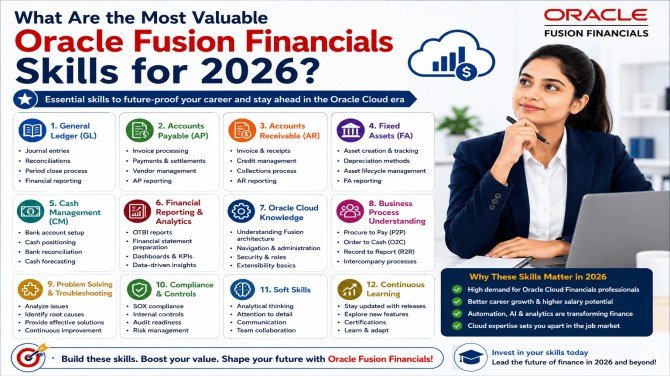
For a Finance professional to attend Oracle Fusion Financials Online Training would be very beneficial for the purpose of studying all the operations which a present day Finance needs to learn i.e reporting, payables, receivables, fixed assets & general ledger.
With your expertise to be proficient with the enterprise financial system the learning would match the industry standard, creating you new job avenues.
The Role of Cloud Technology in Financial Management
Cloud-based financial systems have changed the way businesses handle their finances. These systems are scalable, flexible, and provide instant visibility into their financial activities.
Why you should consider a cloud financial system
Centralized Data Management:
All your financial data is stored in one place, making it easier to access and manage.
Improved Accessibility:
Access your financial information from anywhere, anytime, on any device.
Enhanced Security:
Cloud providers offer robust security measures to protect your sensitive financial data.
Automated Workflows:
Automate routine financial tasks and streamline your business processes.
Faster Reporting:
Generate financial reports quickly and efficiently, allowing for better decision-making.
Better Collaboration:
Improve collaboration among team members and stakeholders with real-time data sharing. By adopting a cloud financial system, businesses can often achieve greater efficiency and reduce their operating expenses. If you're interested in learning more about cloud-based financial systems, consider Oracle Cloud Financials Online Training. This course covers modern financial processes, cloud architecture, automation, and practical business applications by learning
How Organizations Can Overcome Financial Management Challenges
To successfully address modern financial management challenges, organizations should focus on several key strategies:
Invest in Technology
Modern financial platforms provide automation, analytics, and reporting capabilities that improve efficiency and accuracy.
Strengthen Data Governance
Clear data management policies help ensure consistency, accuracy, and reliability across financial operations.
Enhance Employee Skills
Continuous learning enables finance professionals to adapt to changing technologies and business requirements.
Improve Risk Management
Organizations should proactively identify, assess, and mitigate financial risks through structured risk management practices.
Embrace Automation
Automating repetitive tasks reduces manual errors and allows finance teams to focus on strategic activities.
Foster Cross-Department Collaboration
Collaboration between finance, operations, procurement, and leadership teams improves decision-making and business performance.
Conclusion
In today's world, managing finances can be complicated, to say the least. Between complex data, evolving compliance, hard-to-predict futures, cash flow, cyber threats, and digital transformation, modern financial management can feel like a battlefield. And if companies don't take on these issues, they might face reduced efficiency, added risks, and missed opportunities.
Thankfully, technology and smart business practices can help. Businesses that invest in modern financial tech, implement strong governance, and invest in their people can get through the weeds and gain a solid financial foothold.
And as more and more companies seek finance professionals with modern financial systems knowledge and cloud-based finance and accounting, this knowledge can be a career game-changer. By understanding the financial challenges of today and learning to tackle them, both companies and professionals will be in a great position for the digital future.









0 Comments