
Warning Signs Your Home Needs an Electrical Safety Check
Tens of thousands of house fires kick off every single year thanks to electrical faults. Terrifying, right?
But here is the good news. Most of those disasters? Completely preventable.
Look, we're all busy. When a light flickers ominously or a socket suddenly seems quite hot, it's tempting to just let it slide. Who's got time to wait around for a replacement bulb? But if we do, we may as well be taking a risky chance with hidden dangers around the home.
If your goal is to protect your loved ones, then you must be educated on what a failing electrical system both sounds and looks like. Here, we can cut through the technical jargon and see what a normal American house sounds like.
1. The Everyday Annoyances That Actually Matter
You crank the aircon, and the lounge room lights suddenly dim. Don't just blame a cheap light globe.
Persistent flickering is usually your house practically begging for a break. It points to unstable voltage, a loose connection, or a circuit that is completely maxed out.
And what about your switchboard?
Circuit breakers are literal lifesavers designed to cut the power before things get dangerous. But if you're constantly marching out to the meter box in the rain to flip a switch back on, you have a real problem. It’s a dead giveaway of a short circuit or wiring that simply cannot cope with modern life.
Also, keep an eye on your power points. If a plug feels weirdly loose, or you hear a crackling noise when you hit a switch, nip it in the bud. That often means dangerous arcing is happening right behind your plasterboard.
2. Trust Your Nose and Ears
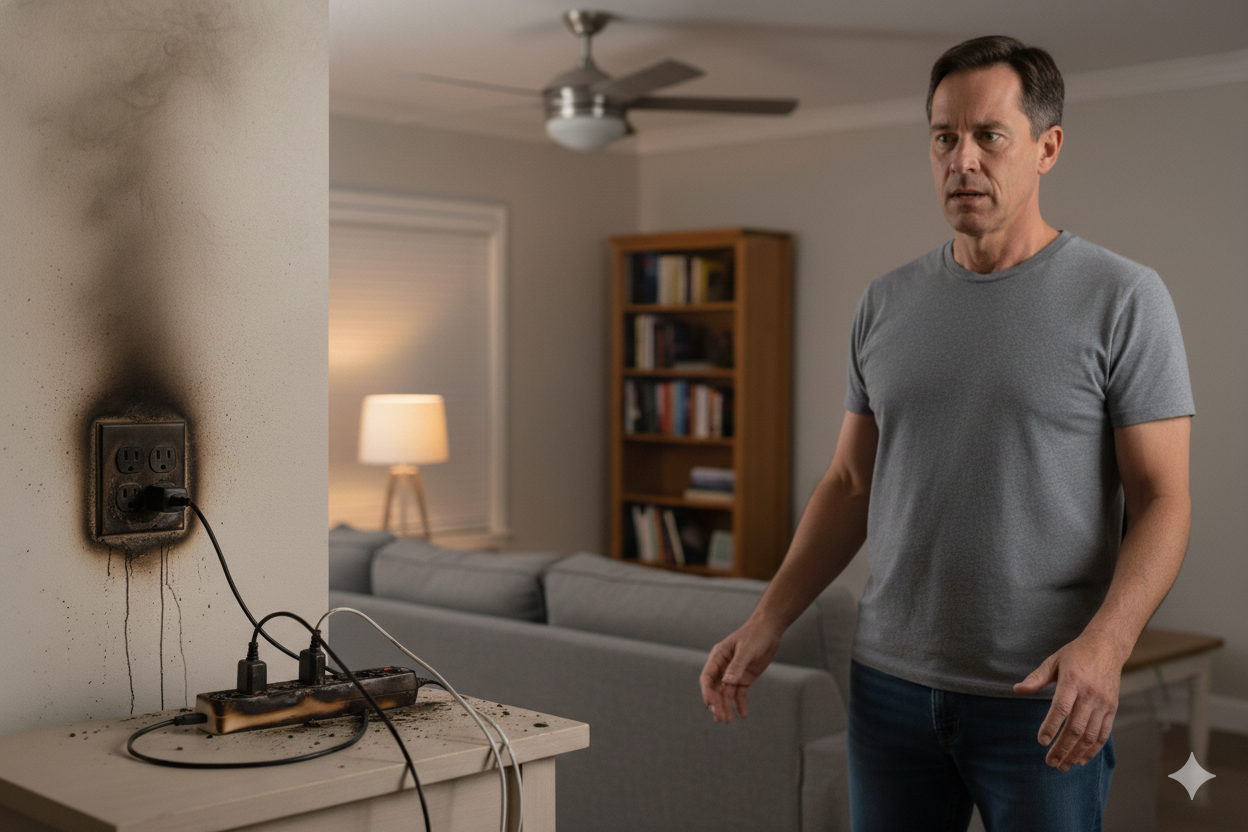
Ever notice how some issues just announce themselves? That sharp burn of melted plastic near an outlet - no detective work needed.
Out the door you go - straight to the main panel, cut power fast. Sparks fly when hot lines meet melted coating, fire takes hold in seconds.
Electricity is also supposed to be dead silent. Can you hear a clicking sound emanating from an wall switch? It's the sound of current arcing caused by frayed wires or loose terminals.
3. When Your House Bites Back
Fair warning: some signs don't just sit there. They physically bite.
A wall socket should never, ever feel hot. Not even if you're blasting a heavy-duty heater. Notice brown scorch marks on the wall plates? Intense heat has been building up behind the scenes, creating a massive fire risk.
Often, a tiny kick off when plugging in a toaster isn't just noise; it could mean the outlet's frayed or wires are wearing thin. If one feels a tingle touching any appliance, in particular one that hums or heats up, that's not normal. It might point to poor grounding or something leaking current. Turned out, those signs don't just hint at problems - they signal real danger. One can't patch this kind of fault oneself; it needs expert hands and proper home safety inspection.
4. What's Hiding in the Walls of Older Aussie Homes?
Sometimes the hazard isn't a new fault. It's just how the house was constructed. Living in an older house built in the 60s or 70s?
You could have solid aluminium wiring radiating throughout those walls. The issue is that aluminium disfigures and is heated at a much more drastic rate than copper. This, over time, releases the links and exponentially increases your chances of a fire.
We also tend to rely way too heavily on power boards and extension cords. Running them permanently creates pinch points where cables kink and short out.
Finally, test your wet areas. Water is a perfect electrical conductor, so any bathroom, kitchen or outdoor patio area should indisputably be fitted with shock-proof safety switches, known worldwide as GFCIs or RCDs. These switch off the electrical supply within 2 milliseconds to prevent you from dying. Missing them, as well as the AFCIs, which notice unsafe wall arcing, indicates a dangerously outdated system.
Final Thoughts:
Come on. Electrical problems don't just disappear.
The tiniest hurdle can escalate to be a fatal bummer if not dealt with now. The general rule of thumb from the experts? Have your home's wiring professionally checked every 3 to 10 years.
Don't risk your home over a dodgy wire. If you spot a sign, bite the bullet and book a thorough electrical safety check today.











0 Comments