
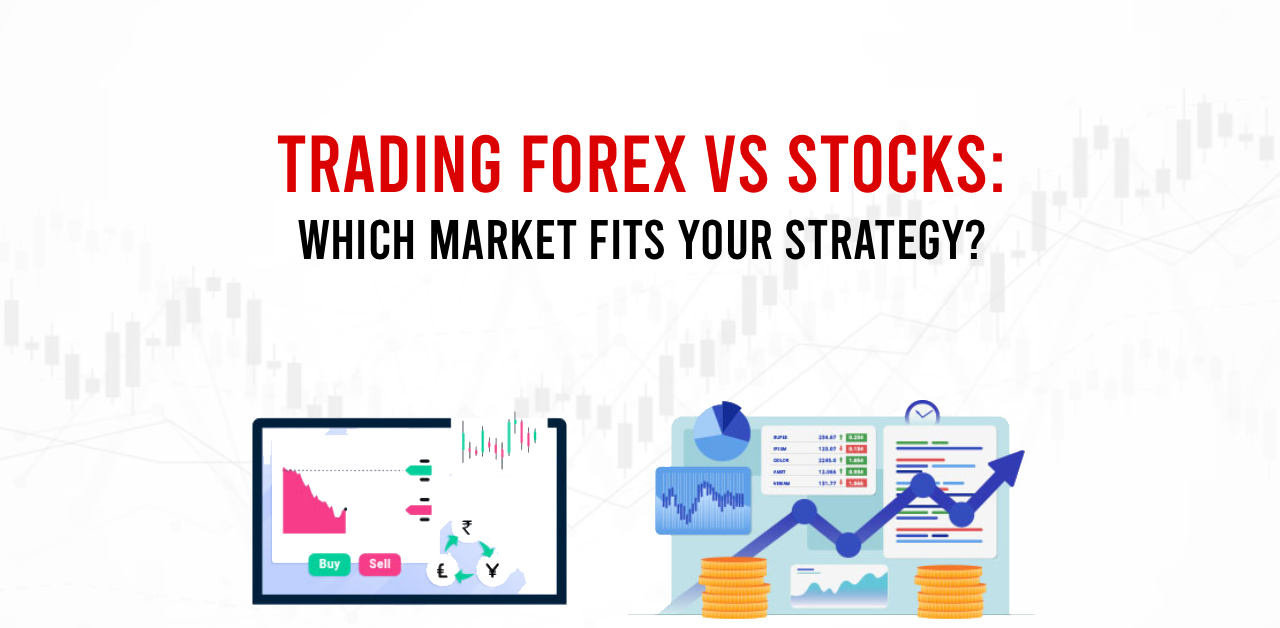
Trading Forex vs Stocks: Which Market Fits Your Strategy?
You’ve read the headlines and heard enough market chatter to feel the pressure building. You want to grow your money, yet something keeps you stuck between two giant choices: foreign currency trading and stocks. It is an interesting evaluation since both markets offer huge profit-making opportunities. However, choosing one is where you begin to feel overwhelmed. Almost every new trader hits this same crossroad: should you chase the steady climb of company shares or step into the fast-moving world of currencies? This hesitation around trading forex vs stocks trading often costs beginners more than they realize—including their time, confidence, and potential returns.
So, here’s a clearer way forward, without the noise or the hype.
Trading Forex vs Stocks: Understanding the Markets
Before anything else, it helps to know what you’re actually dealing with. In stock trading, you buy a piece of a company. That share reflects ownership, giving you a stake in its growth, its failures, and sometimes even its dividends. Because the focus is on a business, your research often revolves around its earnings, leadership, and industry.
Currency trading, however, is a different kind of arena. Instead of companies, you trade the value of one currency against another. EUR/USD, USD/JPY, GBP/USD—each pair reflects the strength of one nation’s economy versus another’s. So, trading forex vs stocks shifts your attention from corporate performance to global economic forces. It’s a major shift in how you process information.
Trading Forex vs Stocks: Market Hours and Liquidity
Another key difference is when you can trade. Stock markets run on fixed schedules. For example, the big U.S. exchanges open from 9:30 AM to 4 PM EST, and outside those hours, you're mostly waiting.
Foreign currency markets don’t wait for anyone. Because it’s a decentralized global market, it moves around the clock, five days a week. It follows the world’s time zones, not a single exchange. That alone makes forex attractive for people who can’t sit at their screens during regular business hours.
Liquidity is also worth noticing. The currency trading market, packed with trillions in daily volume, allows traders to open and close positions almost instantly—especially on major pairs. In contrast, stock liquidity varies widely. Big blue-chip names usually move smoothly, but smaller or lesser-known stocks may not. This makes trading forex vs stocks partly a comparison of how quickly you can act in each market.
Volatility and Leverage
Any trader who plans to survive needs to think carefully about volatility and leverage. Volatility is a measure of how much the price jumps around. Foreign exchange trading is notorious for reacting to interest rate decisions, geopolitical developments and economic data releases. These swings create opportunities, but they also elevate the stakes.
Leverage magnifies this even more. In foreign currency markets, brokers often allow traders to control large positions with relatively small deposits. A 50:1 ratio—or even higher—means both profits and losses can escalate quickly. Stocks, on the other hand, usually offer much lower leverage. The difference is huge once you compare trading forex vs stocks through the lens of personal risk.
This doesn’t make forex “bad” or stocks “safe”. It simply means you must know what you’re stepping into.
Trading Forex vs Stocks: Costs and Trading Style
Costs can influence your long-term success more than you’d expect. Forex trading often avoids commissions altogether; brokers typically earn through spreads. For major currency pairs, these spreads tend to be minimal, which helps active traders.
Stock trading may involve commissions, taxes, or wider bid–ask spreads depending on the exchange. And those costs add up, especially for frequent traders.
So when people weigh trading forex vs stocks, the structure of these costs becomes part of the decision. Someone who prefers fast, repeated trades might lean toward currency pairs. Someone who buys and holds for months or years may find stock costs acceptable.
And of course, personality matters.
The foreign exchange market is good for traders who don’t want to be long-term investors, who like the action and a short-term focus, and who can incorporate news into their trading within seconds.
Stocks may work well if you enjoy understanding businesses, holding onto positions longer term and tracking a company’s progress.
There’s no right or wrong path — it depends on the way you think and how you like to act.
Key Differences in Analysis and Opportunity
The analysis for each market is entirely different, and you must consider this when comparing trading forex vs stocks. Stock traders analyze businesses: earnings, products, leadership, sector competition, and long-term growth. It all depends on how you do business.
In the currency market, you take a step back and view the bigger picture. Interest rates, inflation, GDP and employment data, the central bank's policy, and political stability – all of these affect the value of a currency. You’re balancing two economies, not just one company.
And when it comes to opportunity, there are thousands of options — and countless industries — available in the stock market. That variety supports long-term diversification. The currency exchange also has dozens of pairs, but most of the volume is concentrated in a few of them. This alone makes trading forex vs stocks a choice between breadth and depth.
Choosing Your Path: Trading Forex vs Stocks
There isn’t a single, universal answer. The “best” market is the one that matches your personality, availability, and risk appetite.
If you excel in dynamic, high-stress situations, appreciate access around the clock, and can handle applying and managing leverage, international currency trading may be thrilling and rewarding—you just need to keep your head about you. However, if you like structure and are into long-term investments and analyzing actual companies, stock trading might suit your personality better.
In either case, the markets require knowledge, discipline, and patience. Start small, keep your exposure low, and let the system grow over time. When you evaluate trading forex vs stocks with clarity, the decision becomes far less intimidating.
Conclusion
Now that you have learnt about the differences between trading vs forex and stocks in terms of rhythm, cost, volatility, analysis and opportunities, the real lesson is clear: success has less to do with the market and more to do with the trader. Both are places where discipline is rewarded, guesswork is punished, and patience, planning and control of one’s emotions are essential.
If you enter either of these armed with a calm head and a solid plan, you grow more quickly—but only if you select the market that best fits your lifestyle, your goals, and your comfort level with risk. Once you find that alignment, your evolution as a trader will happen naturally. However, it occurs only if you stop being a reactionary trader and become an intention-based trader who trades with discipline and analysis, unaffected by emotions.
And when you’re ready to explore both worlds with fairness and transparency, a broker like Xtreme Markets offers a trustworthy ECN environment with fast execution, tight pricing, and top support—helping you trade with confidence and stay in control, even when the markets move fast.






0 Comments