
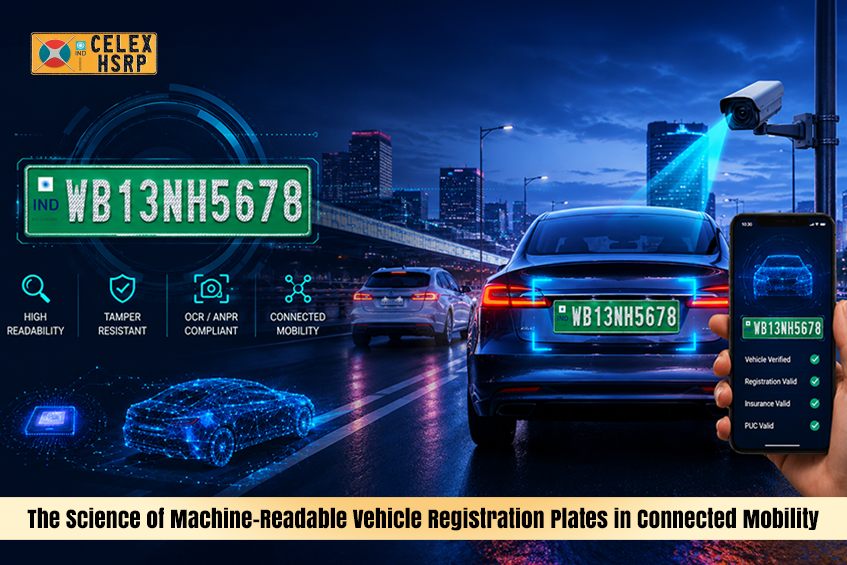
The Science of Machine-Readable Vehicle Registration Plates in Connected Mobility
Have you ever wondered why some vehicles breeze through toll plazas while others cause delays, misreads, or manual intervention? The answer usually comes down to one overlooked detail: the science behind the plate itself. Poorly manufactured registration plates create recognition failures, billing errors, and compliance headaches across India's growing transportation network.
These aren't small inconveniences. They slow down smart cities, frustrate commuters, and undermine the accuracy of intelligent traffic systems that millions of people rely on daily. If you've ever been curious about what actually makes a plate readable by machines, or you manage a fleet frustrated by recognition errors, this article is for you.
You'll learn the real engineering science behind vehicle registration plates, why standardisation matters so much, and how precision manufacturing directly powers India's connected mobility future. Let's get into the details.
Understanding Machine Readability in Modern Vehicle Registration Plates
Machine readability is a completely different challenge than simple human readability. A person can glance at a smudged or oddly angled plate and still figure out the number. Cameras and recognition software cannot do that as easily. They need consistency, precision, and predictability to work accurately at scale.
Why do vehicle registration plates need to be engineered for machines rather than just humans? This is because intelligent transportation systems handle thousands of plates each minute along roads, toll booths and city crossings. Any inconsistency in character height, spacing, or reflectivity introduces errors that ripple through automated systems.
Standardised character dimensions form the foundation of machine-readable registration plates. Every digit and letter follows precise height, width, and stroke thickness specifications set by national standards. Font consistency is equally important because irregular typography confuses optical recognition algorithms when attempting to match characters to known templates.
Contrast ratios between the plate background and characters also play a critical role. High contrast allows cameras to distinguish characters quickly, even at highway speeds or in low light conditions. Engineering precision at this level directly determines whether an automatic number plate recognition system reads a vehicle correctly on the first attempt or requires multiple scanning passes, which slows down traffic and strains system resources.
Why Connected Mobility Depends on Standardised Vehicle Registration Plates?
Connected mobility isn't a single technology. It's an entire web of systems working together, including traffic cameras, toll infrastructure, smart parking sensors, enforcement platforms, and centralised government databases. Every one of these systems needs to identify vehicles accurately and consistently.
India's registered vehicle count crossed 413 million as of 2025 to 2026, according to the Ministry of Road Transport and Highways, and this massive scale makes standardisation absolutely non-negotiable. Imagine if even a small percentage of plates used inconsistent fonts or degraded reflective coatings. The resulting recognition errors would overwhelm enforcement systems and corrupt transportation data nationwide.
Inconsistent or poorly manufactured plates reduce system reliability across the board. A single misread plate at a toll plaza can lead to billing disputes. A misread plate at an enforcement checkpoint creates legal complications for innocent vehicle owners. These errors compound quickly across a transportation network, processing millions of daily interactions.
High-security registration plates manufactured under strict national specifications solve this problem by providing a dependable identification layer. Companies like Celex Technologies produce plates engineered specifically to meet these standards, giving India's connected transportation ecosystem the consistency it needs to function smoothly at scale.
The Optical Engineering That Makes Vehicle Registration Plates Machine Readable
The science behind plate readability starts with retroreflective number plate technology. Retroreflective sheeting bounces light directly back toward its source rather than scattering it randomly. This means headlights and camera flashes illuminate the plate clearly, even in complete darkness.
Another level of accuracy is added with controlled embossing depth. Characters pressed too shallow lose definition under certain lighting angles, while characters embossed too deep can create shadows that confuse recognition software. Manufacturers calibrate this depth carefully to maintain consistent readability across all viewing conditions.
Uniform typography across every plate produced matters enormously for recognition software trained on standardised character templates. If a manufacturer's font varies even slightly from batch to batch, recognition accuracy drops. Environmental durability rounds out this engineering puzzle, since plates must resist fading, cracking, and corrosion from monsoon rains, extreme heat, and years of highway dust exposure.
Contrast optimisation ties everything together, ensuring characters remain sharply distinguishable from the background regardless of weather, lighting, or camera angle. Whether it's bright daylight, pitch-black night, heavy rain, or a car travelling at highway speed, these combined engineering features enable cameras to capture distinct vehicle identities.
The Role of Automatic Number Plate Recognition in Connected Mobility
ANPR systems have become the backbone of automated traffic management across Indian cities and highways. These systems operate through a simple yet complex process. Cameras capture an image of the plate, optical character recognition software converts that image into readable text, and the system then verifies this text against centralised vehicle databases.
This entire chain happens within seconds, enabling automated enforcement, toll management, and real-time vehicle monitoring without human intervention. Smart intersections use this same technology to manage traffic flow, detect violations, and even predict congestion patterns based on vehicle movement data.
ANPR performance depends heavily upon standardised machine-readable registration plates. A recognition system trained to expect consistent fonts, spacing, and reflectivity will struggle badly when it encounters plates that deviate from these standards. High-quality HSRPs reduce this friction significantly, improving recognition accuracy while supporting efficient transportation governance.
This matters more than most people realise. Every automated toll transaction, every digital mobility service, and every smart traffic management decision ultimately traces back to whether the recognition system could read the plate correctly in the first place.
Integrating Machine-Readable Registration Plates with National Vehicle Identity Systems
Every HSRP connects back to India's centralised vehicle registration database, commonly accessed through the government's VAHAN system. This integration allows authorities to verify ownership, check registration validity, and confirm compliance status instantly using just the plate number.
Secure identity synchronisation ensures that the moment a plate gets manufactured and issued, its unique identifier links directly to the vehicle's official record. Registration verification becomes nearly instantaneous, whether conducted by a traffic officer using a handheld scanner or an automated camera system at a checkpoint.
Ownership authentication benefits significantly from this integration too. Insurance companies, resale buyers, and law enforcement agencies can all confirm vehicle history and current ownership status through the same standardised identity layer. Lifecycle traceability follows naturally, since every service record, ownership transfer, and compliance check ties back to this same secure plate identity, creating a dependable digital thread throughout the vehicle's entire operational life.
Why Are Machine-Readable Vehicle Registration Plates Essential for Smart Transportation Networks
This is because every automated process within these networks starts with one basic requirement: knowing exactly which vehicle is present. Without this initial identification step, intelligent surveillance systems cannot operate.
Automated toll collection relies entirely on accurate plate recognition to charge the correct account without manual intervention. Congestion management systems track vehicle flow patterns using plate data collected across multiple checkpoints, helping city planners identify bottlenecks and adjust traffic signals dynamically.
AI-driven traffic enforcement depends on the same accuracy. Systems designed to detect speeding, signal violations, or restricted zone entries need reliable plate identification to issue correct violation notices. Digital compliance monitoring across fleet operations and mobility analytics platforms similarly requires consistent, standardised vehicle identification to generate meaningful insights.
Top-quality HSRP number plates engineered specifically for machine recognition, like those manufactured by Celex Technologies, provide this essential foundation. Without this reliability, the entire intelligent transportation infrastructure loses accuracy and trustworthiness.
How Do High-Security Vehicle Registration Plates Improve Machine Recognition Accuracy?
The answer lies in several engineering elements working together consistently across every single plate produced. Standardised fonts ensure recognition software always encounters familiar character shapes, regardless of which state or manufacturer produced the plate.
Laser-etched vehicle identification numbers provide permanent, non-fading identifiers that remain sharp and readable for years, unlike painted or stamped alternatives that degrade over time. Reflective materials maintain their light-bouncing properties even after prolonged sun exposure and weather cycling, ensuring nighttime readability doesn't deteriorate as the plate ages.
Tamper-resistant construction, including secure snap locks, prevents plate manipulation that could otherwise interfere with recognition accuracy or enable fraud. Manufacturing consistency ties all these elements together, since even minor batch-to-batch variations can introduce recognition errors at scale.
Every engineering element contributes cumulatively to lower error rates and more reliable transportation data. This is exactly why manufacturing quality matters so much within India's expanding intelligent transportation infrastructure.
Artificial Intelligence and the Future of Machine-Readable Vehicle Registration Plates
Artificial intelligence has transformed how transportation authorities analyse and respond to traffic patterns. Predictive traffic analysis tools now anticipate congestion hotspots before they fully develop, using historical plate recognition data collected across major routes.
Intelligent congestion management systems adjust signal timing dynamically based on real-time vehicle flow, while automated violation detection flags speeding, illegal parking, or restricted zone entries without requiring constant human monitoring. Plate recognition is used by smart parking systems to automatically assign spots and compute fees without the need for ticket machines or human input.
Vehicle traceability systems supporting autonomous mobility development also depend heavily on accurate plate data, since self-driving technology research increasingly incorporates transportation infrastructure data for testing and validation purposes. Real-time transportation analytics platforms process millions of plate recognition events daily to generate insights for city planners and policymakers.
None of these AI applications functions reliably without standardised, accurately readable registration plates feeding clean data into the system. Advanced HSRP manufacturing directly strengthens AI performance by ensuring consistent vehicle identification across every intelligent mobility environment these systems touch.
Commercial Mobility and the Growing Importance of Machine-Readable Registration Plates
Commercial transportation places unique demands on registration plate performance that go beyond typical passenger vehicle requirements. Fleet management platforms need fast, accurate identification to track hundreds or thousands of vehicles simultaneously across wide geographic areas.
Weighbridge automation depends on instant plate recognition to log vehicle weight against the correct registration record without slowing down freight movement. Logistics visibility improves dramatically when every checkpoint along a supply chain can identify vehicles accurately and instantly, reducing delays and improving delivery predictability.
Warehouse access control systems increasingly rely on plate recognition instead of manual security checks, granting entry automatically to verified vehicles while blocking unauthorised access. Freight monitoring benefits similarly, since accurate identification allows logistics companies to track cargo movement with far greater confidence than manual logging ever provided.
OEM vehicle registration solutions designed for commercial fleets, like those Celex Technologies manufactures, prioritise durability alongside recognition accuracy. Commercial vehicles face harsher operating conditions than typical passenger cars, making robust engineering essential for maintaining consistent machine readability throughout demanding logistics environments.
How Celex Technologies Is Advancing Machine-Readable Vehicle Registration Plate Technology
Celex Technologies brings over 23 years of specialised experience to India's registration plate manufacturing industry. The company currently maintains an annual manufacturing capacity exceeding 5 crore HSRPs, with a supply footprint spanning 23 states through 348 touch points nationwide.
This scale reflects genuine engineering commitment rather than simple volume production. Partnerships with more than 500 OEM customers demonstrate the confidence vehicle manufacturers place in the company's precision and consistency standards. A dealer network exceeding 12,000 partners ensures vehicle owners across the country can access genuine, compliant plates without unnecessary delays or quality compromises.
The company's turnover exceeding 110 crore during the 2024 to 2025 financial year, supported by a team strength of over 500 professionals, reflects sustained operational excellence within a sector where compliance standards continue tightening. This combination of manufacturing precision, nationwide distribution, and technological focus positions Celex Technologies among India's leading contributors to secure registration plate manufacturing supporting connected mobility infrastructure.
The Future of Machine-Readable Vehicle Registration Plates in Connected Mobility
Connected vehicles, AI-powered transportation platforms, and smart city infrastructure will continue expanding rapidly across India in the coming years. Secure vehicle identification will remain the foundation supporting every layer of this intelligent mobility ecosystem, from automated enforcement to predictive traffic management.
Engineering precision and manufacturing quality will only grow more important as recognition systems demand increasingly accurate and consistent data. Smart road infrastructure projects across major cities already incorporate plate recognition as a core component, and this dependency will deepen as autonomous mobility research progresses.
Celex Technologies continues advancing this evolution through consistent OEM manufacturing standards and secure vehicle registration plate solutions designed specifically for machine readability. As India's roads grow smarter, the science behind every plate produced will directly shape how well these connected systems perform.
Conclusion
Machine-readable vehicle registration plates represent far more engineering complexity than most people ever consider. From retroreflective sheeting to laser-etched precision, every design choice directly impacts how accurately intelligent systems can identify vehicles across India's expanding transportation network. As connected mobility, AI-powered traffic management, and smart city infrastructure continue growing, the science behind plate manufacturing becomes increasingly critical rather than incidental.
Companies like Celex Technologies demonstrate how precision engineering translates directly into reliable, scalable transportation intelligence. Understanding this science helps fleet operators, city planners, and everyday vehicle owners appreciate why manufacturing quality matters so much in building the connected mobility future India is racing toward.
Frequently Asked Questions (FAQs)
1. What makes a vehicle registration plate machine readable?
Standardised fonts, consistent spacing, high contrast ratios, and retroreflective coatings allow cameras and recognition software to identify plates accurately across varying lighting conditions.
2. How does ANPR technology actually work?
ANPR captures a plate image, converts it to text through optical character recognition, then verifies that text against centralised vehicle databases within seconds.
3. Why do registration plates need retroreflective sheeting?
Retroreflective sheeting bounces light directly back toward its source, ensuring plates remain clearly visible and readable during nighttime driving or poor visibility conditions.
4. Can poorly manufactured plates affect toll and enforcement systems?
Yes, inconsistent fonts or degraded reflectivity cause recognition errors, leading to billing disputes, enforcement mistakes, and slower automated processing at checkpoints.
5. Why choose an experienced OEM registration plate manufacturer?
Experienced manufacturers ensure consistent quality, standardised engineering, and reliable machine readability, which directly improves recognition accuracy across intelligent transportation systems.








0 Comments