

Machine Learning Interview Questions and Answers
Machine Learning has become a cornerstone of modern software engineering, data science, and artificial intelligence. Organizations across finance, healthcare, e-commerce, and manufacturing actively seek professionals who can design, implement, and optimize intelligent systems. To succeed in a Machine Learning interview, candidates must demonstrate strong foundations in mathematics, statistics, programming, and modeling techniques, along with practical experience.
In this guide, we present an in-depth collection of hire machine learning experts carefully structured to cover beginner, intermediate, and advanced concepts. We address theory, algorithms, implementation, and real-world applications to help candidates prepare with confidence.
Fundamental Machine Learning Concepts
What Is Machine Learning?
Machine Learning is a subset of Artificial Intelligence that enables systems to learn from data and improve performance without explicit programming. Models identify patterns, make predictions, and adapt based on experience.
Core components include:
Data – structured or unstructured information
Features – measurable attributes extracted from data
Algorithms – mathematical procedures for learning patterns
Models – learned representations used for inference
Evaluation metrics – measures of performance
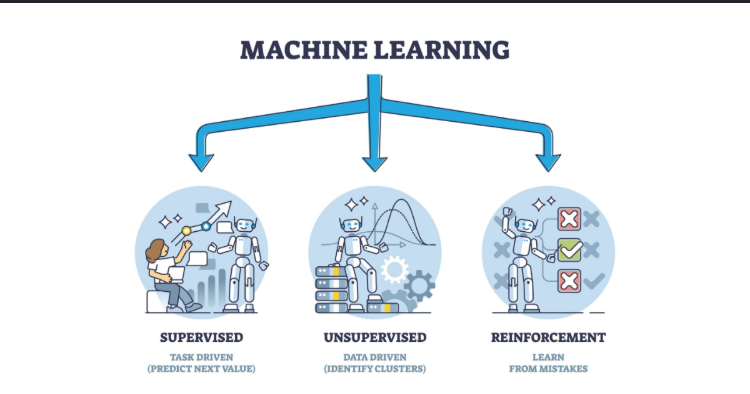
Types of Machine Learning
Supervised Learning
Models learn from labeled data. Common tasks include classification and regression.
Examples:
Linear Regression
Logistic Regression
Support Vector Machines
Decision Trees
Random Forests
Unsupervised Learning
Models discover hidden patterns in unlabeled data.
Examples:
K-Means Clustering
Hierarchical Clustering
Principal Component Analysis (PCA)
Semi-Supervised Learning
Combines labeled and unlabeled data to improve learning efficiency.
Reinforcement Learning
Agents learn optimal actions through rewards and penalties in an environment.
Examples:
Q-Learning
Deep Q Networks
Core Interview Questions on Algorithms
Explain Linear Regression
Linear Regression models the relationship between dependent and independent variables using a linear equation:
y = mx + c
It minimizes error through Ordinary Least Squares (OLS). Key assumptions include linearity, independence, homoscedasticity, and normal distribution of residuals.
Difference Between Classification and Regression
Classification predicts discrete categories (spam vs non-spam).
Regression predicts continuous values (house prices).
What Is Logistic Regression?
Despite its name, Logistic Regression is a classification algorithm. It uses the sigmoid function to map outputs between 0 and 1 and estimates probabilities for binary outcomes.
Explain Bias-Variance Tradeoff
Bias: Error from overly simplistic assumptions (underfitting).
Variance: Error from sensitivity to small data changes (overfitting).
An optimal model balances both to minimize total error.
Decision Trees and Ensemble Learning
How Do Decision Trees Work?
Decision Trees split data based on information gain, Gini impurity, or entropy. Nodes represent decisions, and leaves represent outcomes.
Advantages:
Easy to interpret
Handles non-linear relationships
Disadvantages:
Prone to overfitting
What Is Random Forest?
Random Forest is an ensemble learning method that builds multiple decision trees and aggregates predictions. It improves accuracy by reducing variance through bagging.
Explain Gradient Boosting
Gradient Boosting sequentially builds weak learners, each correcting errors from the previous model. Popular implementations include:
XGBoost
LightGBM
CatBoost
Support Vector Machines
What Is SVM?
Support Vector Machines find the optimal hyperplane that maximizes margin between classes. Kernel functions enable SVMs to handle non-linear boundaries.
Common kernels:
Linear
Polynomial
Radial Basis Function (RBF)
Unsupervised Learning Questions
Explain K-Means Clustering
K-Means partitions data into K clusters by minimizing within-cluster variance. Steps include:
Initialize centroids
Assign points to nearest centroid
Recompute centroids
Repeat until convergence
What Is PCA?
Principal Component Analysis reduces dimensionality by transforming features into orthogonal components that maximize variance. PCA improves performance and visualization while reducing noise.
Neural Networks and Deep Learning
What Is an Artificial Neural Network?
An ANN consists of:
Input layer
Hidden layers
Output layer
Each neuron applies weights, bias, and activation functions such as ReLU, Sigmoid, or Tanh.
Explain Backpropagation
Backpropagation computes gradients of loss with respect to weights and updates parameters using optimization algorithms like Gradient Descent or Adam.
What Is Overfitting in Neural Networks?
Overfitting occurs when models memorize training data. Prevention techniques include:
Dropout
Regularization (L1/L2)
Early stopping
Data augmentation
Model Evaluation Metrics
Classification Metrics
Accuracy
Precision
Recall
F1-Score
ROC-AUC
Regression Metrics
Mean Absolute Error (MAE)
Mean Squared Error (MSE)
Root Mean Squared Error (RMSE)
R² Score
Feature Engineering and Data Preparation
What Is Feature Engineering?
Feature Engineering involves transforming raw data into meaningful inputs. Techniques include:
Normalization and scaling
One-hot encoding
Handling missing values
Feature extraction
Why Is Data Preprocessing Important?
Clean data ensures model stability, improves convergence, and increases predictive accuracy.
Advanced Machine Learning Interview Questions
Explain Cross-Validation
Cross-validation evaluates models by splitting data into multiple folds. The most common method is K-Fold Cross Validation, which provides robust performance estimates.
What Is Transfer Learning?
Transfer Learning leverages pre-trained models on large datasets and fine-tunes them for new tasks, significantly reducing training time.
Explain Concept Drift
Concept Drift occurs when data distributions change over time, degrading model performance. Monitoring and retraining are required in production systems.
Difference Between Batch and Online Learning
Batch Learning trains on entire datasets.
Online Learning updates models incrementally with streaming data.
Practical Implementation Questions
Which Programming Languages Are Used in Machine Learning?
Popular languages include:
Python
R
Java
Scala
Python dominates due to libraries such as NumPy, Pandas, Scikit-learn, TensorFlow, and PyTorch.
Explain the ML Pipeline
Data collection
Data preprocessing
Feature engineering
Model selection
Training
Evaluation
Deployment
Monitoring
Real-World Machine Learning Applications
Recommendation systems
Fraud detection
Medical diagnosis
Image recognition
Natural Language Processing
Autonomous vehicles
These applications demonstrate how Machine Learning drives business intelligence and automation.
Conclusion
Preparing for Machine Learning interviews requires a deep understanding of algorithms, model evaluation, data preprocessing, and real-world deployment strategies. Mastery of these topics enables candidates to articulate solutions clearly and demonstrate practical competence. By studying both theoretical foundations and applied techniques, professionals can confidently approach technical interviews and deliver impactful results.








0 Comments