
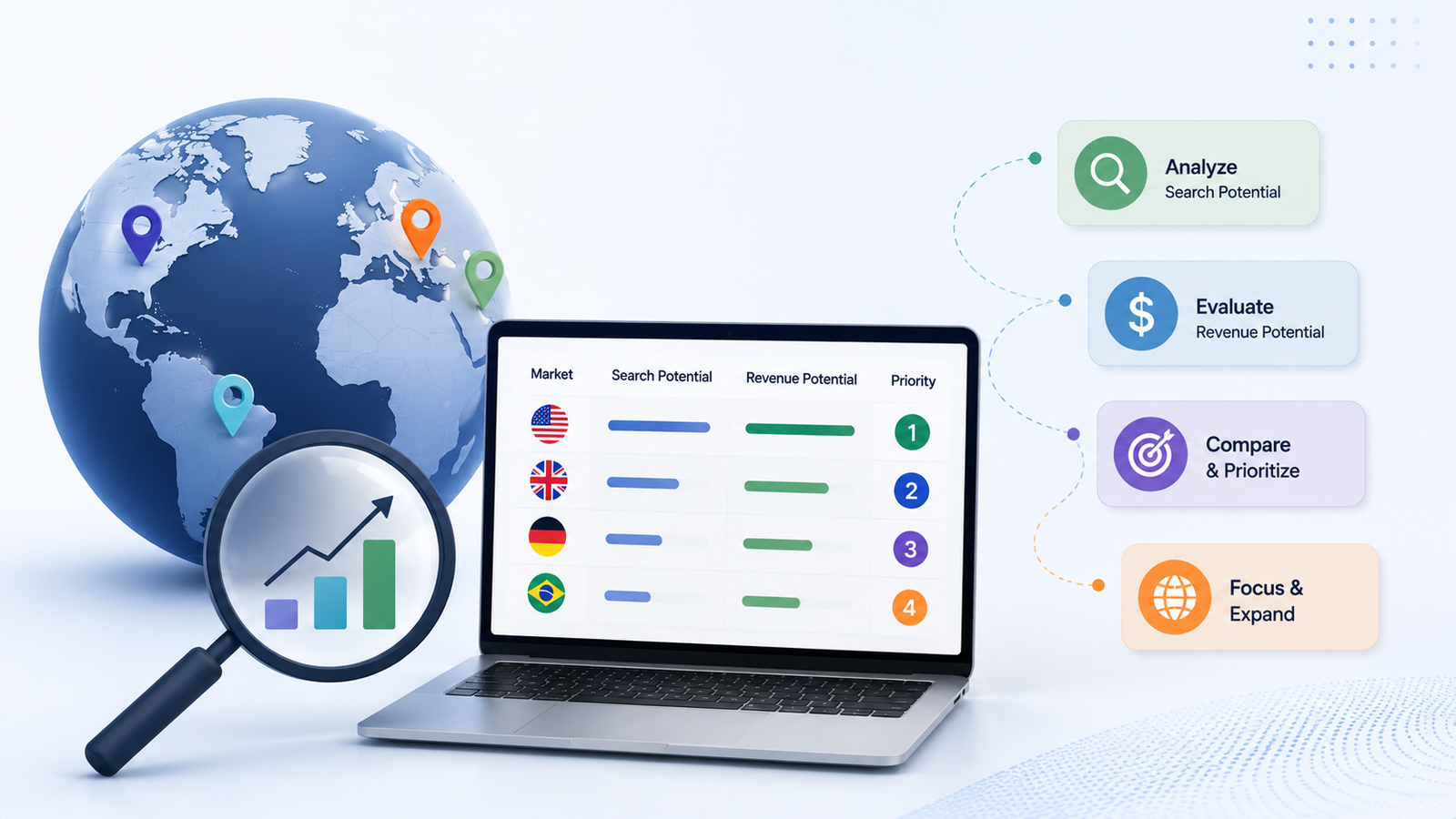
How to Prioritize International Markets Based on Search and Revenue Potential
Expanding into a new country can look attractive when the market has a large population and strong search demand. But high search volume does not automatically mean high revenue potential.
A market may generate millions of searches for a product while having low purchasing power, strong local competition, expensive customer acquisition, or limited demand for the company's actual offering. Another market with fewer searches may produce better leads, higher conversion rates, and stronger customer value.
For companies planning international growth, multilingual SEO services can play an important role in this evaluation. The starting point, however, should not be translating the website into every language. It should be deciding which markets deserve investment first and why.
Start With the Business Case, Not Search Volume
The first question should be simple:
If we increase organic visibility in this market, how much business could it realistically create?
Look at existing business data before looking at keyword tools.
Useful indicators include:
- Current revenue by country
- Number of customers
- Average order or contract value
- Conversion rate
- Lead quality
- Customer lifetime value
- Existing brand awareness
- Cost of serving the market
- Product availability
- Local competition
This creates a baseline for comparing markets.
For example, Country A might have twice the search volume of Country B. But if customers in Country B convert at a much higher rate and have a greater average order value, Country B may be the better SEO investment.
Which Countries Already Show Signs of Demand?
Existing website data can reveal markets that are already interested in the business.
Check Google Search Console, analytics, CRM, and sales data for countries where the website is already receiving:
- Organic impressions
- Organic clicks
- Leads
- Purchases
- Product enquiries
- Branded searches
A country that already generates organic demand without dedicated local optimization can be particularly interesting.
It suggests that the business does not have to create demand from nothing. There is already some level of interest that SEO could potentially capture more effectively.
How Large Is the Search Opportunity?
Once existing demand is understood, compare the search opportunity across potential markets.
Do not look at one keyword.
Build a broader market-level picture using groups of terms related to:
- Core products
- Services
- Product categories
- Problems customers want to solve
- Commercial searches
- Comparison searches
- Brand searches
Then compare search demand between countries.
This helps avoid a common mistake: choosing a market because one keyword has a large search volume while ignoring the wider demand for the company's products.
Does Search Intent Match What You Sell?
Search volume becomes useful only when the searches represent a real opportunity.
Suppose a company sells enterprise cybersecurity software.
A country may show strong search demand around cybersecurity education and general security topics but relatively little demand for enterprise security platforms.
Another market may have lower overall search volume but much stronger commercial searches from businesses looking for enterprise solutions.
The second market could be more valuable.
Review whether searches in each market show:
- Problem awareness
- Product research
- Commercial investigation
- Purchase intent
- Demand for specific solutions
The closer the search intent is to the company's actual offering, the more meaningful the opportunity becomes.
What Does Your Revenue Data Say?
Search data tells you about potential demand. Revenue data tells you what the market is already worth to the business.
Compare potential markets using metrics such as:
Organic traffic × conversion rate × average customer value
This does not need to be a complicated forecasting model. Even a basic comparison can reveal major differences between countries.
For example:
Market A
10,000 monthly organic visits
1% conversion rate
$500 average customer value
Market B
4,000 monthly organic visits
3% conversion rate
$900 average customer value
Market B has less traffic but can represent a much stronger commercial opportunity.
This is why international SEO decisions should not be based on search volume alone.
Is the Market Already Converting?
Existing conversions are one of the strongest signals that a market deserves attention.
Look at countries where visitors are already taking meaningful actions.
Depending on the business, that could mean:
- Completing a purchase
- Requesting a quote
- Booking a consultation
- Signing up for a trial
- Requesting a demo
- Contacting sales
A market that already produces customers provides stronger evidence than one that looks attractive only because keyword tools show high search volume.
How Difficult Will It Be to Compete?
A large market can also be an expensive market.
Before choosing where to invest, review the strength of the local search results.
Look at:
- Established competitors
- Local brands
- Domain strength
- Content quality
- Search intent coverage
- Backlink profiles
- SERP features
- Shopping results where relevant
- Local search presence
The goal is not to avoid competitive markets completely.
Instead, estimate whether the potential revenue justifies the effort required to gain visibility.
A smaller market with moderate competition may deliver a better return than a huge market dominated by established local players.
Does the Business Have a Real Advantage in That Market?
SEO cannot solve every market-entry problem.
Ask whether the company can actually serve customers in the country.
Consider:
- Shipping or delivery
- Pricing
- Payment methods
- Customer support
- Local regulations
- Product availability
- Sales coverage
- Local partnerships
- Market-specific product requirements
If the business cannot serve customers effectively, generating more organic traffic will not create sustainable growth.
SEO should support a viable market opportunity, not replace one.
Language Is More Than Translation
A country may speak the same language as another market but still use different search terms.
People may describe the same product differently based on their location, industry, culture, or buying habits.
For example, users in two English-speaking countries may use different terms for the same product.
That means international keyword research should consider:
- Local terminology
- Search behavior
- Spelling differences
- Product names
- Industry language
- Buying preferences
- Cultural context
The same applies when entering markets that use completely different languages.
A direct translation of existing keywords may miss the way local customers actually search.
Should You Enter One Market or Several at Once?
Expanding into multiple countries simultaneously can spread resources too thin.
A more practical approach is to rank markets based on opportunity and start with the strongest candidates.
For example:
Tier 1: High potential
Strong search demand, clear commercial intent, existing revenue, and manageable competition.
Tier 2: Emerging potential
Limited current revenue but growing search demand and good market conditions.
Tier 3: Long-term opportunity
Large theoretical market potential but high competition, low current demand, or significant localization requirements.
This gives the SEO team a clear sequence rather than an unmanageable list of countries.
Build a Market Opportunity Score
A simple scoring system can make the decision more objective.
Score each market from 1 to 5 across factors such as:
- Search demand
- Commercial intent
- Existing organic traffic
- Conversion rate
- Revenue potential
- Customer value
- Competition
- Brand presence
- Market accessibility
- Localization requirements
Then compare the total scores.
The exact weighting should depend on the business.
For a high-value B2B company, customer value and qualified leads may matter more than search volume.
For ecommerce, purchase conversion, average order value, product demand, and shipping capability may carry more weight.
What Should You Do After Choosing a Market?
Choosing the country is only the beginning.
Before launching localized pages, review the technical and content requirements for that market.
This can include:
- Local keyword research
- Market-specific content
- Language targeting
- URL structure
- Hreflang implementation
- Local metadata
- Internal linking
- Localized product information
- Local backlinks and mentions
- Search Console monitoring
Avoid translating the entire website simply because a market has high search volume.
Start with the pages most closely connected to demand and revenue.
For example, a business might prioritize product and service pages first, followed by category pages, comparison content, and supporting informational resources.
How Do You Know If the Market Is Working?
After launching, compare performance against the original market assumptions.
Monitor:
- Organic impressions
- Non-branded clicks
- Rankings
- Qualified organic traffic
- Conversion rate
- Leads or purchases
- Revenue
- Customer acquisition value
Do not judge a market only by traffic growth.
If organic traffic increases by 80% but qualified leads remain flat, the strategy may be attracting the wrong searches.
If traffic grows more slowly but revenue and conversion rates improve, the market may be performing much better than the traffic numbers suggest.
Final Thoughts
International SEO should start with a business decision, not a translation project.
Search demand can show where people are looking for products and services, but revenue data reveals where those searches can become meaningful business opportunities. The strongest markets are usually the ones where several signals come together: genuine demand, relevant search intent, existing conversions, strong customer value, and a realistic path to compete.
For companies evaluating multilingual SEO services, this approach provides a more practical way to decide where SEO investment should begin. Instead of launching every language and country at once, businesses can rank markets according to commercial potential and build their international presence in a more controlled way.
As a performance-driven SEO agency, ResultFirst approaches international SEO by looking beyond search volume and considering market demand, organic performance, conversion data, competition, and business value when identifying where growth opportunities are most likely to exist.











0 Comments