
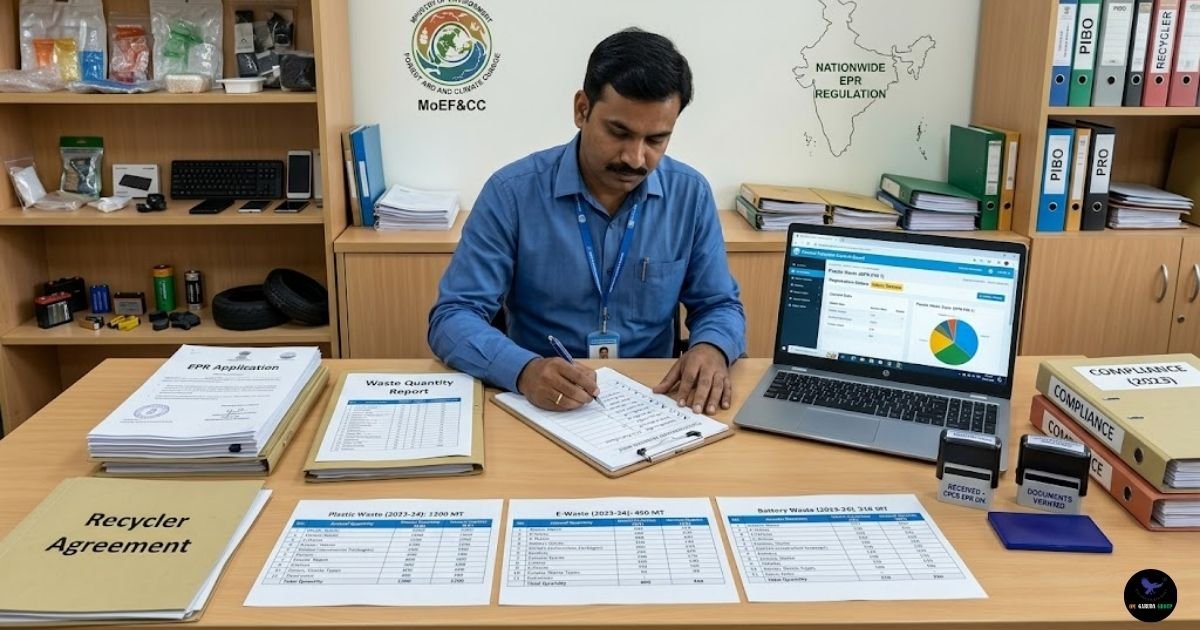
EPR Registration Services in India: Documents, Fees & Approval Timeline
India’s waste problem is no longer limited to landfills and pollution headlines. The government has made producers, importers, and brand owners legally responsible for managing the waste generated by their products. This is where Extended Producer Responsibility (EPR) comes into action.
If your business manufactures, imports, sells, or uses plastic packaging, electronics, batteries, or related materials, EPR compliance is not optional. Without proper registration, companies face penalties, product bans, and legal notices from pollution control authorities.
This guide explains the documents required, government fees, and the realistic approval timeline so you can plan the process correctly.
What is EPR and Why Is It Mandatory?
Extended Producer Responsibility is a policy introduced by the Central Pollution Control Board (CPCB) under the Ministry of Environment, Forest and Climate Change (MoEFCC). It makes producers responsible for collecting, recycling, and disposing of the waste generated from their products after consumer use.
EPR applies to:
- Plastic waste
- E-waste (electronics)
- Battery waste
- Tyre waste
- Packaging materials
Any Producer, Importer, Brand Owner (PIBO), or manufacturer dealing in these categories must obtain authorization from CPCB through the EPR portal.
Who Needs EPR Registration?
You must apply if your company falls into any of these categories:
- Manufacturers using plastic or multilayer packaging
- Importers bringing packaged goods into India
- Brand owners selling products under their label
- E-waste producers and electronic importers
- Battery manufacturers and importers
- Online sellers using plastic packaging for shipments
Even small and medium businesses are covered under this rule.
Documents Required for EPR Registration
Most applications get delayed because of incomplete or incorrect documentation. The CPCB portal requires accurate data, and mismatches often lead to rejection.
Here are the key documents generally required:
- Company PAN and GST certificate
- IEC certificate (for importers)
- Certificate of incorporation / MSME / partnership deed
- Authorized signatory details
- Product details with packaging composition
- Sales data for previous financial year
- Plastic, battery, or e-waste quantity data (in metric tons)
- Agreement with authorized recyclers
- Pollution control board authorization (if applicable)
- Undertaking and declaration forms
Accurate calculation of waste generation is critical. Wrong data here leads to queries and long delays.
Government Fees Involved
There is no fixed “one price” for EPR approval. The cost depends on:
- Type of waste category (plastic, e-waste, battery)
- Quantity of material introduced in the market
- Number of states you operate in
- Recycler agreements and compliance planning
Apart from official government charges, companies must also allocate budget for:
- Recycler procurement costs
- Annual return filing
- Compliance reporting
- Consultant or expert handling fees
Many businesses underestimate this and face compliance issues later.
Step-by-Step EPR Application Process
- Registration on CPCB EPR portal
- Submission of company and product details
- Uploading required documents
- Declaration of waste generation quantity
- Upload of recycler agreements
- Application review by CPCB officials
- Query response (if raised)
- Approval and issuance of EPR certificate
Most delays happen at step 7 when companies cannot justify their data.
Approval Timeline: What to Expect Realistically
Officially, the timeline looks short. In practice, it depends on how well your application is prepared.
- Documentation and data preparation: 5–10 days
- Portal submission and initial review: 10–15 days
- Query resolution (if any): 10–20 days
- Final approval: 7–10 days
On average, businesses receive approval within 30 to 45 days when documents are properly arranged. Incorrect data can stretch this to 2–3 months.
Common Reasons for Application Rejection
- Incorrect waste quantity declaration
- Missing recycler agreement
- Wrong category selection on the portal
- Mismatch between GST data and sales data
- Improper documentation format
- Applying under the wrong waste rule
These mistakes are very common when companies try to handle the process without expert guidance.
Why Professional Support Matters
EPR is not just about getting a certificate. It is an ongoing compliance system involving annual returns, waste offset targets, and recycler coordination.
This is where professional EPR Registration Services become important. Experienced consultants understand CPCB expectations, documentation format, and data accuracy, which reduces approval time and prevents rejection.
Om Garuda Group provides complete support for businesses looking for reliable EPR Registration Services in India, from documentation to approval and post-registration compliance.
Final Thoughts
EPR compliance is now directly linked with business continuity in India. Authorities are actively checking marketplaces, import records, and brand owners for valid EPR authorization.
Delaying registration or submitting incorrect information can result in heavy penalties and even a ban on product sales.
The smartest approach is to treat EPR as a legal requirement and complete the process correctly the first time. With the right documents, accurate data, and proper guidance, approval is straightforward and timely.








0 Comments