
Carbon Fiber Market Growth Outlook Points to USD 10.78 Billion Opportunity by 2030
Market Overview and Growth Outlook
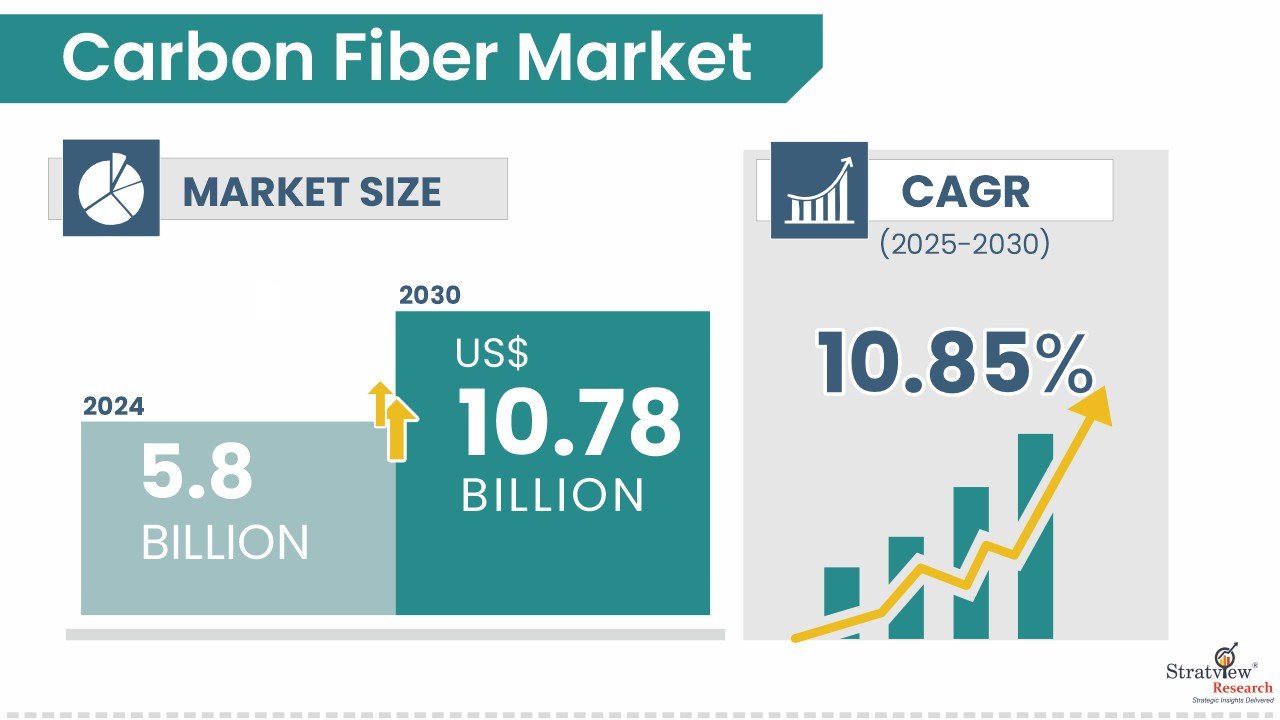
The Carbon Fiber Market is moving toward USD 10.78 billion by 2030 from an estimated USD 5.8 billion in 2024, representing a CAGR of 10.85% during 2025–2030. The market outlook is being shaped by two explicitly identified demand engines: rising use of lightweight materials in electric vehicles and aerospace, and expanding renewable-energy installations, particularly wind turbines. Both drivers favor carbon fiber because manufacturers require strength, stiffness, fatigue resistance, and reduced structural weight in demanding applications.
Examining Carbon Fiber Market growth through its end-use structure highlights the importance of industrial demand. The industrial end-use industry segment is estimated to hold the major market share during the forecast period, supported by automotive lightweight-material requirements and increasing carbon-composite use in wind turbines. PAN-based carbon fiber is also likely to be the largest and fastest-growing precursor segment, reflecting its application across transportation, wind energy, and aerospace/defense markets. These patterns establish clear demand concentrations within the broader industry outlook.
The Carbon Fiber Market is expected to grow at a CAGR of 10.85% during 2025–2030. That expansion is closely linked with the material's performance characteristics, which include high stiffness, a strong strength-to-weight ratio, tensile strength, chemical resistance, temperature tolerance, and low thermal expansion. These properties support its role as a strengthening material and help explain why carbon fiber is increasingly relevant to applications where structural performance must be achieved alongside lower component weight.
Request a free sample report:
https://www.stratviewresearch.com/Request-Sample/carbon-fiber-market#form
Market Segmentation Analysis
Under End-Use Industry Type, the exact segmentation is Aerospace [Commercial, Regional Jets, General Aviation, Helicopters, Defense, and Space], Industrial [Marine, Wind Energy, Transportation/Automotive, Civil/Construction, Electrical & Electronics, and Others], and Sporting Goods [Golf; Rackets; Skis, Snowboards, and Other winter Sports; Fishing Pole; and Others]. Industrial is estimated to hold the major share during the forecast period. Stratview links this position with automotive demand for high-performance lightweight materials and increasing use of carbon composites in wind turbines.
Under Precursor Type, the market consists of PAN-based Carbon Fiber and Pitch-based Carbon Fiber. PAN-based carbon fiber is likely to be both the largest and fastest-growing segment during the forecast period. Its market position is supported by applications in transportation, wind energy, and aerospace/defense. This broad application base gives PAN-based carbon fiber an important role in the market forecast because growth is supported by demand across several separate end-use ecosystems rather than one isolated application.
Under Tow Size Type, the market consists of Small Tow (≤24k) and Large Tow (>24k). Under Modulus Type, it consists of Standard Modulus, Intermediate Modulus, and High Modulus. These classifications complete the material-focused segmentation disclosed by Stratview. Since no dominant or fastest-growing segment is explicitly provided for Tow Size Type or Modulus Type, no additional hierarchy is assigned. This preserves the integrity of the market analysis while retaining the exact segment terminology used in the report scope.
Regional Market Insights
Europe is estimated to be the largest as well as the fastest-growing region in the Carbon Fiber Market during the forecast period. Stratview identifies growing product demand from aerospace, automotive, and wind energy industries as the regional growth driver. These industries all use carbon fiber where lightweight structures and high material performance are important, creating a multi-industry demand foundation for Europe's projected leadership during the 2025–2030 market forecast period.
The complete regional segmentation includes North America (Country Analysis: the USA, Canada, and Mexico), Europe (Country Analysis: Germany, France, the UK, Russia, Spain, and Rest of Europe), Asia-Pacific (Country Analysis: China, Japan, India, South Korea, and Rest of Asia-Pacific), and Rest of the World (Sub-Region Analysis: Latin America, the Middle East, and Others). Stratview does not identify another region as dominant or fastest-growing, making Europe the central region highlighted in the published regional analysis.
Emerging Trends Shaping the Carbon Fiber Market
Recycled carbon fiber is becoming a strategic area within the market as resource efficiency and circular manufacturing receive greater emphasis. Stratview identifies improvements in pyrolysis, solvolysis, and other recovery processes as potential enablers for reducing material waste, energy consumption, and production costs. Recovered carbon fiber could expand across automotive, sporting goods, industrial, and other applications where performance requirements are less stringent than aerospace, supporting a broader circular-manufacturing pathway within the industry's development.
Production economics are also shaping emerging growth trends. Conventional carbon fiber manufacturing depends on energy-intensive stabilization and carbonization and comparatively expensive precursor materials. In response, the market is seeing development efforts around alternative precursors, automated production, energy-efficient processing, and scalable manufacturing. Stratview states that lower-cost technology could improve the economic viability of carbon fiber for higher-volume applications including automotive, infrastructure, hydrogen storage, and industrial equipment, directly addressing one of the industry's principal adoption barriers.
Key Growth Drivers of the Market
- Demand for lighter electric vehicles: Vehicle manufacturers seek lower component weight to improve energy efficiency and increase vehicle range. Carbon fiber composites address this requirement through a high strength-to-weight ratio suited to structural applications.
- Aerospace lightweighting: Aerospace manufacturers increasingly use lightweight materials where weight reduction can improve transportation performance. Carbon fiber provides structural strength while helping reduce component mass.
- Increasing wind turbine scale: Wind turbine manufacturers require stiff, fatigue-resistant materials for increasingly large blades. Carbon fiber enables longer blades with lower structural weight while helping manage structural loads.
- PAN-based carbon fiber application breadth: Transportation, wind energy, and aerospace/defense all use PAN-based carbon fiber. This diversified demand supports its projected position as the largest and fastest-growing precursor segment.
- Advances in manufacturing and recovery: Recycled carbon fiber processes, alternative precursors, automation, scalable production, and energy-efficient processing target cost and material-efficiency barriers. Addressing these constraints can support wider carbon fiber adoption across the ecosystem.
Competitive Landscape
Top Companies in the Market
Cytec Solvay Group
DowAksa
Formosa Plastics Corporation
Hexcel Corporation
Hyosung Corporation
Mitsubishi Rayon Corporation Limited
Nippon Graphite Fiber Corporation
SGL Carbon Group
Teijin Limited
Conclusion and Strategic Outlook
A market moving from USD 5.8 billion in 2024 to USD 10.78 billion in 2030 at a CAGR of 10.85% presents a clear long-term expansion trajectory. The strongest documented demand signals come from lightweight-material adoption in electric vehicles and aerospace and carbon-composite use in wind turbine blades. Industrial applications are expected to retain the major end-use share, while PAN-based carbon fiber is positioned as both the largest and fastest-growing precursor segment during the forecast period.
The strategic outlook is not without constraints. High production costs and energy-intensive manufacturing reduce competitiveness against conventional materials in some high-volume applications, while recycling polymer-based carbon fiber composites remains technically and economically challenging. However, recycled carbon fiber, circular manufacturing, lower-cost technologies, alternative precursors, automation, and energy-efficient processing are creating pathways to address these constraints. These developments will remain important to the Carbon Fiber Market's evolution through its 2030 forecast horizon.
FAQs – Carbon Fiber Market
1. What are the current size and 2030 forecast for the Carbon Fiber Market?
The Carbon Fiber Market was estimated at USD 5.8 billion in 2024. Stratview forecasts that the market will reach USD 10.78 billion by 2030.
2. How fast is the Carbon Fiber Market expected to grow?
The Carbon Fiber Market is expected to grow at a CAGR of 10.85% during 2025–2030. The forecast indicates sustained expansion across the period rather than a static market outlook.
3. Which factors are driving Carbon Fiber Market growth?
Growing use of lightweight materials in electric vehicles and aerospace is a major driver because manufacturers seek lower weight, better energy efficiency, and increased vehicle range. Expanding wind turbine installations also support demand for stiff, fatigue-resistant, lightweight carbon fiber composites.
4. Where is regional demand strongest in the Carbon Fiber Market?
Europe is estimated to be both the largest and fastest-growing region during the forecast period. Increasing demand from aerospace, automotive, and wind energy industries supports its regional market outlook.
5. What risks and opportunities shape the carbon fiber market investment outlook?
High manufacturing costs, energy-intensive production, and recycling limitations are important challenges affecting the market. Recycled carbon fiber, circular manufacturing, alternative precursors, automated production, scalable manufacturing, and energy-efficient processing represent strategic opportunities identified by Stratview.









0 Comments