
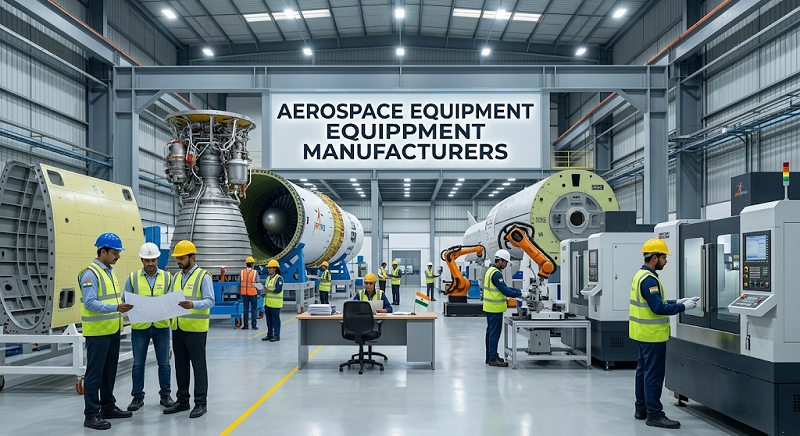
Aerospace Equipment Manufacturers: Standards and Compliance
Aerospace is one of the few industries where compliance isn't just about protecting market access — it's about protecting lives. Aerospace equipment manufacturers operate under a documentation and standards regime that touches every stage of design, manufacturing, testing, and delivery. Understanding what those standards require, and why, helps both manufacturers and their supply chains build the kind of quality culture that makes compliance sustainable rather than performative.
The Core Standards Framework
AS9100 is the quality management standard specific to aerospace. It builds on ISO 9001 but adds requirements specific to aviation, space, and defense: configuration management, product safety considerations, first article inspection requirements, and customer-focused risk management. Any aerospace equipment manufacturer supplying to prime contractors or OEMs is expected to hold AS9100 certification, and many customers require their sub-tier suppliers to hold it as well.
NADCAP accreditation applies to special processes — heat treatment, NDT, chemical processing, welding, and surface treatment. Company stamping operations that supply aerospace components may find their forming processes or surface treatments subject to NADCAP audit if the application is flight-critical.
FAR/DFAR Compliance
For defense-related aerospace programs, material sourcing is governed by Federal Acquisition Regulations (FAR) and Defense Federal Acquisition Regulation Supplement (DFARS). These require the use of domestically sourced specialty metals — including titanium, tantalum, and certain steel grades — in flight hardware. Aerospace equipment manufacturers supplying to defense prime contractors must maintain supply chain documentation proving FAR/DFAR compliance, which requires active management of material certifications across multiple tiers.
Design Verification and Validation
Aerospace standards require that every design change be formally reviewed, analyzed, and documented before implementation. First Article Inspection (FAI) per AS9102 applies when a new part is manufactured, when there's been a significant design change, or after a lapse in production. FAI is not a formality — it requires dimensional inspection of every feature, material certification review, and functional testing where applicable.
Traceability and Configuration Management
Traceability Requirements
Every part manufactured for aerospace must be traceable from raw material certificate to finished part, through every processing step. This means lot control, traveler documents, and revision-controlled manufacturing instructions. For company stamping components entering aerospace assemblies, this traceability chain must be maintained even for small, low-value hardware.
Configuration Management
Aerospace equipment manufacturers must ensure that what's being built matches what was designed and approved. Engineering change control, effectivity tracking, and obsolescence management are ongoing disciplines. Parts built to superseded drawings, even inadvertently, create non-conformance events that require formal disposition.
Supplier Qualification and Ongoing Monitoring
Aerospace OEMs maintain approved supplier lists and conduct regular surveillance audits. Getting on the list is an achievement; staying on it requires consistent performance across quality, delivery, and compliance metrics. Suppliers who fall below defined thresholds can be placed on corrective action plans or removed from the approved list entirely.
Compliance in aerospace is demanding, but it creates a manufacturing discipline that produces measurable quality outcomes. The companies that approach it as an operational standard rather than a documentation exercise consistently outperform those treating it as overhead. First Article Inspection (FAI) per AS9102 applies when a new part is manufactured, when there's been a significant design change, or after a lapse in production. FAI is not a formality — it requires dimensional inspection of every feature, material certification review, and functional testing where applicable.


0 Comments