
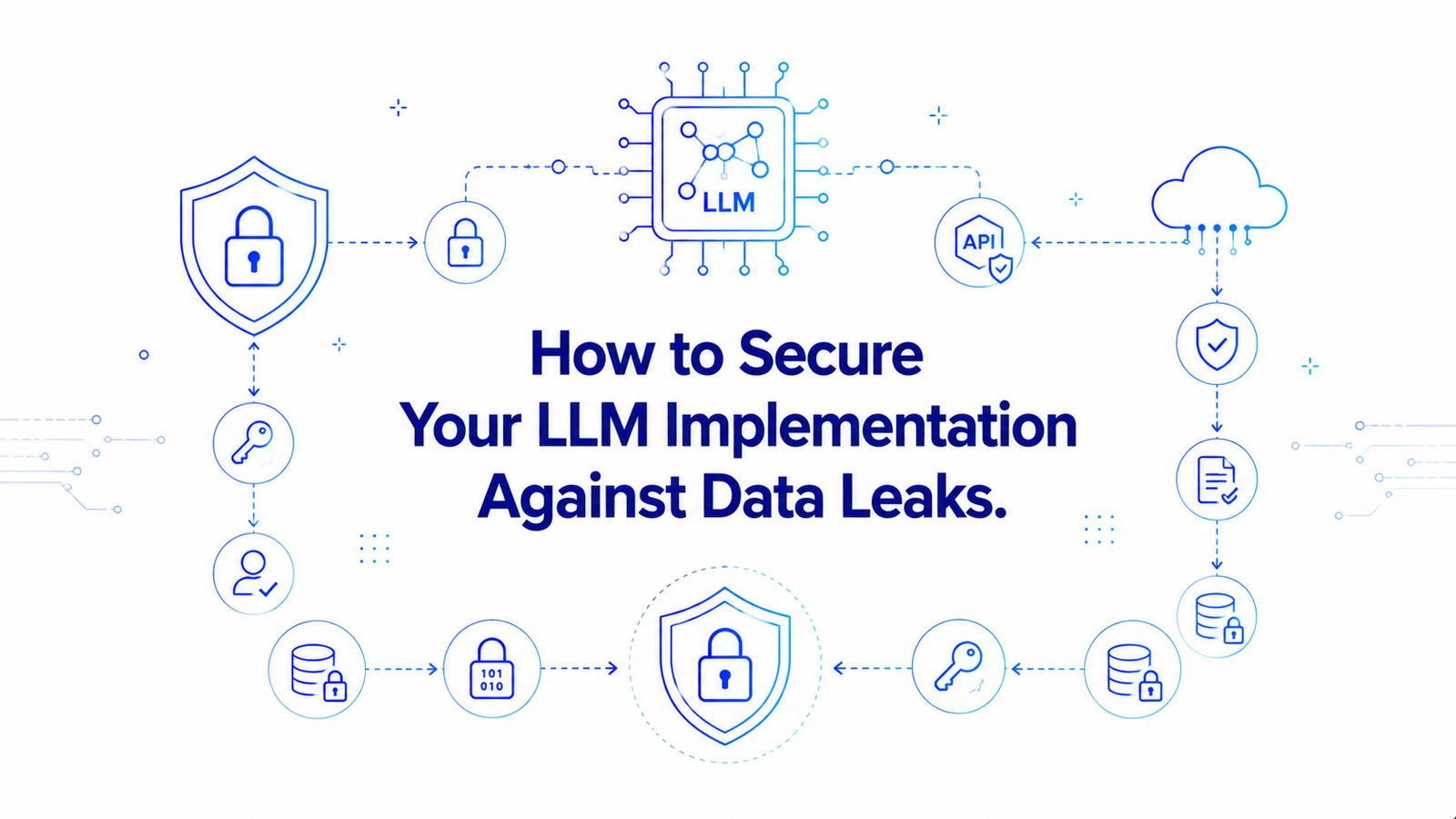
How to Secure Your LLM Implementation Against Data Leaks
Many companies have started to adopt large language models (LLMs) as a vital component of their operations. The popularity of LLMs is due to their ability to help automate repetitive processes and provide high-quality information or customer support. However, a secure LLM implementation requires ensuring that confidential information is not leaked by accident or intentionally.
There are several measures that must be taken to ensure that no sensitive data remains exposed when implementing artificial intelligence. For businesses that want to invest in AI development services, it is essential to take a proactive approach to security to ensure that no valuable data is lost and that operations are interrupted as little as possible.
Overview of Sources of Data Leaks
Before taking any security measures, it is essential to understand what sources of data leaks could threaten the confidentiality and integrity of valuable information. Since these models rely on APIs, databases, cloud storage, third-party applications, and user queries, each of these components must be examined for potential weaknesses. For example, a company's sensitive data may be included in a prompt or stored in a database insecurely.
Moreover, businesses should document all the data processing stages so that the team can locate and address the issue quickly in case of an incident.
Avoid Exposing Sensitive Information Before Processing
The first method for securing data when implementing LLMs is to make sure that any private data does not get to the model. In cases where this is possible, personally identifiable information (PII), financial information, and other sensitive data must be tokenized. Furthermore, all data transmission and storage must be encrypted so as to protect the private information from hackers.
Nowadays, a lot of firms providing AI development services offer solutions for processing data without giving access to the critical data for AI models.
Ensure Access Control and Hire Specialized Teams for AI Development
When securing such complex technologies as LLMs, businesses must consider all points of potential breach. First, companies should apply the principle of least privilege to ensure that no employees have access to data and operations that they do not need to perform their daily tasks. Second, it is essential to require all staff to use strong and unique passwords and multifactor authentication.
Many businesses choose to hire dedicated developer teams and cybersecurity specialists who can establish strong access control and implement enterprise-level security measures. The businesses working with them should also ensure that employees only have access to the information required for their job functions.
Filter Prompt Content and Assess Risks Posed by Queries
One of the most common ways of attacking such AI systems is through prompts. Attackers could inject malicious code in prompts to exfiltrate data or get the model to perform unintended actions. Thus, it is essential to make sure that prompts are not used to compromise the system in any way. Organizations could achieve this by using prompt filters and monitoring all queries and responses. In addition, businesses could utilize LLM development services that offer tools to scan all prompts for vulnerabilities and potential breaches.
Many companies that offer AI development services have built robust systems capable of analyzing queries in real time and raising alerts whenever they encounter suspicious content.
LLM Implementation Security: Protecting APIs Against Threats
Given that most LLM applications are dependent on APIs for integrating the databases, cloud storage platforms, and applications, firms need to make sure that the data transferred via these nodes is protected. The API calls need to be authenticated with secure and up-to-date protocols and can only be permitted if they have been called from legitimate sources. In addition, firms should use input validations to ensure that there are no harmful scripts that enter the firm's system through these API endpoints.
In case of third-party applications, it is necessary to conduct periodic security assessments to avoid any threats. It is also necessary to update the AI applications with security updates regularly by firms that provide development services.
Establish Governance Policies, Perform Audits, and Provide Employee Training
Even though it is necessary to employ technology-based security measures, it is equally important to create a governance policy, which would ensure that there are no data breaches or any other incidents of security failure. This policy should detail the processes used by an organization when using AI systems and the security protocols adopted to protect sensitive data. Moreover, businesses need to adhere to government regulations and standards and increase employee awareness regarding the possible risks of AI.
It is also important for businesses to ask for a complete documentation of all processes when collaborating with AI development agencies on creating secure AI-based software solutions.
Conduct Continuous Testing and Evaluation
Since new threats and vulnerabilities are discovered constantly, businesses should conduct regular penetration tests, vulnerability assessments, and AI model evaluations to ensure that no weaknesses exist. All organizations leveraging AI development solutions should also establish response protocols for data security incidents and have response plans to ensure that any breaches are addressed quickly.
In addition, businesses should update their AI systems using the latest security patches and tools to prevent known attacks and reduce potential threats. Moreover, when hiring experienced companies that offer AI development services, businesses could also benefit from their threat modeling solutions to ensure that their assets are not vulnerable to any potential threats.
Summary
Overall, when implementing LLMs, businesses should utilize a combination of approaches to address diverse security challenges. For these solutions to be truly secure, they must be built on safe infrastructure, operated under responsible governance policies, be guarded against prompt injections, have resilient APIs, and have employees who follow established security procedures.
Since AI applications play an increasingly critical role in modern organizations, businesses should invest in AI development services to ensure that they use these powerful tools without exposing confidential data to potential threats.


0 Comments