
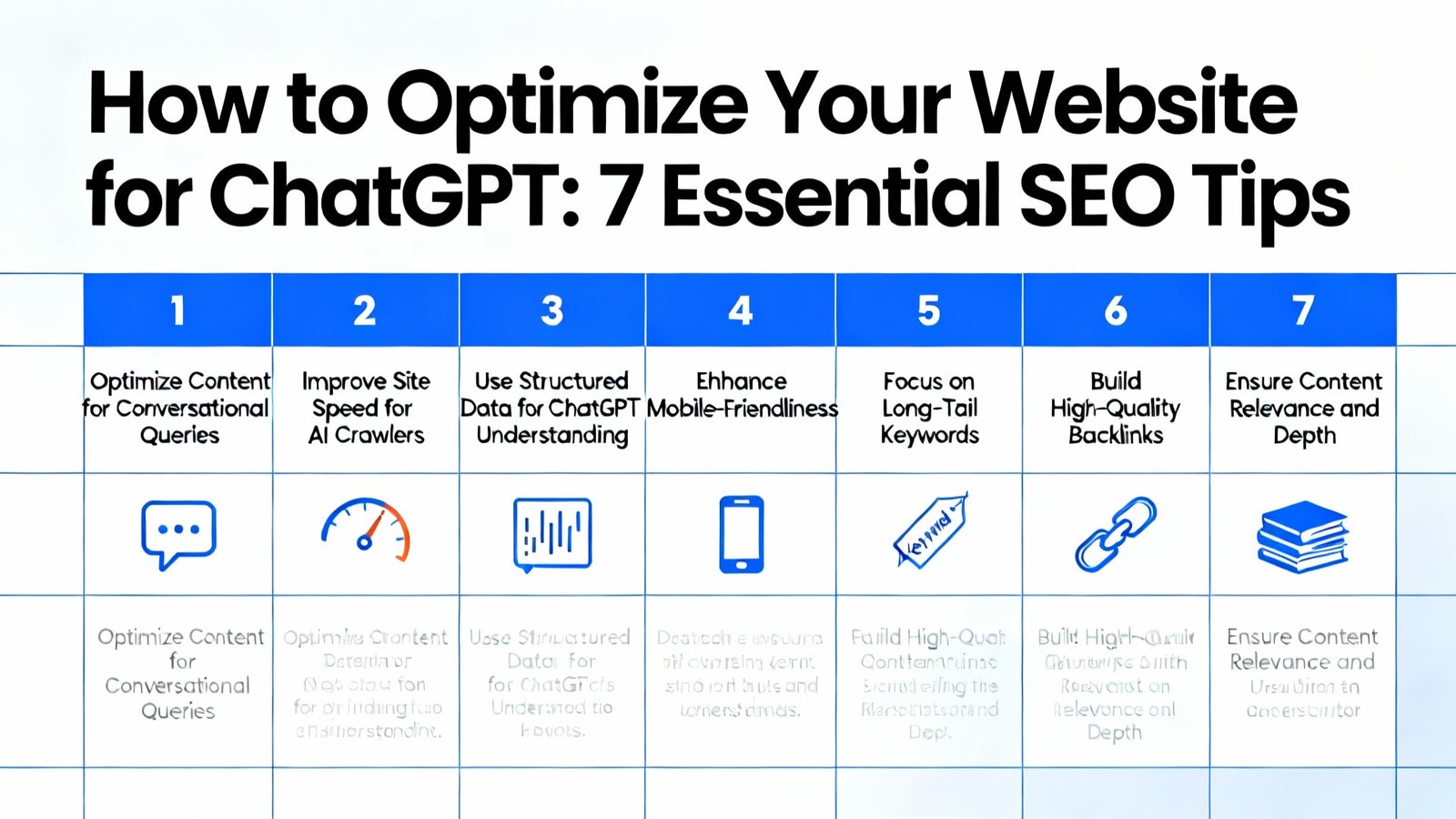
How to Optimize Your Website for ChatGPT: 7 Essential SEO Tips
The digital marketing paradigm is undergoing a seismic shift. For over two decades, the primary goal was to rank on the first page of search engines like Google. However, the rise of Large Language Models (LLMs) and AI platforms such as ChatGPT has introduced a new objective: becoming the cited source in AI-generated answers. This transition requires businesses to move beyond traditional keyword stuffing and focus on Generative Engine Optimization (GEO). To ensure a brand remains visible and relevant in this new ecosystem, understanding how these AI models retrieve and synthesize information is critical.
Prioritizing Comprehensive and Intent-Based Content
In the age of AI, content quality is measured by its ability to answer complex user queries comprehensively. Unlike traditional search engines that provide a list of links, platforms like ChatGPT aim to provide a direct, synthesized answer. Therefore, content must be structured to serve as the definitive source of truth. This involves identifying the specific questions your target audience is asking and providing in-depth, logically structured answers. Instead of creating thin content that targets a single keyword, businesses must develop robust resources that cover a topic holistically. This "topic cluster" approach ensures that when an AI searches for information on a subject, it finds a complete, authoritative resource on your website, increasing the likelihood of your content being used to generate a response.
Leveraging Structured Data in an AI Context
Artificial Intelligence requires clear signals to understand the context of web content. Structured data, also known as schema markup, acts as a translator between your website's human-readable content and the machine-readable data that AI models process. By implementing specific schema types—such as FAQ, How-To, Article, and LocalBusiness—you explicitly tell the AI what your content is about. This does not just help with indexing; it facilitates "retrieval-augmented generation" (RAG), a process where the AI fetches specific, structured facts from your site to construct an accurate answer. Without this markup, an AI might struggle to distinguish between a product price, a phone number, or a publication date, reducing the chances of your site being cited.
Shifting from Backlinks to Brand Entity Authority
For years, backlinks were the gold standard of SEO. While they remain important, the AI era places a heavier emphasis on "brand mentions" and semantic authority. LLMs are trained on vast amounts of text data from across the internet. They learn to associate brands with specific industries, qualities, and sentiments based on how frequently and in what context they appear together. Consequently, a strategy focused on building a "brand entity" is essential. This means securing mentions in industry reports, appearing in expert roundups, and being discussed in relevant community forums. When an AI sees your brand consistently mentioned alongside By using authoritative terms in your niche, the AI "learns" that your business is a credible leader, even without a direct hyperlink.
Building Trust Through User Sentiment and Verification
Credibility is a major filter for AI algorithms. To prevent the spread of misinformation (often called "hallucinations"), modern AI models are biased toward sources that demonstrate high levels of trust. This trustworthiness is often gauged through user sentiment and third-party verification. Displaying verified reviews, testimonials, and case studies prominently on your digital assets provides the social proof that AI systems analyze to determine reputation. Furthermore, ensuring that all claims on your website are fact-checked and cited with links to reputable sources helps establish your content as a verified data point. When an AI assesses your site, positive sentiment and factual accuracy act as quality signals that boost your visibility in generated responses.
The Critical Role of Content Freshness
AI models are constantly being updated, and many now have the ability to browse the live web for the most current information. Static, outdated content is rapidly devalued in this environment. To maintain visibility, businesses must adopt a strategy of continuous content lifecycle management. This involves more than just changing the date on a blog post; it requires substantive updates that reflect the latest industry trends, statistics, and regulatory changes. By consistently refreshing your digital library, you signal to both search crawlers and AI retrieval systems that your website is a living, breathing source of current intelligence, making it a preferred candidate for answering time-sensitive queries.
Establishing Authorship and Expert Authority
The concept of E-E-A-T (Experience, Expertise, Authoritativeness, and Trustworthiness) is central to how both Google and AI models evaluate content value. Since AI algorithms are increasingly capable of identifying who is behind the content, strategic AI SEO services emphasize that establishing clear authorship is vital. Articles should be written or reviewed by recognized experts in the field, with clear bylines and bio pages that detail their credentials, certifications, and professional background. When content is attributed to a verifiable expert, it gains a layer of authority that anonymous content lacks. This allows the AI to connect the content to the author's broader digital footprint, validating the information's reliability.
Achieving Omnichannel Consistency
AI models ingest data from everywhere, not just your website. They scan social media, press releases, video transcripts, and podcast directories to build a comprehensive understanding of a brand. Inconsistency in messaging across these platforms can confuse the model and dilute your brand authority. A unified brand voice and consistent factual information across all channels ensure that the AI builds a coherent profile of your business. Whether a user asks a question on a social platform or a search engine, the data retrieved should paint a consistent picture of who you are and what you offer.
Navigating the Complexity with Professional Guidance
Adapting to this new landscape can be technically demanding and resource-intensive. The rules of engagement are changing rapidly as AI models evolve. For many businesses, partnering with experts who specialize in AI SEO services is the most efficient path forward. These specialized services go beyond traditional optimization; they focus on optimizing for large language models, implementing complex schema strategies, and managing brand entity reputation across the web. By using professional AI SEO services, businesses can make sure their online systems are well-built and ready for the future of search, giving them an edge in the AI-focused market.
Conclusion
The integration of AI into the search experience is not a passing trend; it is the new reality of digital information discovery. Businesses that fail to adapt to these changes risk becoming invisible. By focusing on deep, answer-centric content, technical clarity through structured data, and robust brand authority, companies can position themselves as the go-to resources for AI-generated answers. It is a shift from chasing algorithms to building genuine, verifiable authority—a strategy that benefits both human users and the intelligent machines that serve them.



0 Comments